
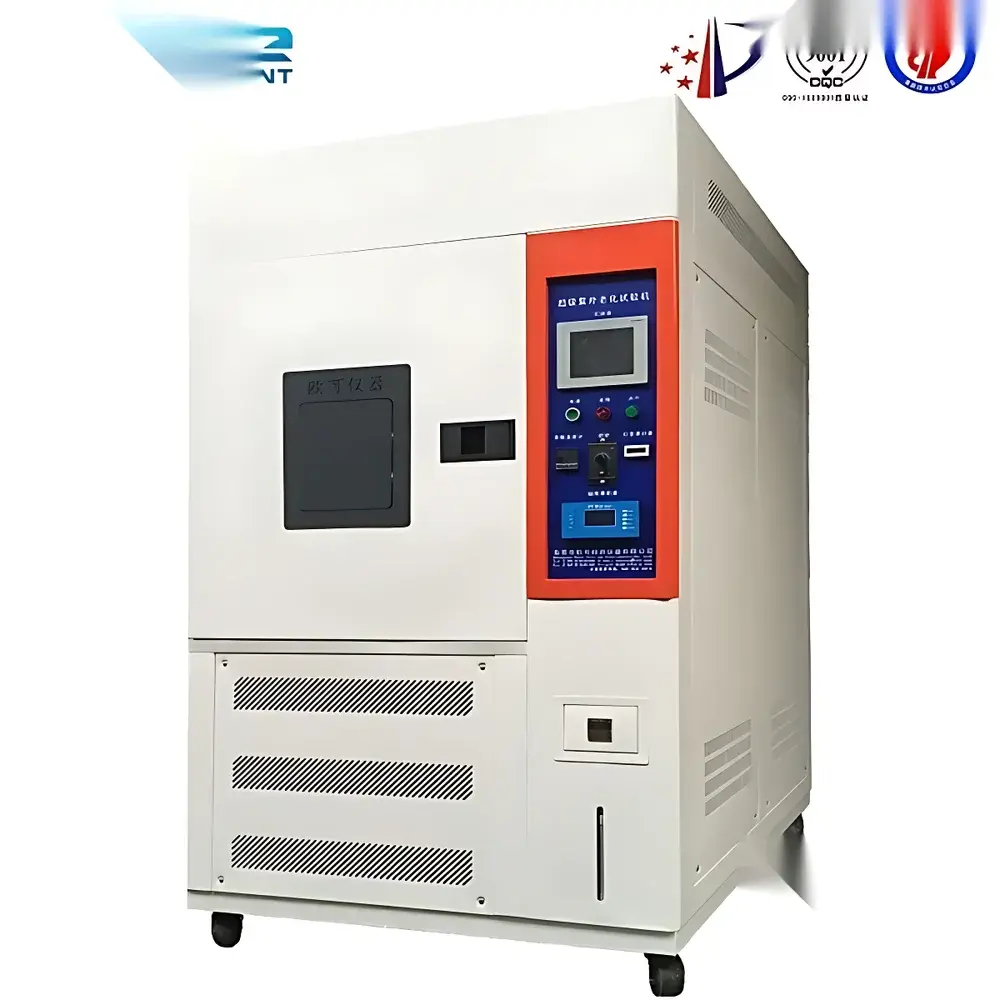
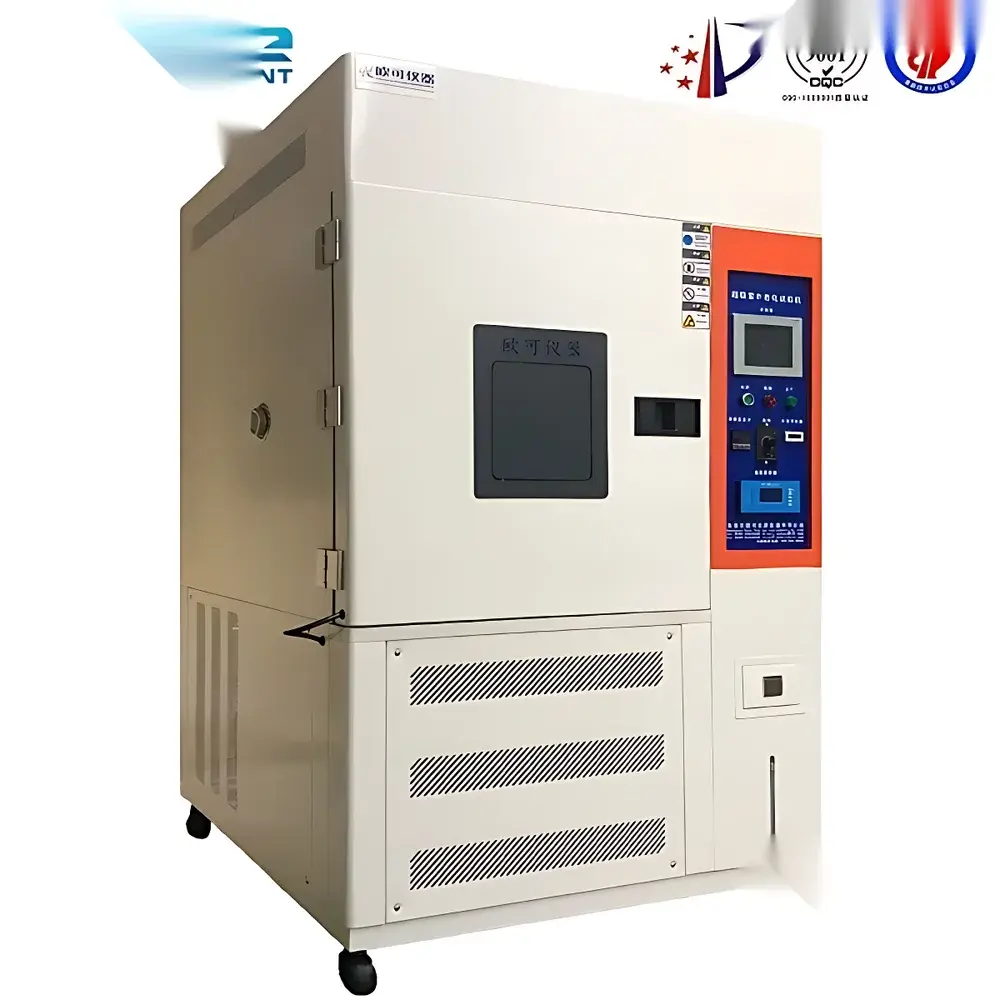
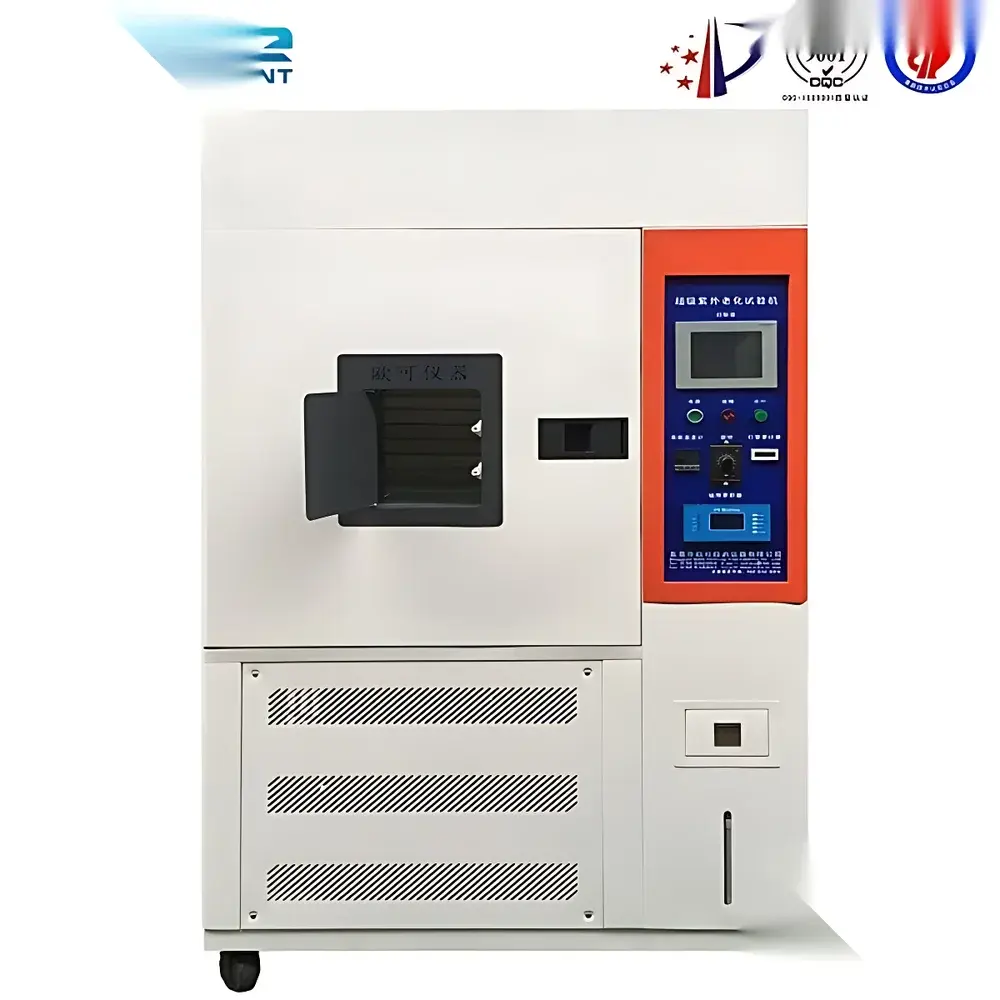
UV Aging Test Chamber – Custom Metal Halide Lamp-Based Environmental Test System
| Brand | Other Brands |
|---|---|
| Origin | Imported |
| Manufacturer Type | Authorized Distributor |
| Temperature Range | RT to 85 °C (Operating: 50 ± 10 °C) |
| Humidity Range | 40–70 % RH (Illumination), 50–90 % RH (Dark Cycle) |
| Temp. Control Accuracy | ±0.5 °C |
| Humidity Control Accuracy | ±2.0 % RH |
| Temp. Uniformity | ±2.0 °C |
| Humidity Uniformity | ±3.0 % RH |
| Ramp-up Time (RT → 85 °C) | ≤25 min |
| Light Source | 1 × 2.5 kW Air-Cooled Metal Halide Lamp |
| Spectral Range | 295–450 nm |
| Irradiance | 200 ± 8 W/m² |
| Irradiance Uniformity | ≥90 % |
| UV Sensor | Spectral Radiometric Transmitter (developed by No. 622 Institute) |
| Filter | Custom High-Borosilicate Glass (IR-blocking, ~30 % IR attenuation) |
| Black Panel Temperature (BPT) | 40–85 °C |
| Test Modes | UV Irradiation, Condensation, Water Spray, and Programmable Cycling |
| Sample Tray | 500 × 400 mm Stainless Steel Rack |
| Illumination Geometry | Top-mounted lamp with reflective direct irradiation |
| Cooling | Integrated Forced-Air Internal Circulation System |
| Irradiance Integration | LCD-based Real-Time Accumulated Dose Calculator |
Overview
The UV Aging Test Chamber is an engineered environmental test system designed to simulate accelerated solar ultraviolet (UV) radiation exposure under controlled thermal and hygrothermal conditions. It employs a high-intensity, air-cooled metal halide lamp as the primary radiation source, generating a continuous spectral output from 295 nm to 450 nm — encompassing the critical UVA and UVB bands responsible for polymer degradation, pigment fading, coating chalking, and sealant embrittlement. The optical path incorporates a custom high-borosilicate glass filter that attenuates approximately 30 % of infrared (IR) energy while preserving the photobiologically relevant UV–visible spectrum. This spectral profile closely approximates the terrestrial solar irradiance filtered through 3 mm of standard window glass — a key requirement for ASTM G154, ISO 4892-2, and SAE J2020 compliance in automotive, aerospace, and architectural material qualification.
Key Features
- Single 2.5 kW air-cooled metal halide lamp with integrated forced-air internal circulation cooling — ensuring stable lamp operation and extended service life without external water connections.
- Precise black panel temperature (BPT) control from 40 °C to 85 °C, monitored via a calibrated, blackened stainless steel plate (150 × 70 × 1 mm) equipped with a bonded platinum resistance thermometer (PRT), conforming to ASTM G147 and ISO 4892-2 definitions.
- Real-time irradiance monitoring using a traceable spectral radiometric transmitter developed by China’s No. 622 Institute — enabling direct measurement of incident UV flux (W/m²) at the sample plane.
- Programmable multi-mode operation: independent or sequential execution of UV irradiation, condensation (via bottom-mounted water reservoir and heated chamber floor), and water spray cycles — supporting full IEC 61215, UL 1703, and GB/T 18209 test protocols.
- LCD-based irradiance integration module with automatic cumulative dose calculation (J/m²), time-stamped logging, and user-configurable alarm thresholds for irradiance deviation or thermal excursion.
- Uniform exposure field validated to ≥90 % irradiance homogeneity across the 500 × 400 mm sample tray, achieved through optimized reflector geometry and top-mounted lamp positioning with diffuse reflective chamber walls.
Sample Compatibility & Compliance
This chamber accommodates flat-panel specimens up to 500 × 400 mm and 50 mm thickness, including polymer films, painted panels, roofing membranes, automotive trim, and photovoltaic encapsulants. Its operational envelope meets the core physical requirements of multiple international standards: temperature control accuracy (±0.5 °C) and humidity stability (±2.0 % RH) satisfy ISO 17025 calibration traceability prerequisites; BPT measurement methodology aligns with ASTM G151 and ISO 4892-2 Annex A; and spectral fidelity supports validation per CIE S 012/E and IEC 60068-2-5. While not certified to specific regulatory marks out-of-the-box, the system architecture permits full GLP-compliant audit trails when paired with optional 21 CFR Part 11–enabled software extensions.
Software & Data Management
The chamber operates via an embedded industrial controller with a 7-inch resistive touchscreen interface. All critical parameters — chamber temperature, relative humidity, black panel temperature, real-time irradiance, accumulated UV dose, and cycle phase status — are continuously logged with millisecond timestamp resolution. Data export is supported via USB mass storage in CSV format, compatible with MATLAB, JMP, and LIMS platforms. Optional Ethernet connectivity enables remote monitoring and integration into centralized facility management systems. Audit-ready data records include operator ID, method version, calibration certificate references, and sensor health diagnostics — essential for ISO/IEC 17025 accredited laboratories conducting material durability validation.
Applications
- Accelerated weathering evaluation of exterior automotive plastics (PP, TPO, ABS) per SAE J2527 and GMW 14124.
- Photostability testing of architectural coatings and façade systems under cyclic UV/condensation per ASTM D4587 and ISO 11507.
- Qualification of PV module backsheet materials per IEC 61215-2 MQT10 and UL 1703 Section 22.
- UV resistance assessment of medical device packaging polymers (e.g., Tyvek®, PETG) aligned with ISO 11607-1 Annex B.
- Research-grade degradation kinetics studies on organic photovoltaics, OLED encapsulation, and biodegradable films requiring spectrally resolved UV dosimetry.
FAQ
What spectral standard does the lamp/filter combination replicate?
It approximates the global solar spectral irradiance transmitted through 3 mm clear float glass — matching the reference spectrum defined in ASTM G154 Cycle 1 and ISO 4892-2 Method A.
Is black panel temperature (BPT) actively controlled or only monitored?
BPT is actively regulated via proportional-integral-derivative (PID) feedback using the integrated PRT sensor; chamber air temperature is independently controlled to maintain thermal gradient stability.
Can the system perform simultaneous UV + condensation + spray cycles?
Yes — all three exposure modes are programmable in sequence or overlap, with user-defined dwell times, ramp rates, and transition logic per IEC 60068-2-5 and GB/T 18209.
What calibration documentation is provided with the UV sensor?
The spectral radiometric transmitter includes a factory calibration certificate traceable to NIM (National Institute of Metrology, China), with wavelength-specific responsivity data across 295–450 nm.
Is the chamber suitable for ISO/IEC 17025 accredited testing?
Yes — when operated with documented procedures, scheduled maintenance logs, and third-party sensor calibration records, it fulfills the technical requirements for accredited weathering testing per ISO/IEC 17025 Clause 7.8.



