
UV Aging Test Chamber – Fluorescent UV/Condensation Environmental Test System
| Brand | Other Brands |
|---|---|
| Origin | Imported |
| Manufacturer Type | Authorized Distributor |
| Price | USD 2,650 (Reference Only) |
| UV Lamp Type | UVA-340 or UVB-313 |
| Temperature Range | 40–70°C (Irradiation), 30–60°C (Condensation) |
| Humidity Control | Condensation Cycle via Water Reservoir |
| Sample Capacity | Standard 3–5 Specimen Holders |
| Compliance | ASTM G154, ISO 4892-3, JIS D0205, SAE J2020 |
| Optional Features | Water Spray Function, Irradiance Monitoring Sensor, Touchscreen Controller |
Overview
The UV Aging Test Chamber – Fluorescent UV/Condensation Environmental Test System is an engineered solution for accelerated weathering evaluation of polymeric materials, coatings, adhesives, automotive components, and architectural finishes. It operates on the principle of controlled ultraviolet radiation exposure combined with cyclic condensation humidity—mimicking key degradation drivers in natural outdoor environments: solar UV photons (primarily 290–400 nm), thermal cycling, and moisture-induced stress. Unlike xenon arc or carbon arc testers, this system employs fluorescent UV lamps (UVA-340 for near-sunlight UV spectrum or UVB-313 for aggressive, short-wavelength acceleration) to deliver reproducible irradiance profiles. The integrated condensation cycle replicates nocturnal dew formation through controlled water vapor saturation at elevated temperatures, inducing hydrolytic degradation mechanisms critical to long-term material stability assessment.
Key Features
- Fluorescent UV lamp array with selectable spectral output (UVA-340 or UVB-313), compliant with ASTM G154 spectral requirements
- Programmable irradiance control (0.35–1.55 W/m² @ 340 nm) with real-time feedback via optional calibrated sensor
- Automated condensation cycle: temperature-controlled water reservoir generates saturated humid air at specimen surface without direct water contact
- Integrated water spray function (optional) simulates thermal shock and surface erosion during simulated rainfall events
- Dual-zone temperature control: independent regulation of chamber air (irradiation phase) and black-panel temperature (specimen surface monitoring)
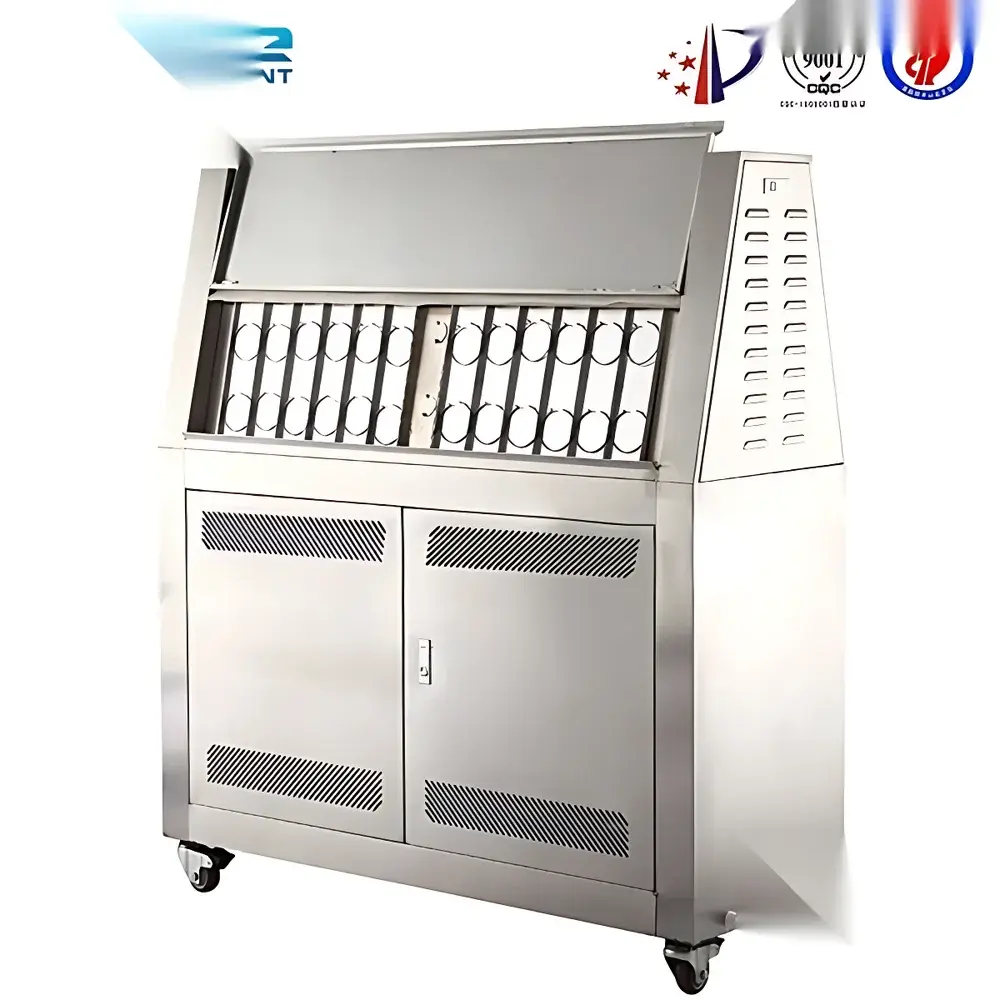
- Corrosion-resistant stainless-steel interior (304 grade) with removable specimen racks and quartz UV-transmissive lamp housings
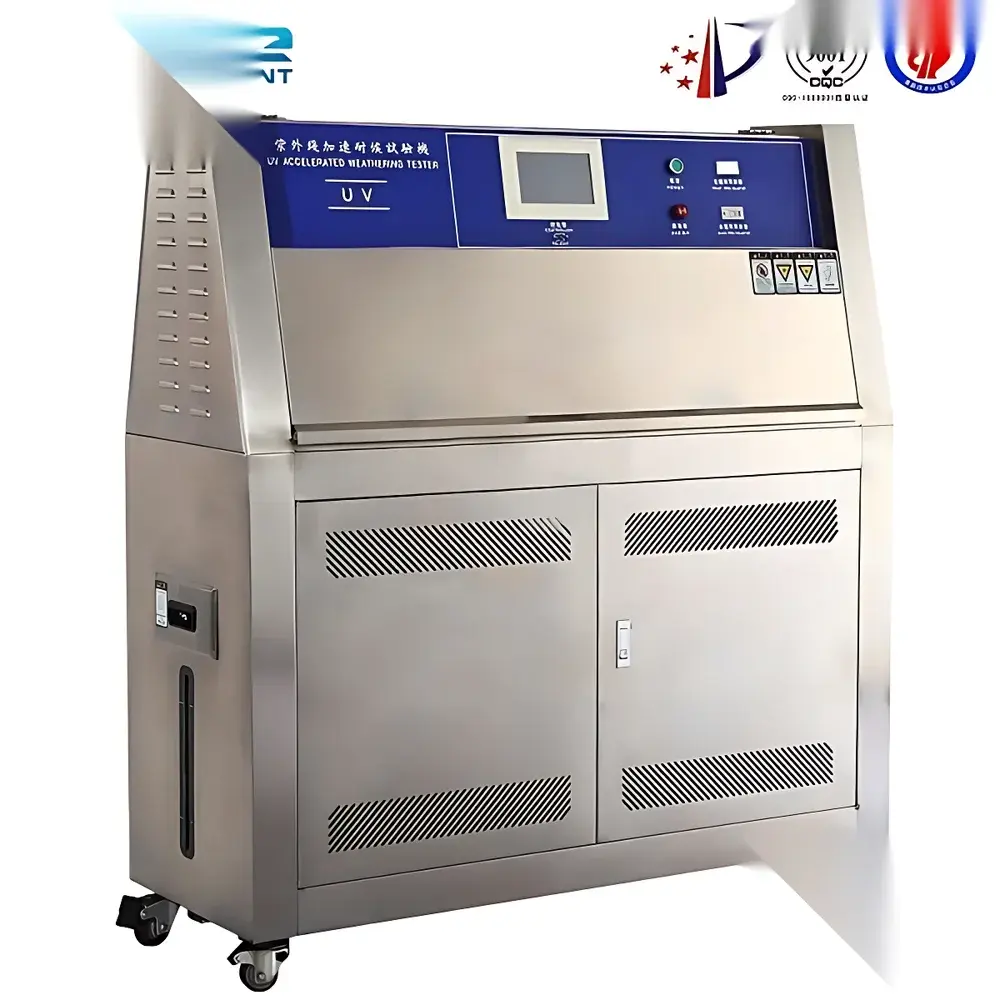
- Touchscreen controller with preloaded test standards (ASTM G154 Cycle 1–4, ISO 4892-3 Method A/B), data logging, and password-protected user profiles
- FDA 21 CFR Part 11–compatible audit trail option for GLP/GMP-regulated laboratories
Sample Compatibility & Compliance
This chamber accommodates flat sheet specimens up to 150 mm × 75 mm × 6 mm (standard holder configuration), with custom rack options available for irregular geometries. It supports rigid plastics, elastomers, paints, powder coatings, textile laminates, and composite substrates. All operational parameters align with internationally recognized weathering protocols: ASTM G154 (Standard Practice for Operating Fluorescent Ultraviolet (UV) Lamp Apparatus for Exposure of Non-Metallic Materials), ISO 4892-3 (Plastics — Methods of Exposure to Laboratory Light Sources — Part 3: Fluorescent UV Lamps), and JIS D0205 (Automotive Paint Durability Testing). For regulated industries—including medical device packaging and aerospace sealants—the system meets baseline requirements for environmental qualification per MIL-STD-810H Method 505.5 (Solar Radiation) when configured with black-panel temperature monitoring and irradiance traceability.
Software & Data Management
The embedded controller firmware records time-stamped operational data—including lamp voltage, chamber temperature, condensation duration, and (if equipped) irradiance intensity—at user-defined intervals (1–60 min). Exportable CSV files support post-test analysis in MATLAB, JMP, or Excel. Optional PC-based software provides remote monitoring, multi-chamber fleet management, and automated report generation compliant with ISO/IEC 17025 documentation standards. Audit trail functionality logs all parameter modifications, user logins, and calibration events—enabling full traceability for FDA, ISO 9001, or IATF 16949 audits. Calibration certificates for UV sensors are NIST-traceable and issued annually upon service contract renewal.
Applications
- Accelerated validation of automotive exterior trim against ISO 11341 and SAE J2020 specifications
- Comparative ranking of pigment stability in architectural coatings under ASTM D4303
- Hydrolytic degradation screening of polyurethane adhesives used in photovoltaic module lamination
- UV resistance benchmarking of medical-grade silicone tubing per ISO 10993-12
- Qualification testing of OLED encapsulation layers exposed to tropical climatic conditions (high UV + high humidity)
- Failure mode analysis of polymer-based optical films subjected to prolonged UV/condensation cycling
FAQ
What UV lamp types are supported, and how do they differ?
The system accepts standard F40 UV lamps: UVA-340 lamps replicate solar UV down to 295 nm and are recommended for general-purpose weathering; UVB-313 lamps emit shorter wavelengths (down to 280 nm) and are used for aggressive, high-acceleration testing per ASTM G154 Cycle 3.
Is condensation achieved by spraying water onto samples?
No. Condensation is generated passively via heated water reservoirs that saturate chamber air—mimicking dew formation without mechanical spray impact or localized cooling effects.
Can the chamber operate unattended for extended cycles?
Yes. With proper water reservoir fill level, stable power supply, and ambient ventilation, it supports continuous operation for up to 1,000 hours. Scheduled maintenance checks are recommended every 500 operational hours.
How often must UV lamps be replaced?
Lamp output degrades over time; replacement is required every 1,600–2,000 hours of irradiation (typically 4–6 months under daily use), verified via radiometric measurement—not elapsed time alone.
Does the system meet GLP compliance requirements?
When equipped with the optional audit trail module and operated under documented SOPs, it satisfies core GLP data integrity criteria per OECD Principles of Good Laboratory Practice, including electronic signature capability and immutable event logging.



