
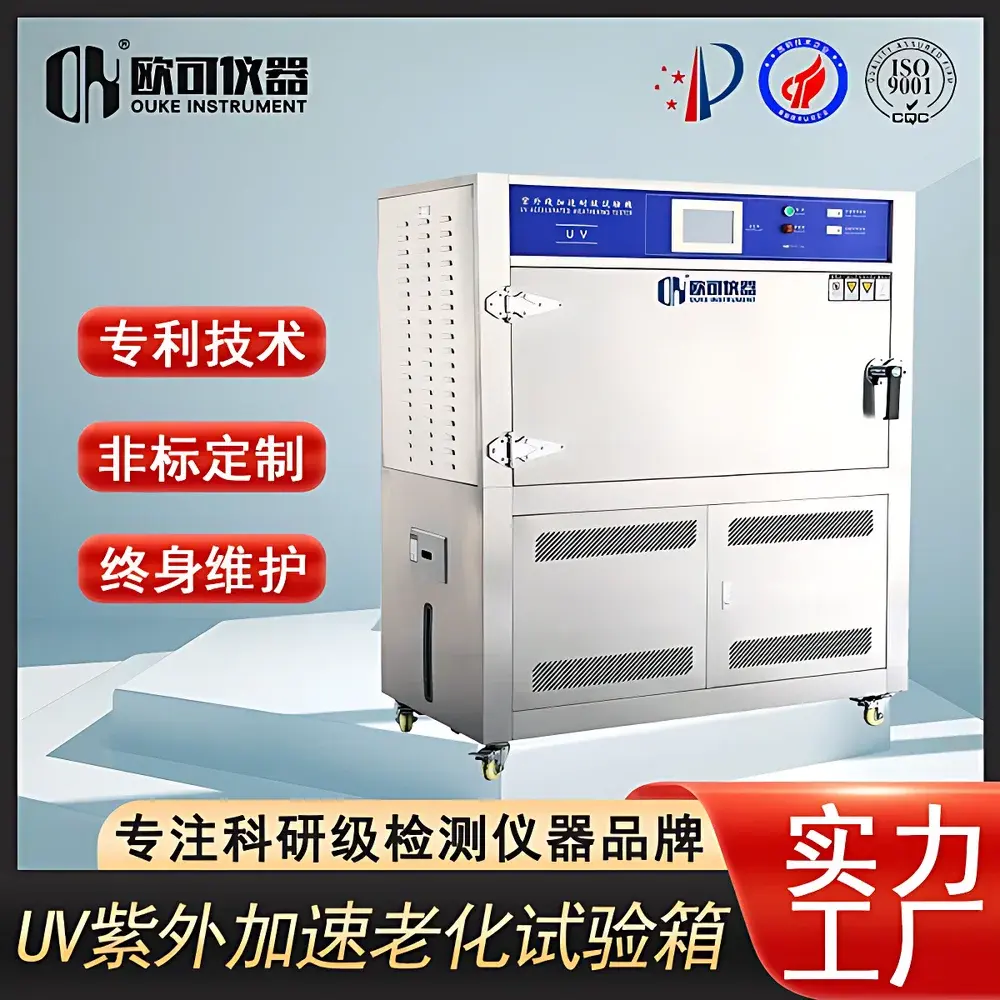
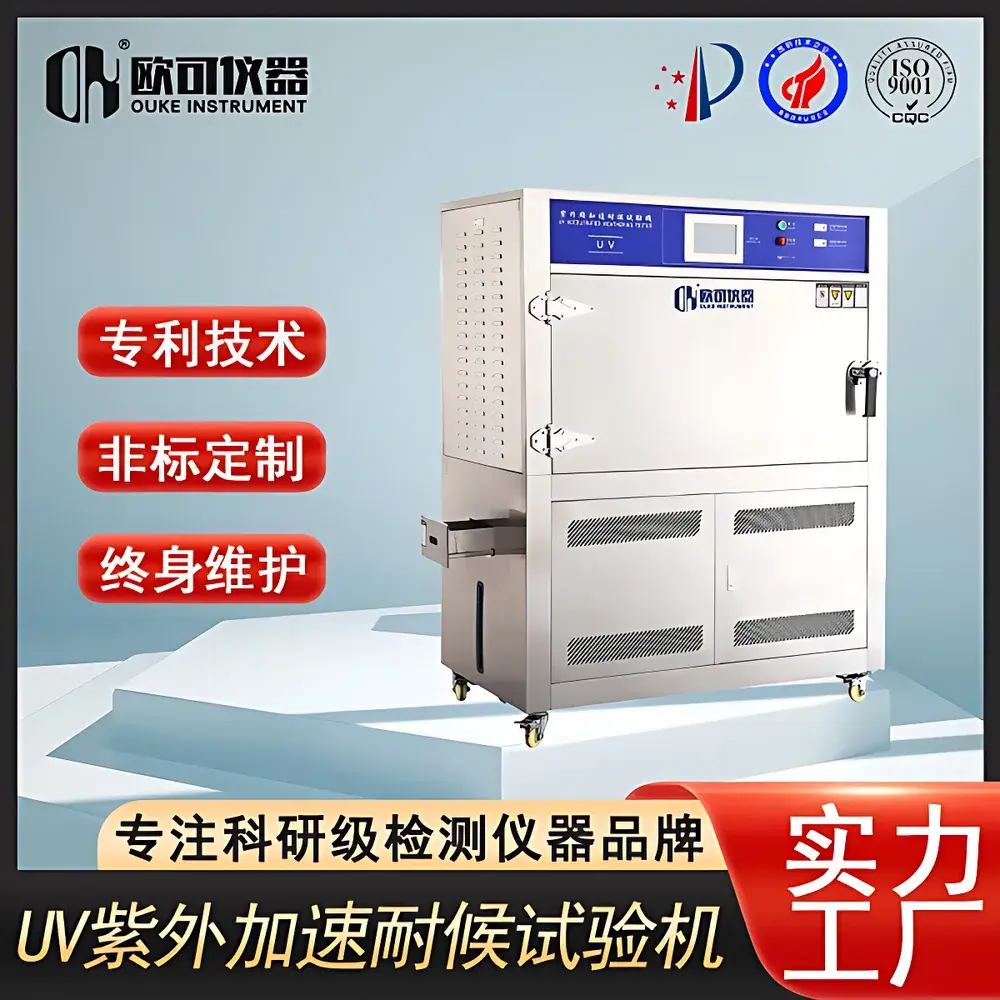
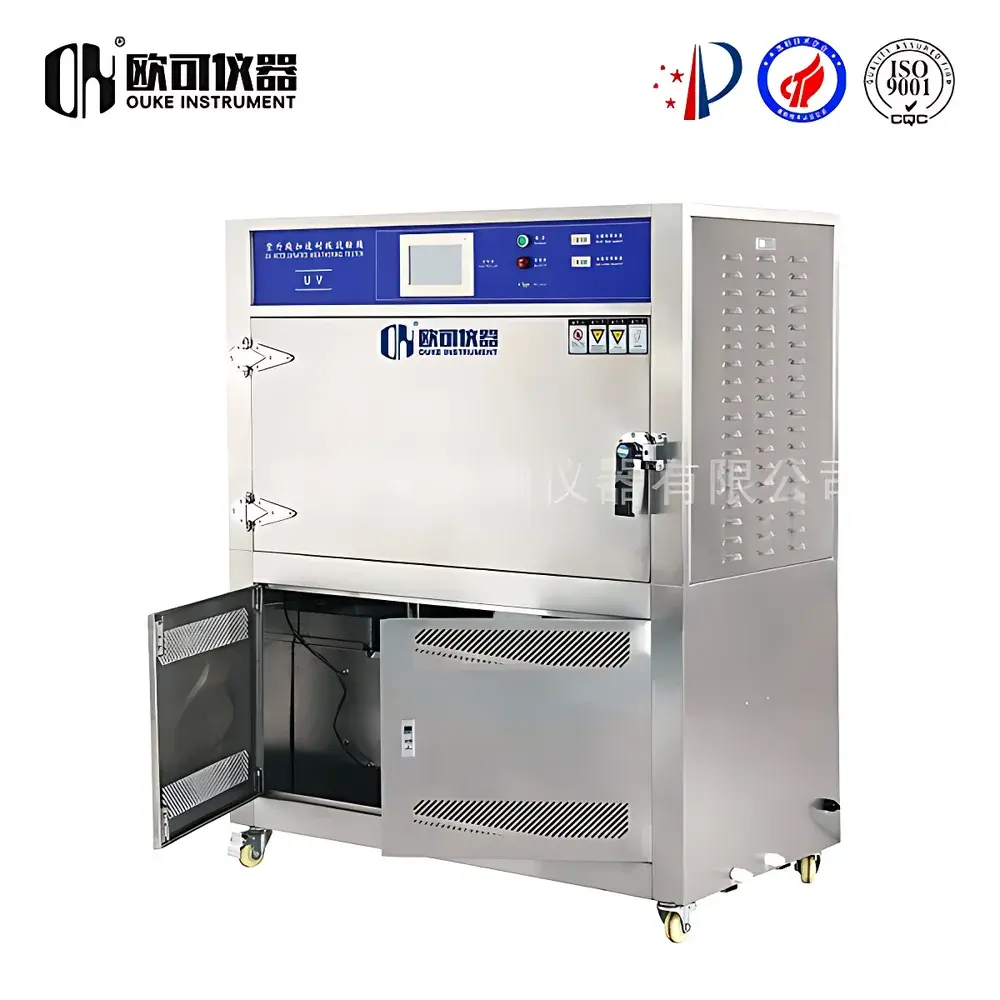
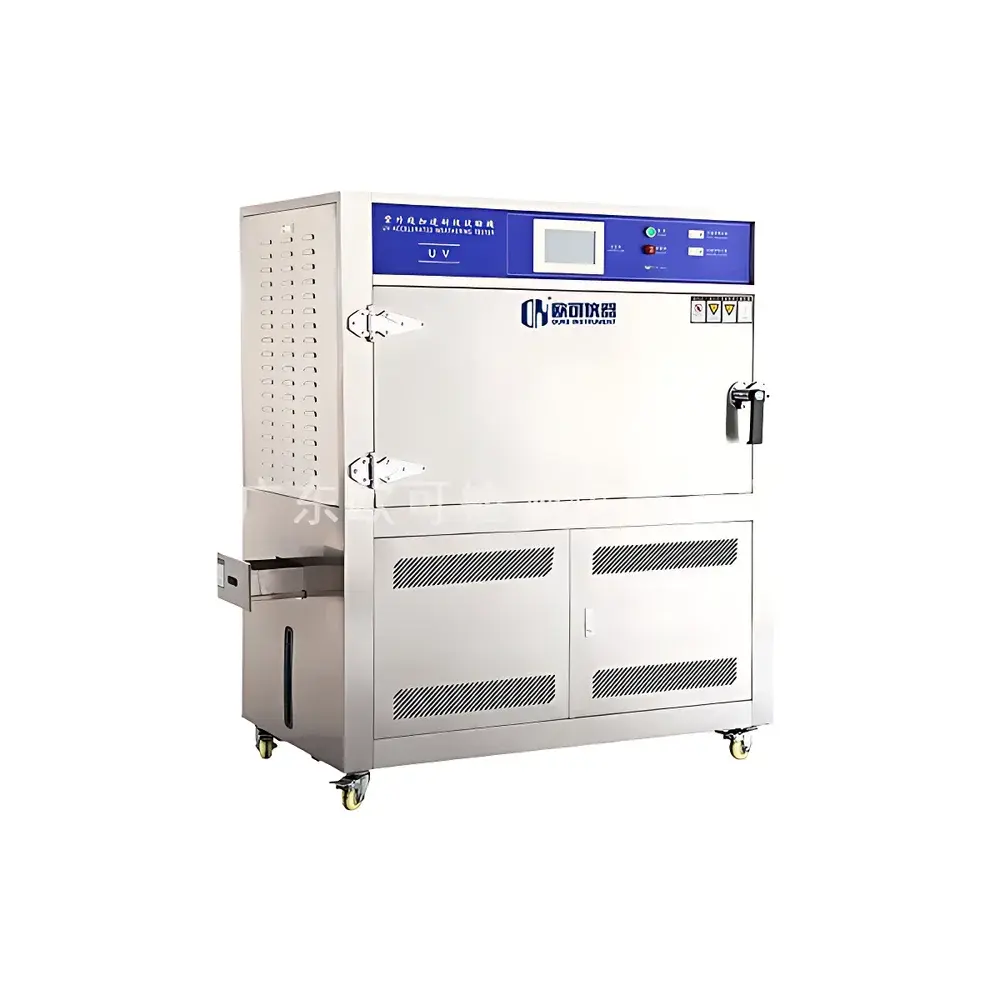
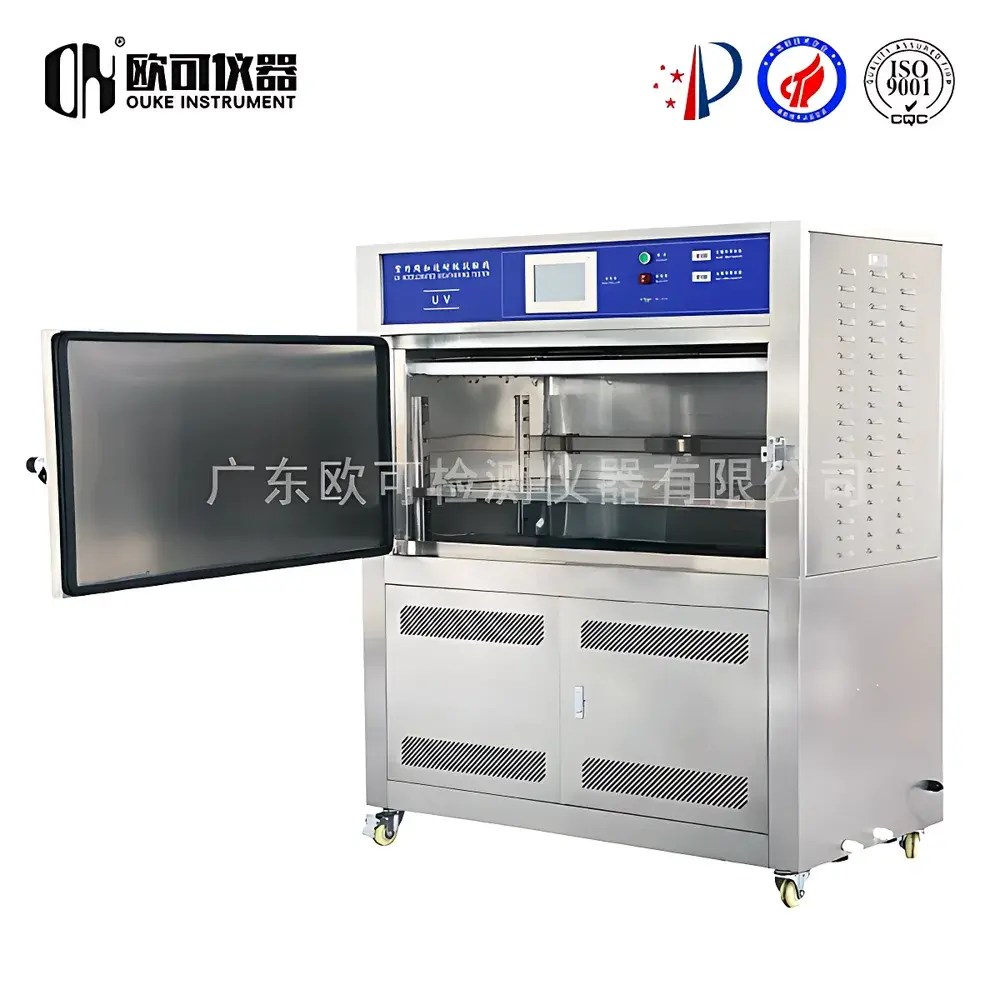
OK UV Aging Test Chamber OK-UV-290.0021
| Brand | OK Instruments |
|---|---|
| Origin | Guangdong, China |
| Manufacturer Type | Direct Manufacturer |
| Model | OK-UV-290.0021 |
| Humidity Range | ≥95% RH (in-chamber actual value) |
| Lamp Power | 40 W per tube |
| Irradiance Range | 0.72 W/m² |
| Exposure Time | 1–9999 h (adjustable) |
| Illumination Temperature Range | RT to 70 °C |
| UV Wavelength Range | 280–400 nm |
| Chamber Dimensions (L×W×H) | 1170 × 400 × 400 mm |
Overview
The OK UV Aging Test Chamber OK-UV-290.0021 is a laboratory-scale accelerated weathering instrument engineered for precision simulation of solar ultraviolet radiation, moisture condensation, and water spray exposure. It operates on the principle of fluorescent ultraviolet (UV) irradiation—employing UVA-340–type spectral output lamps to replicate the terrestrial solar UV spectrum between 295 nm and 365 nm, the most photochemically active region responsible for polymer degradation. Unlike broad-spectrum xenon arc or carbon arc systems, this chamber delivers high reproducibility in UV-driven photochemical aging mechanisms, including chain scission, crosslinking, chromophore bleaching, and surface oxidation. Designed for compliance with internationally recognized test protocols—including ASTM G154, ISO 4892-3, and GB/T 16422.3—the system enables controlled, repeatable assessment of material durability under standardized UV stress conditions. Its primary engineering objective is to accelerate natural outdoor aging effects—such as color fading, gloss loss, chalking, microcracking, embrittlement, and tensile strength reduction—within days or weeks rather than months or years.
Key Features
- Stainless steel interior chamber (SUS304) with high-density polyurethane insulation for thermal stability and corrosion resistance.
- Dual-mode UV lamp configuration supporting standardized spectral output: UVA-340 lamps (peak at 340 nm) for realistic solar simulation; optional UVB-313 compatibility for aggressive durability screening (subject to lamp replacement).
- Precise irradiance control at 0.72 W/m² (measured at sample plane), calibrated to NIST-traceable reference standards.
- Integrated humidity generation system achieving ≥95% RH during condensation cycles via heated water reservoir and saturated vapor diffusion.
- Programmable exposure sequences: independent control of UV irradiation duration (1–9999 h), black-panel temperature (RT to 70 °C), condensation hold time, and optional water spray intervals.
- Intelligent PID-based controller with real-time monitoring of chamber temperature, relative humidity, and cumulative UV dose; data logging capability via RS485/USB interface.
- Adjustable sample rack accommodating standard 75 × 150 mm or 100 × 200 mm test panels at 45° inclination for optimal irradiance uniformity (±5% across working area).
Sample Compatibility & Compliance
The OK-UV-290.0021 accommodates rigid and semi-rigid flat specimens up to 1170 × 400 mm footprint and 25 mm thickness, including coated metal substrates, plastic injection-molded parts, textile laminates, automotive trim components, architectural sealants, and powder-coated wood composites. All operational parameters adhere to the physical constraints defined in ASTM G154 Annex A1 (fluorescent UV exposure apparatus specifications) and ISO 4892-3 Clause 6 (chamber geometry, sensor placement, and irradiance uniformity requirements). The system supports full traceability for GLP-compliant laboratories: audit trails for parameter changes, user login logs, and timestamped exposure records are retained internally. While not pre-certified for FDA 21 CFR Part 11, the controller firmware allows integration with validated LIMS platforms through configurable export formats (CSV, XML).
Software & Data Management
The embedded control system features a 7-inch TFT-LCD touchscreen interface with multilingual support (English, Chinese, Spanish). Test programs are created using a hierarchical sequence editor—defining discrete phases (e.g., “UV@60°C/4h → Condensation@50°C/4h → Spray@25°C/0.5h”) with cycle repetition counts and fail-safe termination logic. Real-time graphs display chamber temperature, humidity, and cumulative UV dose. Export functions generate ISO-compliant test reports including start/stop timestamps, setpoint deviations, lamp operating hours, and alarm history. Optional PC software (OK-UV Manager v3.2) enables remote monitoring, batch report generation, irradiance drift compensation modeling, and comparative analysis across multiple test runs—supporting statistical process control (SPC) workflows for QC departments.
Applications
This chamber serves as a core qualification tool in R&D and quality assurance labs across regulated and industrial sectors. In automotive OEM supply chains, it validates UV resistance of interior trims per SAE J2020 and exterior clearcoats per GMW14872. Paint and coating manufacturers apply it for binder stability ranking against ISO 11507 and ASTM D4587. Polymer compounders use irradiance-controlled cycles to optimize HALS (hindered amine light stabilizer) loading levels in PP, PE, and PVC formulations. Construction material producers assess photostability of silicone sealants (ASTM C1184), roofing membranes (ASTM D4459), and fiber-cement boards. Academic researchers employ its programmable condensation mode to study hydrolytic degradation kinetics in biodegradable polyesters under cyclic wet/dry stress.
FAQ
What UV lamp types are compatible with the OK-UV-290.0021?
Standard configuration uses UVA-340 fluorescent tubes (340 nm peak); UVB-313 tubes may be installed as an alternative for accelerated screening—though spectral mismatch with natural sunlight requires careful interpretation per ISO 4892-3 Annex B.
How often must UV lamps be replaced?
Lamp service life is rated at 1600–2000 hours under continuous operation; irradiance decay exceeds ±10% beyond this threshold, necessitating scheduled replacement to maintain test validity.
Does the chamber meet ASTM G154 Class I or Class II requirements?
Yes—it satisfies Class I (condensation-only) and Class II (condensation + water spray) configurations when operated within specified irradiance, temperature, and humidity tolerances per Section 7.2 of ASTM G154-22.
Can humidity be controlled independently of UV exposure?
Yes: condensation cycles operate without UV illumination, enabling isolated moisture stress testing; spray function is triggered only during designated phases and does not interfere with temperature stabilization.
Is calibration documentation provided with shipment?
Each unit ships with factory calibration certificates for temperature sensors (traceable to NIM, China) and irradiance sensors (calibrated against a NIST-traceable reference meter), valid for 12 months from date of manufacture.



