
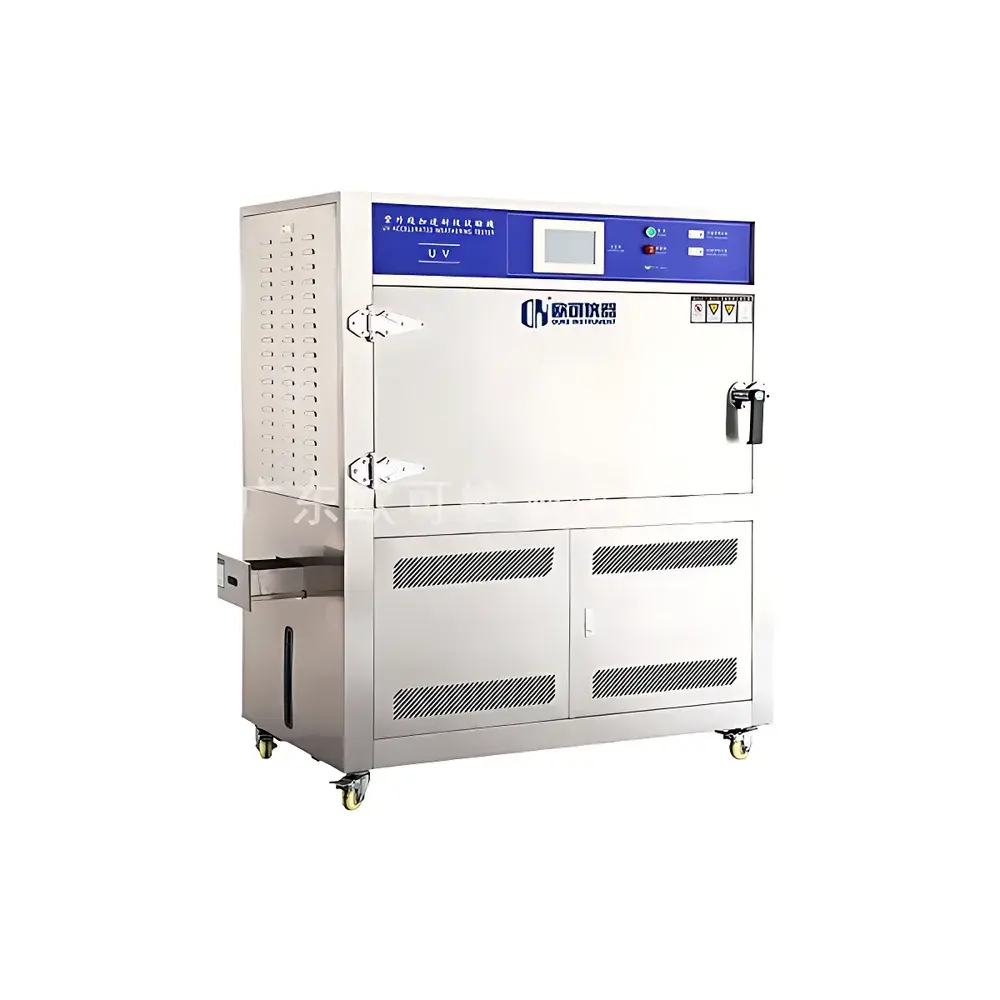
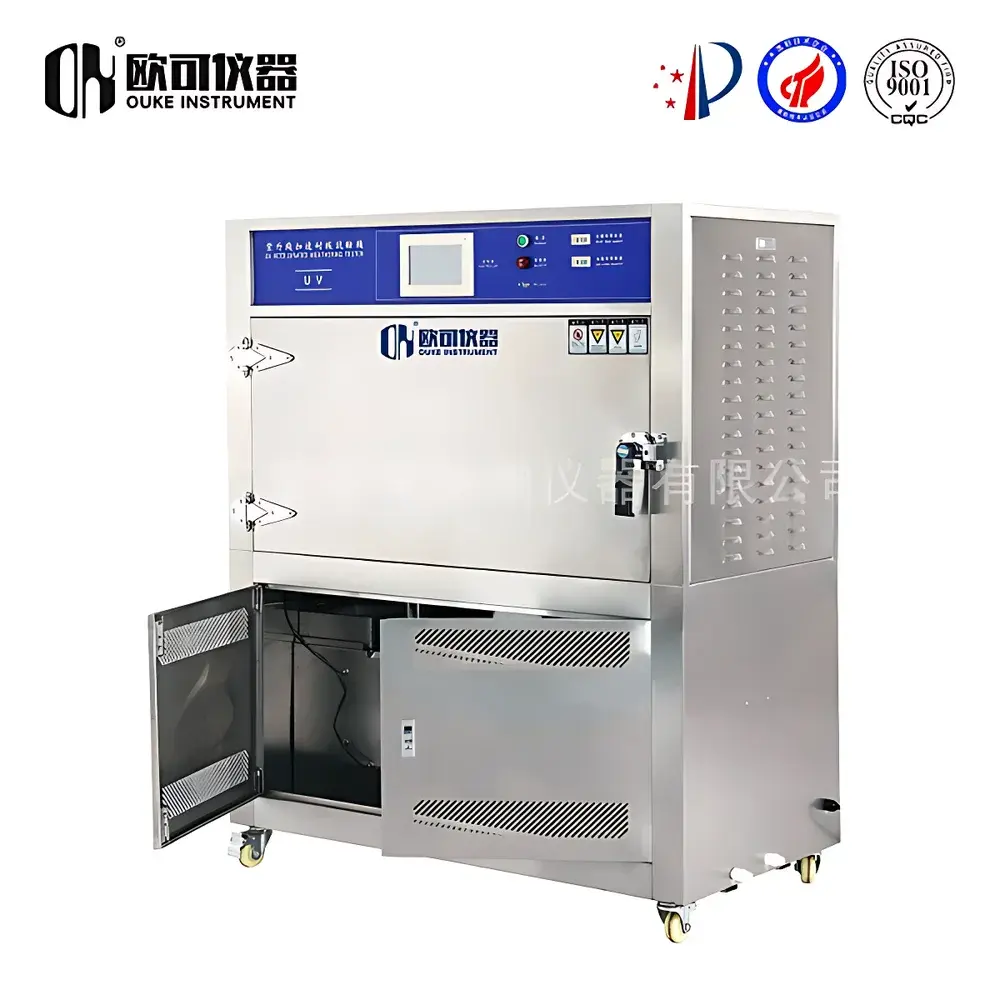
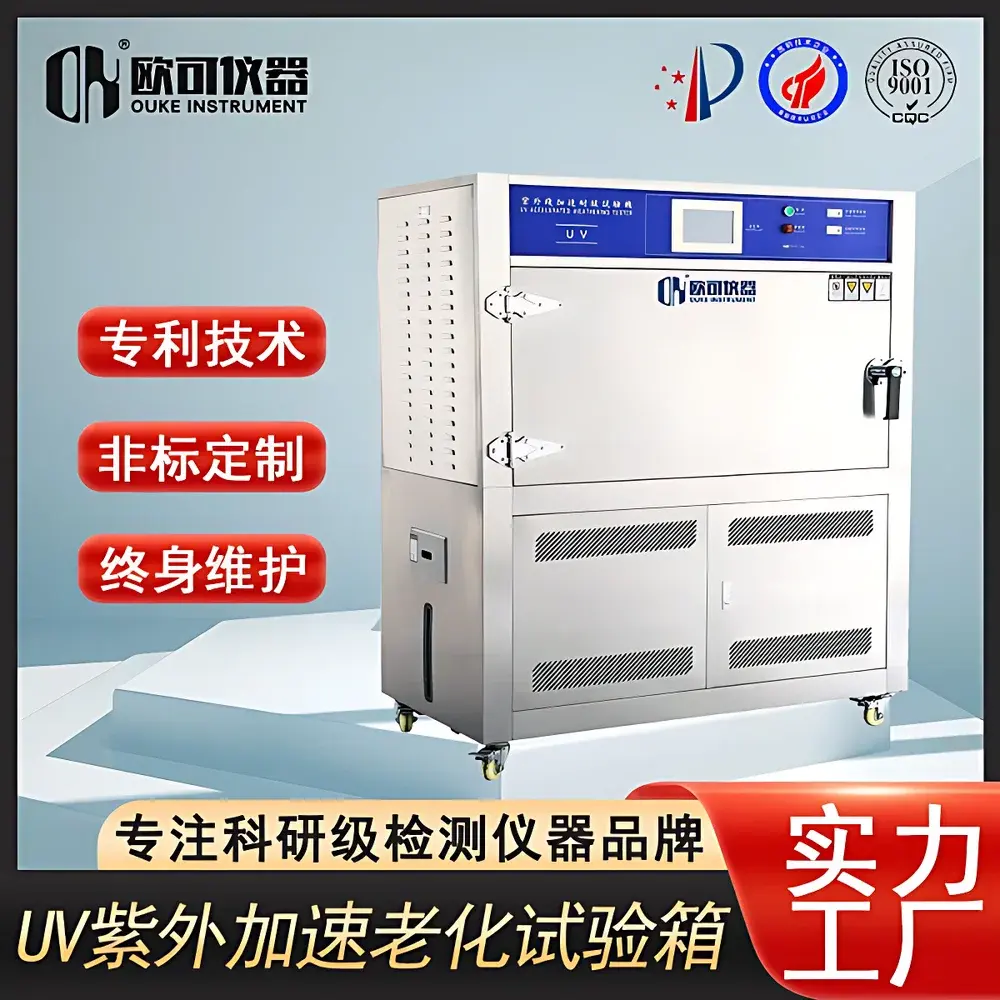
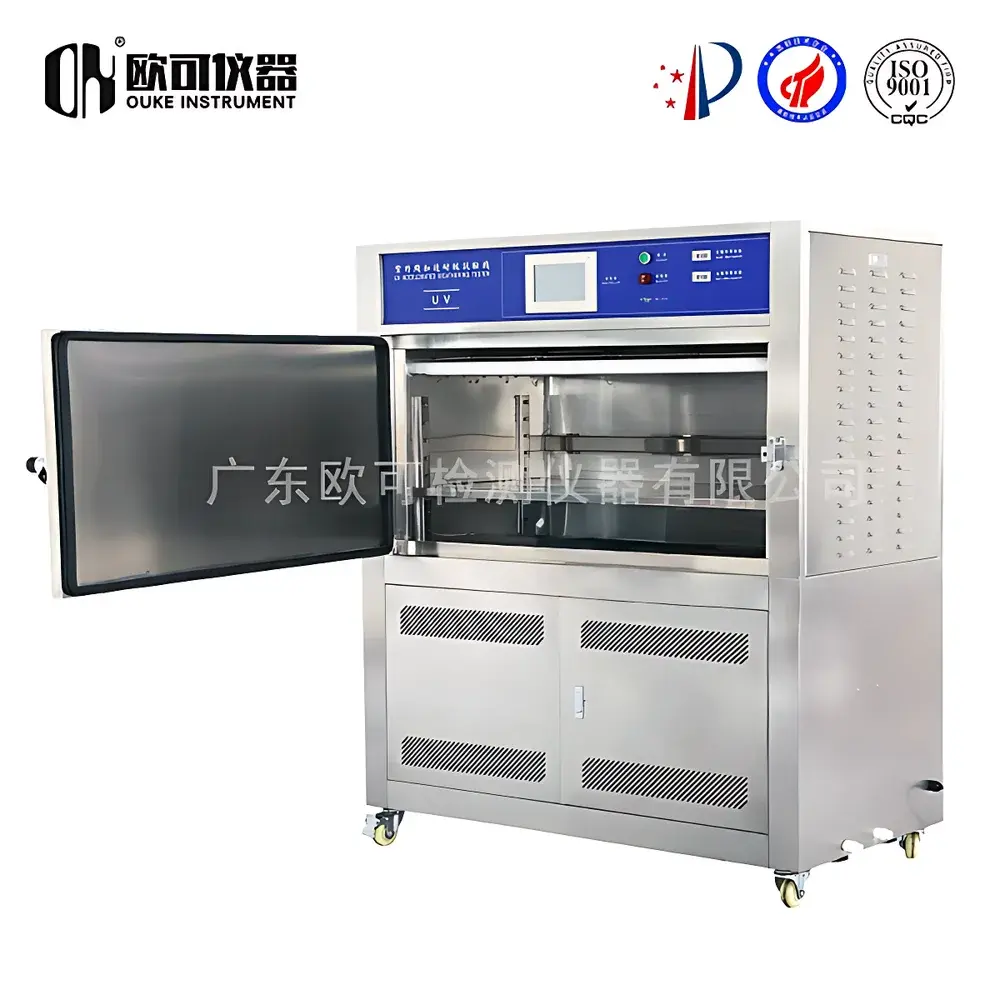
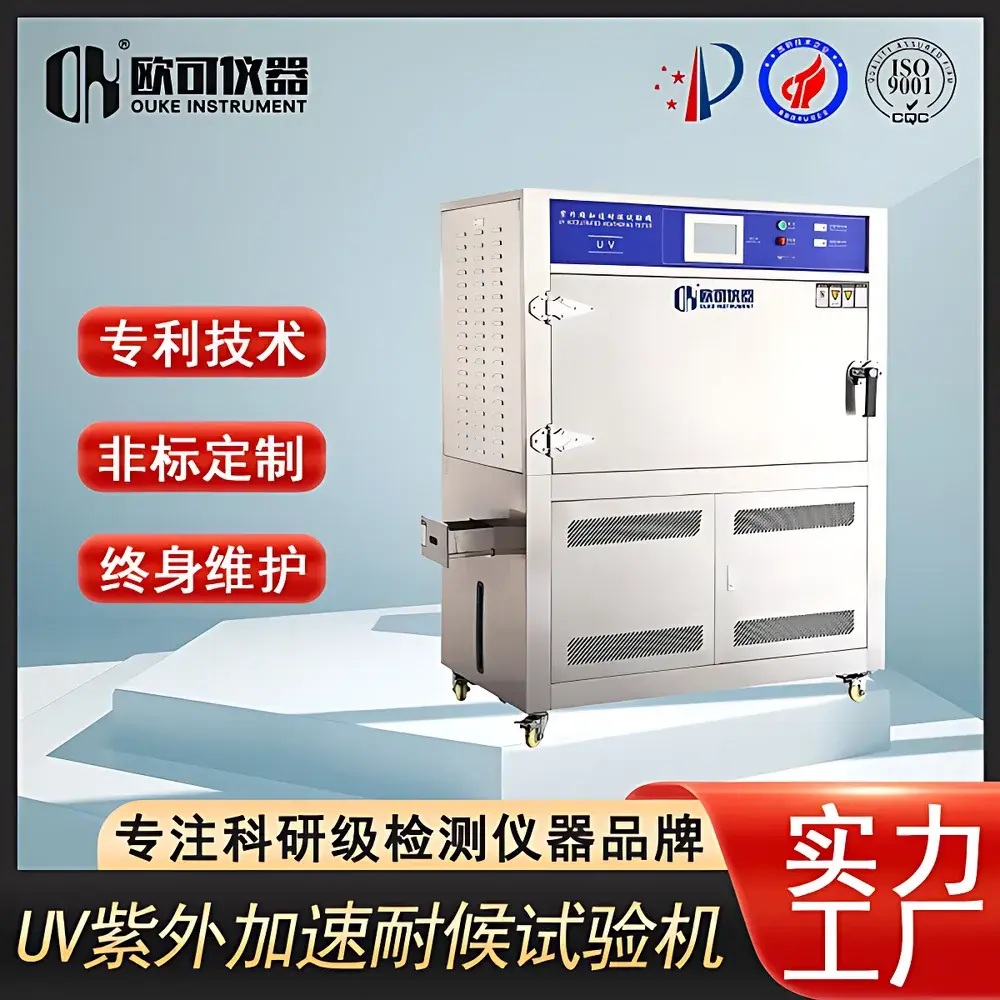
OK UV Aging Test Chamber OK-UV-290.101
| Brand | OK Instruments |
|---|---|
| Origin | Guangdong, China |
| Manufacturer Type | Direct Manufacturer |
| Product Origin | Domestic |
| Model | OK-UV-290.101 |
| Humidity Range | ≥95% RH (actual chamber humidity) |
| Lamp Power | 40 W per tube |
| Irradiance Range | 0.72 W/m² |
| Test Duration | 1–9999 h (adjustable) |
| Illumination Temperature Range | RT to 70 °C |
| UV Wavelength Range | 280–400 nm |
| Chamber Dimensions (L×W×H) | 1170 × 400 × 400 mm |
Overview
The OK UV Aging Test Chamber OK-UV-290.101 is an engineered environmental test system designed for accelerated ultraviolet (UV) exposure testing of polymeric, coated, and composite materials under controlled laboratory conditions. It operates on the principle of controlled photodegradation—using calibrated fluorescent UV lamps to replicate the most photochemically aggressive portion of terrestrial solar radiation (280–400 nm), while simultaneously introducing cyclic moisture via condensation and optional water spray. Unlike full-spectrum xenon arc or carbon arc systems, this chamber isolates UV-driven degradation mechanisms—enabling rapid, reproducible evaluation of surface embrittlement, color shift, gloss loss, chalking, cracking, and adhesion failure. Its architecture conforms to the core physical requirements of ASTM G154 (Standard Practice for Operating Fluorescent Ultraviolet (UV) Lamp Apparatus for Exposure of Nonmetallic Materials), ISO 4892-3 (Plastics — Methods of Exposure to Laboratory Light Sources — Part 3: Fluorescent UV Lamps), and GB/T 16422.3 (Chinese national standard for UV exposure testing). The chamber is not intended for thermal-only or mechanical stress evaluation; rather, it serves as a dedicated tool for UV-specific durability qualification in R&D, quality assurance, and regulatory pre-compliance workflows.
Key Features
- Eight-position UV lamp array with standardized UVA-340 spectral output (280–400 nm), optimized for realistic simulation of terrestrial solar UV irradiance below 365 nm
- Integrated condensation cycle system: heated water pan generates saturated humid air, enabling natural dew formation on specimen surfaces during dark/cooling phases
- Precise black-panel temperature control (RT to 70 °C) with PID-regulated heating elements and forced-air circulation for uniform thermal distribution
- Programmable digital controller with touch interface supporting multi-step UV/condensation/spray cycles, real-time monitoring, and data logging
- Corrosion-resistant stainless-steel interior chamber (1170 × 400 × 400 mm usable volume) with quartz-glass UV-transmissive viewing window
- Fixed irradiance output of 0.72 W/m² at 340 nm (measured at specimen plane), compliant with baseline calibration requirements of ASTM G154 Cycle 1
- Independent humidity maintenance ≥95% RH during condensation phase without active humidification—achieved solely through thermal equilibrium and surface saturation
Sample Compatibility & Compliance
The OK-UV-290.101 accommodates flat or low-profile specimens up to 1100 mm in length, including coated metal panels, plastic injection-molded parts, textile swatches, elastomeric gaskets, and architectural film laminates. Specimen mounting fixtures are non-reflective and thermally inert to avoid secondary heating or spectral interference. All operational parameters—including irradiance intensity, temperature ramp rates, condensation duration, and cycle sequencing—can be configured to align with test protocols mandated by automotive OEMs (e.g., SAE J2020), paint manufacturers (AAMA 2605), and building material standards (EN 927-6). The system supports GLP-aligned operation: test logs include timestamped parameter records, operator ID fields, and exportable CSV reports traceable to individual test runs. While not FDA 21 CFR Part 11 validated out-of-the-box, its audit-ready data structure enables integration into validated QA environments with supplementary procedural controls.
Software & Data Management
The embedded controller provides local configuration, real-time graphing of chamber temperature and elapsed time, and automatic shutdown upon cycle completion. All settings—including total exposure duration (1–9999 hours), UV-on/off intervals, condensation hold times, and setpoint temperatures—are stored in non-volatile memory with password-protected access levels. Data export is supported via USB flash drive (no network connectivity required), generating timestamped .csv files containing: cycle phase markers, black-panel temperature readings at 1-minute intervals, and cumulative UV exposure time. For enterprise integration, optional RS-485 Modbus RTU communication allows remote supervision via SCADA or LIMS platforms—supporting automated report generation, alarm forwarding, and historical trend analysis across multiple chambers.
Applications
This chamber is routinely deployed in tier-1 automotive supplier labs for evaluating UV resistance of instrument panel substrates, exterior trim coatings, and headlamp lens polycarbonates. In industrial coatings R&D, it supports formulation screening of acrylic-urethane topcoats and silicone-modified alkyds under ASTM G154 Cycle 4 (UV + condensation + water spray). Plastics compounders use it to quantify yellowing index (ASTM D1925) and tensile retention (ISO 527-2) after fixed-dose UV exposure. Textile laboratories apply it to assess fading kinetics of reactive-dyed cotton per AATCC TM16, while construction material developers validate weatherability of PVC window profiles per EN 12608. Its cost-effective UV-specific acceleration makes it especially suitable for high-throughput QC release testing where full-spectrum fidelity is secondary to repeatability and throughput.
FAQ
What UV lamp type is installed in the OK-UV-290.101?
The chamber is equipped with eight UVA-340 fluorescent tubes, delivering spectral power distribution closely matching terrestrial sunlight from 295 nm to 365 nm.
Does the system support irradiance calibration and adjustment?
No—this model maintains a fixed nominal irradiance of 0.72 W/m² at 340 nm. For applications requiring dynamic irradiance control or radiometric traceability, a spectroradiometer-equipped variant is recommended.
Can the chamber perform water spray cycles?
Yes—optional spray nozzles can be activated during designated dark phases to simulate rainfall, subject to user-defined timing and duration.
Is ISO 4892-3 compliance verified by third-party certification?
The chamber’s design and performance envelope meet the physical requirements of ISO 4892-3 Annex A; however, formal certification requires on-site verification by an accredited body per ISO/IEC 17025.
What maintenance is required for long-term stability?
UV lamps must be replaced every 1600–2000 hours of operation; the water pan requires weekly deionized water replenishment and quarterly descaling; stainless-steel interior surfaces should be wiped with ethanol after each test series to prevent residue buildup.



