
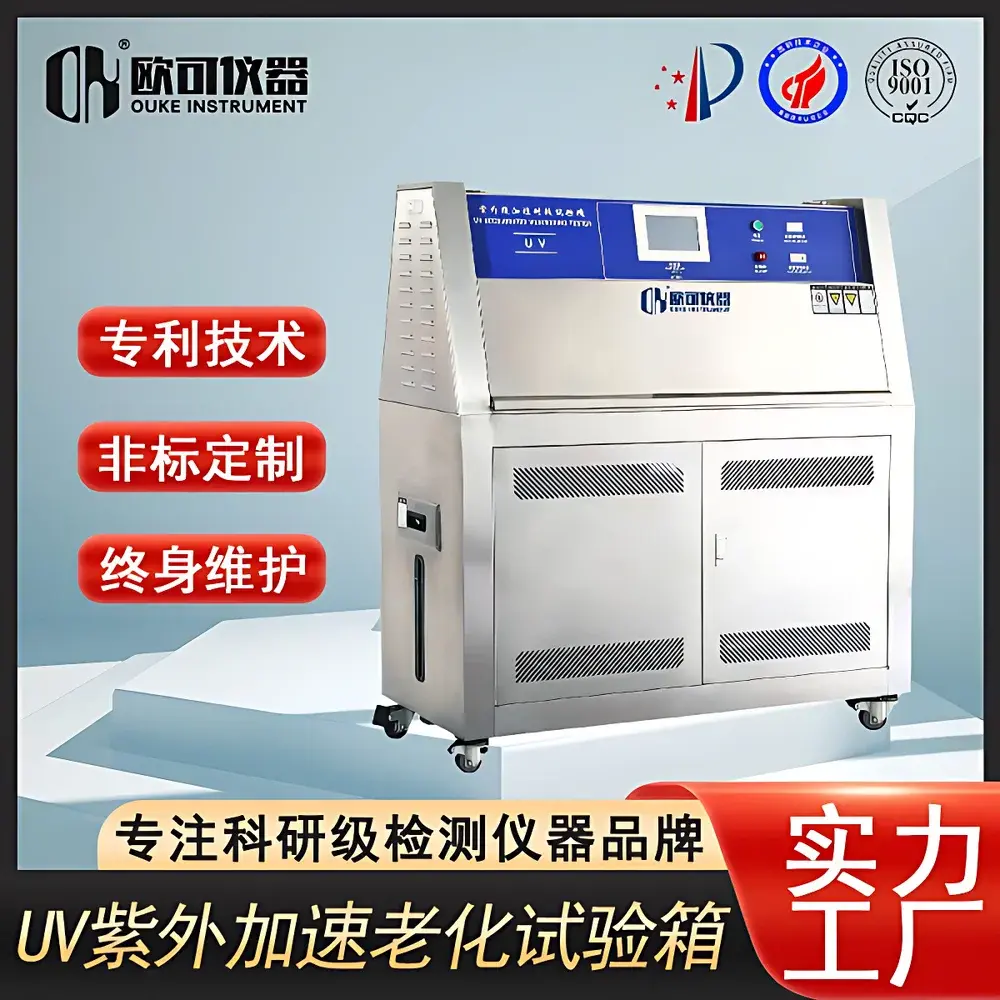
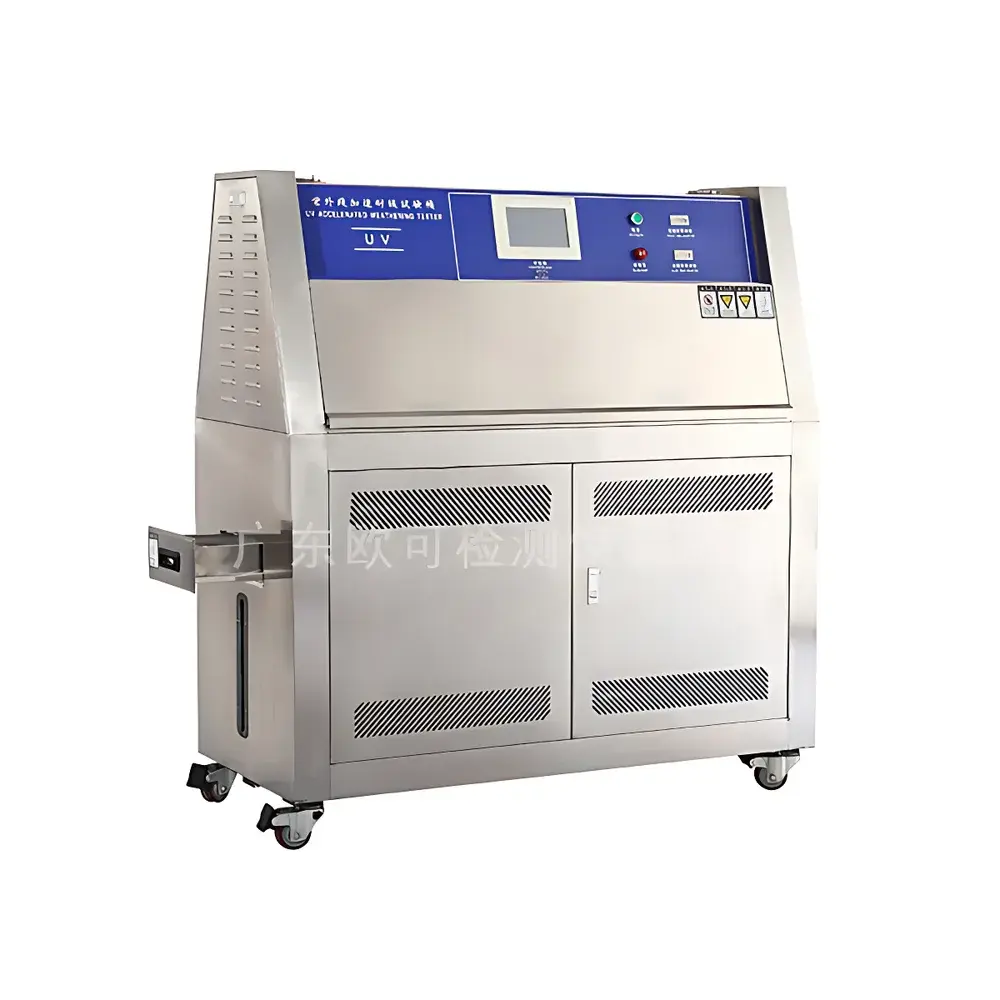
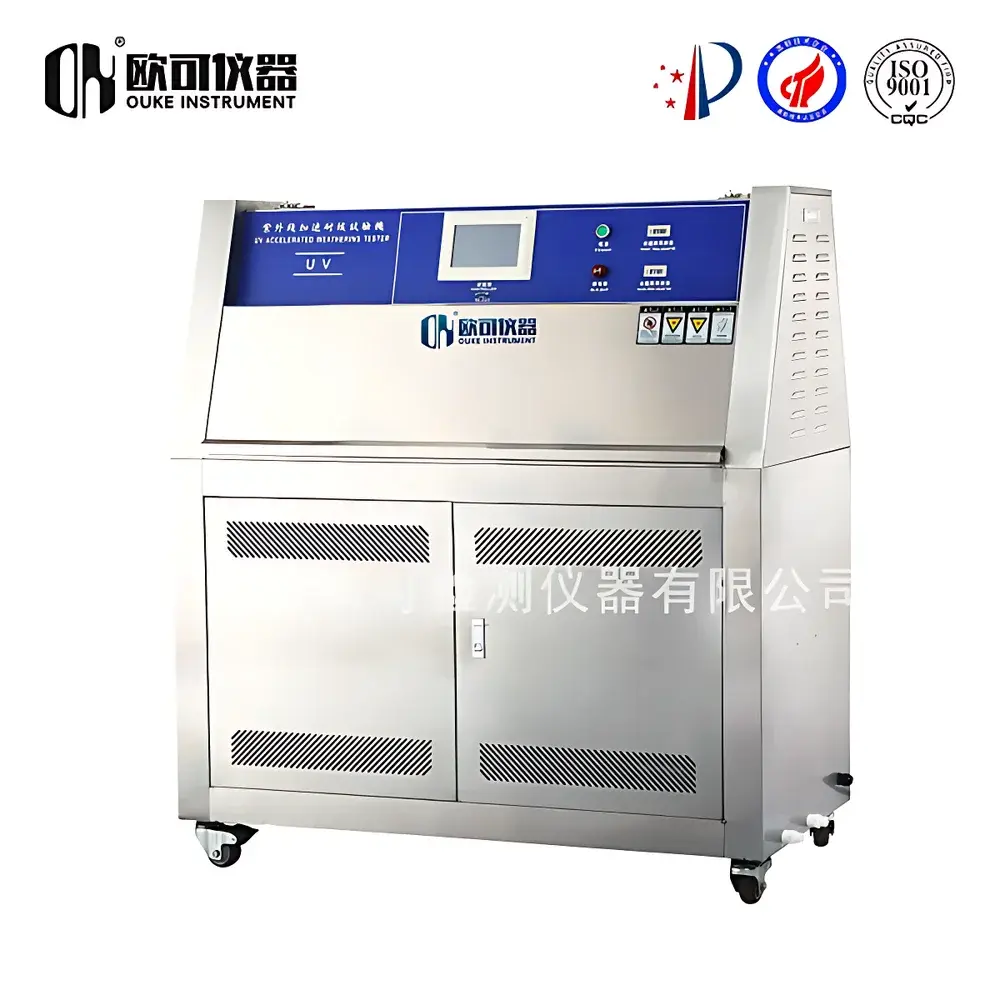
OK UV Aging Test Chamber OK-UV-290
| Brand | OK Instruments |
|---|---|
| Origin | Guangdong, China |
| Manufacturer Type | Direct Manufacturer |
| Country of Origin | China |
| Model | OK-UV-290 |
| Humidity Range | ≥95% RH (actual chamber humidity) |
| UV Lamp Power | 40 W per lamp |
| Irradiance Range | 0.72 W/m² |
| Exposure Time | 1–9999 h (adjustable) |
| Illumination Temperature Range | RT to 70 °C |
| UV Wavelength Range | 280–400 nm |
| Chamber Internal Dimensions (L×W×H) | 1170 × 400 × 400 mm |
Overview
The OK UV Aging Test Chamber OK-UV-290 is an engineered environmental test system designed for accelerated ultraviolet (UV) exposure testing of polymeric materials, coatings, adhesives, textiles, and automotive components. It operates on the principle of controlled UV irradiation combined with regulated thermal and hygrothermal cycling to replicate outdoor weathering degradation mechanisms—primarily photochemical bond scission, oxidation, and surface embrittlement induced by short-wave UV photons. The chamber integrates UVA-340 and UVB-313 fluorescent lamp options to support both realistic solar-spectrum simulation (UVA-340, 295–365 nm) and aggressive, high-intensity accelerated aging (UVB-313, peak at 313 nm). Its design conforms to core international standards including ASTM G154 (Standard Practice for Operating Fluorescent Ultraviolet (UV) Lamp Apparatus for Exposure of Nonmetallic Materials), ISO 4892-3 (Plastics — Methods of Exposure to Laboratory Light Sources — Part 3: Fluorescent UV Lamps), and GB/T 14522 (Chinese national standard for UV aging testing of non-metallic materials).
Key Features
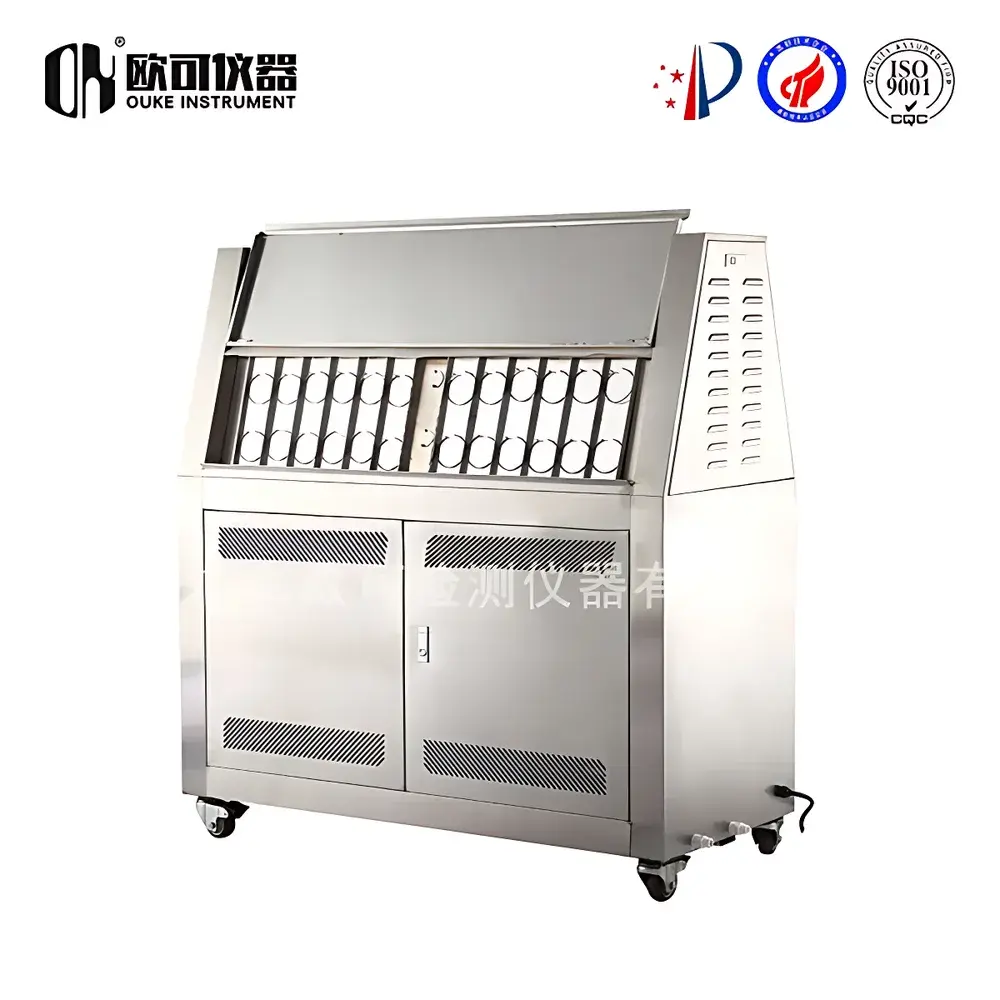
- Eight standardized UV fluorescent lamps (UVA-340 or UVB-313 selectable) mounted symmetrically on dual chamber walls, delivering uniform irradiance distribution across the test area.
- Precision-controlled irradiance output of 0.72 W/m² at 340 nm (calibrated per ASTM E2498), maintained via integrated electronic ballasts and real-time feedback monitoring.
- Temperature regulation from ambient (RT) to 70 °C using a stainless-steel inner water bath heating system—ensuring rapid thermal response and ±1.5 °C uniformity across the working volume.
- Cold-condensation humidity generation: saturated water vapor condenses directly onto specimen surfaces at elevated temperature, replicating dew formation and moisture-driven degradation pathways per ASTM D4329.
- Optional water spray function enables cyclic wet/dry exposure to simulate rain erosion, thermal shock, and leaching effects—fully programmable and interlocked with UV and condensation phases.
- Specimen-to-lamp distance fixed at 50 mm (parallel alignment), optimized for radiometric consistency and compliant with ISO 4892-3 geometric requirements.
- Self-leveling water reservoir with automatic float-controlled补水 system; drain assembly features vortex-type sediment trap and U-shaped silt collector for low-maintenance operation.
- Ergonomic dual-hinged chamber lid with gas-assisted lift mechanism; reinforced PU casters with locking brakes for stable positioning and safe relocation.
Sample Compatibility & Compliance
The OK-UV-290 accommodates up to 20 standard specimens (404 × 105 mm each) on adjustable aluminum sample racks. Compatible substrates include rigid plastics, flexible films, painted metal panels, elastomers, fiber-reinforced composites, and architectural sealants. All internal chamber surfaces are constructed from SUS304 stainless steel with electropolished finish to resist UV-induced corrosion and chloride accumulation. The system supports GLP-compliant validation protocols—including IQ/OQ documentation templates—and is compatible with third-party calibration services traceable to NIST standards. While not inherently 21 CFR Part 11 compliant, audit trails and user-access logs can be implemented via external data acquisition software meeting FDA regulatory expectations for material qualification in pharmaceutical packaging or medical device R&D.
Software & Data Management
The chamber is equipped with a programmable digital controller supporting multi-step exposure profiles: independent or synchronized control of UV intensity, condensation duration, spray cycles, and temperature ramps. Up to 100 user-defined test programs may be stored, each with timestamped start/stop events, alarm history, and real-time parameter logging (irradiance, chamber temperature, humidity, elapsed time). Data export is supported via RS485 Modbus RTU interface for integration into centralized LIMS or MES platforms. Optional PC-based software provides graphical trend analysis, pass/fail threshold alerts, and automated report generation aligned with ISO/IEC 17025 documentation requirements.
Applications
This UV aging chamber is routinely deployed in quality assurance laboratories for comparative durability benchmarking of exterior automotive trim, aerospace polymer housings, solar panel encapsulants, marine-grade coatings, and UV-stabilized agricultural films. In R&D settings, it supports formulation optimization of photostabilizers (e.g., HALS, benzotriazoles), evaluation of pigment fade resistance, and correlation studies between accelerated exposure and natural weathering (e.g., Florida or Arizona field trials). Industrial users apply it for supplier qualification, batch release testing, and failure root-cause analysis of premature cracking, chalking, or gloss loss.
FAQ
What UV lamp types are supported, and how do they differ in application?
The chamber accepts both UVA-340 and UVB-313 lamps. UVA-340 closely matches terrestrial solar UV below 365 nm and is recommended for realistic weathering simulation. UVB-313 delivers higher photon energy and accelerates degradation but may induce non-representative failure modes—thus best suited for QC screening or comparative ranking.
Is condensation the only moisture mechanism available?
No. The system supports standalone condensation cycles, standalone water spray, or fully programmable alternating sequences (e.g., 4 h UV + 4 h condensation + 0.5 h spray), enabling replication of diverse climatic stressors.
How is irradiance calibrated and maintained over time?
Irradiance is monitored using a calibrated broadband UV sensor (320–400 nm spectral response). Lamp output degrades gradually; users are advised to replace lamps after 1600–2000 hours of operation or when irradiance falls below 90% of initial value—per ASTM G154 Section 7.3.
Can the chamber operate unattended for extended durations?
Yes. With automatic water replenishment, overtemperature/overhumidity safety cutoffs, and non-volatile program memory, the OK-UV-290 supports continuous operation up to 9999 hours without manual intervention.
Does the system meet CE or UL certification requirements?
The chamber complies with IEC 61000-6-3 (EMC emission) and IEC 61000-6-2 (immunity), and its electrical architecture meets IP20 enclosure rating. CE marking is available upon request with full EU Declaration of Conformity; UL listing requires site-specific evaluation under UL 508A.



