
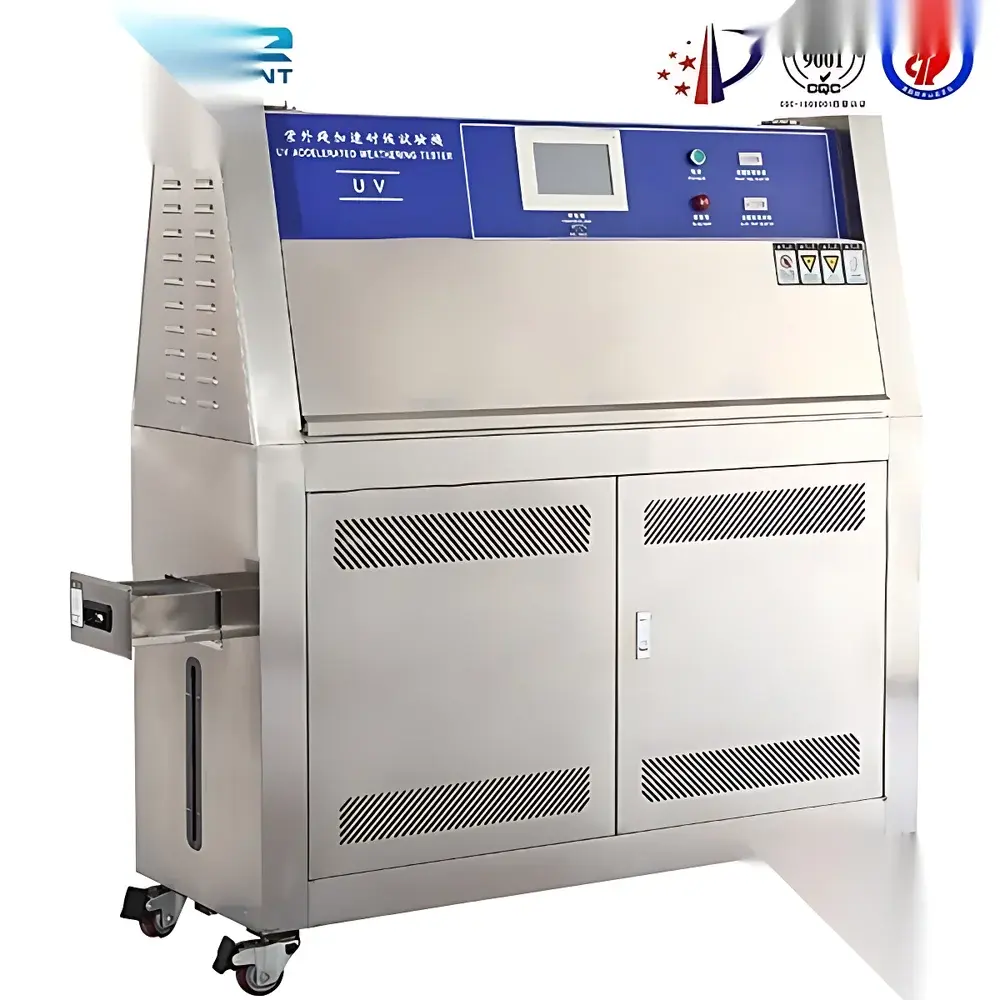
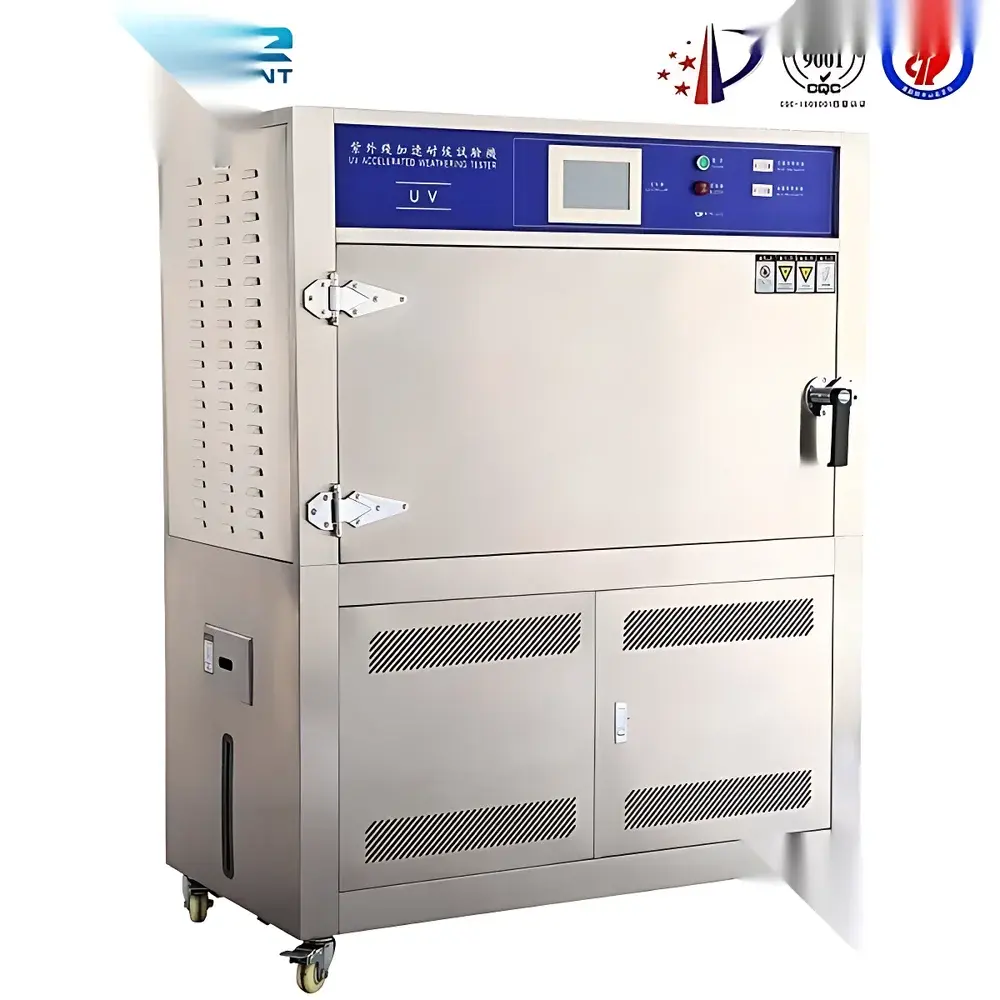
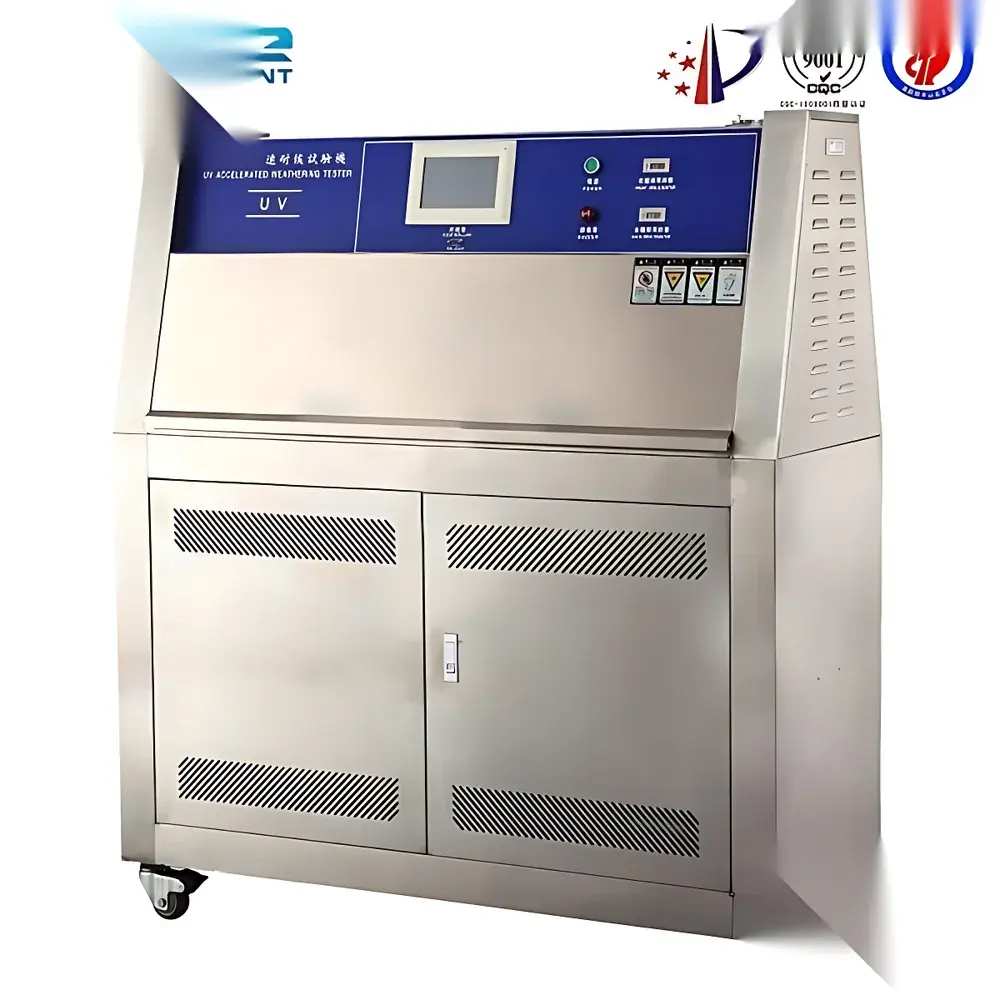
UV Aging Test Chamber OK-UV-290
| Brand | Other Brands |
|---|---|
| Origin | Imported |
| Manufacturer Type | General Distributor |
| Price | USD 3,150 (FOB) |
| Model | OK-UV-290 |
| Interior Dimensions (W×H×D) | 114 × 40 × 40 cm |
| Exterior Dimensions (W×H×D) | 135 × 140 × 65 cm |
| Temperature Range | Ambient to 70 °C |
| Humidity Range | ≥95% RH |
| Temperature Control Accuracy | ≤±0.5 °C |
| Temperature Uniformity | ≤±2 °C or ≤±3% |
| UV Lamp Type | Fluorescent UV Tubes (UVA-340 or UVB-313 equivalent) |
| UV Wavelength Range | 280–400 nm |
| Lamp Lifetime | Approx. 2,000 hours |
| Exposure Time Range | 0–999 hours (adjustable) |
| Chamber Material | SUS#304 Stainless Steel (inner & outer) |
| Heating System | U-shaped Titanium Alloy Heaters |
| Safety Features | Interlocked UV cutoff on door opening, Overtemperature Protection, Low-water Level Cut-off |
| Power Supply | AC 220 V ±5%, 50 Hz |
Overview
The OK-UV-290 UV Aging Test Chamber is an engineered environmental simulation system designed for accelerated weathering evaluation of polymeric, coated, and composite materials under controlled ultraviolet irradiation and condensation cycles. It operates on the principle of fluorescent ultraviolet (UV) radiation exposure—primarily within the UVA (315–400 nm) and UVB (280–315 nm) spectral bands—to replicate photochemical degradation mechanisms induced by solar UV in real-world outdoor service environments. Unlike xenon arc or carbon arc testers, this chamber employs low-intensity, spectrally stable fluorescent UV lamps to isolate and intensify the most damaging short-wavelength components of sunlight, while synchronized condensation cycles simulate dew formation and moisture absorption at elevated temperatures. This dual-stress methodology enables rapid assessment of surface-level degradation phenomena—including photolysis, oxidation, chain scission, and hydrolysis—within days or weeks, compressing years of natural exposure into a reproducible laboratory protocol.
Key Features
- Fluorescent UV lamp array compliant with ASTM G154 spectral requirements (UVA-340 or UVB-313 lamp options available per test specification)
- Precise temperature control (ambient to 70 °C) with ±0.5 °C accuracy and uniformity maintained within ±2 °C across the test chamber volume
- High-humidity condensation cycle generation (≥95% RH) via controlled water reservoir heating and thermal gradient-induced dew formation
- Full stainless steel construction (SUS#304) for corrosion resistance, ease of cleaning, and long-term dimensional stability
- Interlocked UV safety circuit: automatic lamp power cutoff upon door opening, preventing operator UV exposure
- Dual-stage thermal protection: independent overtemperature sensor and mechanical thermal cutout for heater failure redundancy
- Modular lamp tray design enabling quick replacement and alignment verification without tooling
Sample Compatibility & Compliance
The OK-UV-290 accommodates flat-panel specimens up to 110 cm wide × 40 cm high × 10 cm deep, supporting standard ASTM and ISO sample holders (e.g., 75 × 150 mm, 100 × 100 mm). Its operational parameters align with internationally recognized accelerated weathering standards including ASTM G154 (fluorescent UV exposure), ASTM D4329 (plastics), ASTM D4587 (coatings), ASTM D4799 (wood composites), SAE J2020 (automotive exterior materials), and ISO 4892-3 (method A for UV fluorescent lamps). The chamber’s design supports GLP-compliant testing workflows when integrated with validated data logging and audit-trail-enabled software (see Software & Data Management section). While not inherently FDA 21 CFR Part 11 certified, its hardware architecture permits integration with third-party compliant software platforms for regulated industries requiring electronic records and signature validation.
Software & Data Management
The OK-UV-290 includes a programmable digital controller with embedded real-time clock, multi-step cycle programming (e.g., 4-hour UV @ 60 °C / 4-hour condensation @ 50 °C), and non-volatile memory retention for up to 100 user-defined test profiles. Optional RS485/Modbus RTU interface enables connection to SCADA systems or centralized lab management platforms. When paired with optional PC-based software (sold separately), users gain access to automated data export (CSV/Excel), calibration history tracking, alarm event logging with timestamps, and PDF report generation—including temperature/humidity/UV intensity trend plots and pass/fail annotations against preloaded standard criteria. All logged data are time-stamped and attributable to operator ID, satisfying basic ALCOA+ principles (Attributable, Legible, Contemporaneous, Original, Accurate) for quality-controlled laboratories.
Applications
- Automotive: Evaluation of paint clearcoat durability, headlamp lens yellowing, interior trim fading, and sealant adhesion loss
- Coatings & Inks: Accelerated assessment of gloss retention, chalking resistance, and color shift in architectural and industrial coatings
- Plastics & Elastomers: Screening of UV stabilizer efficacy in PP, PE, PVC, TPO, and thermoplastic polyurethanes
- Wood & Composites: Monitoring surface checking, lignin degradation, and binder hydrolysis in MDF, OSB, and WPCs
- Adhesives & Sealants: Quantifying cohesive strength decay and interfacial delamination under cyclic UV/moisture stress
- Textiles & Nonwovens: Testing colorfastness and tensile property retention in outdoor fabrics and geotextiles
FAQ
What UV lamp types are supported, and how do they differ in application?
Standard configuration uses UVA-340 lamps, which closely match terrestrial solar UV below 365 nm and are recommended for general polymer and coating testing per ASTM G154 Cycle 1. UVB-313 lamps provide more aggressive short-wavelength output and are used for highly accelerated screening per ASTM G154 Cycle 3 or ISO 4892-3 Method B.
Is the chamber capable of water spray functionality?
No—the OK-UV-290 implements only condensation-based moisture cycling. For combined UV/spray testing, a separate model with integrated water spray nozzles (e.g., OK-UV-290S) is required and complies with ASTM D4329 Annex A2.
How often must UV lamps be replaced, and is recalibration required after replacement?
Lamps should be replaced after approximately 2,000 hours of operation or when irradiance drops below 90% of initial output (verified using a NIST-traceable UV radiometer). No system recalibration is needed post-replacement; however, irradiance mapping is recommended every 500 hours to ensure spatial uniformity compliance per ASTM G154 Section 7.3.2.
Can the chamber operate unattended for extended durations?
Yes—its dual thermal protection, low-water shutoff, and door interlock allow safe 24/7 operation. For GLP/GMP environments, continuous monitoring via external data loggers and periodic visual inspection of lamp integrity are advised.



