
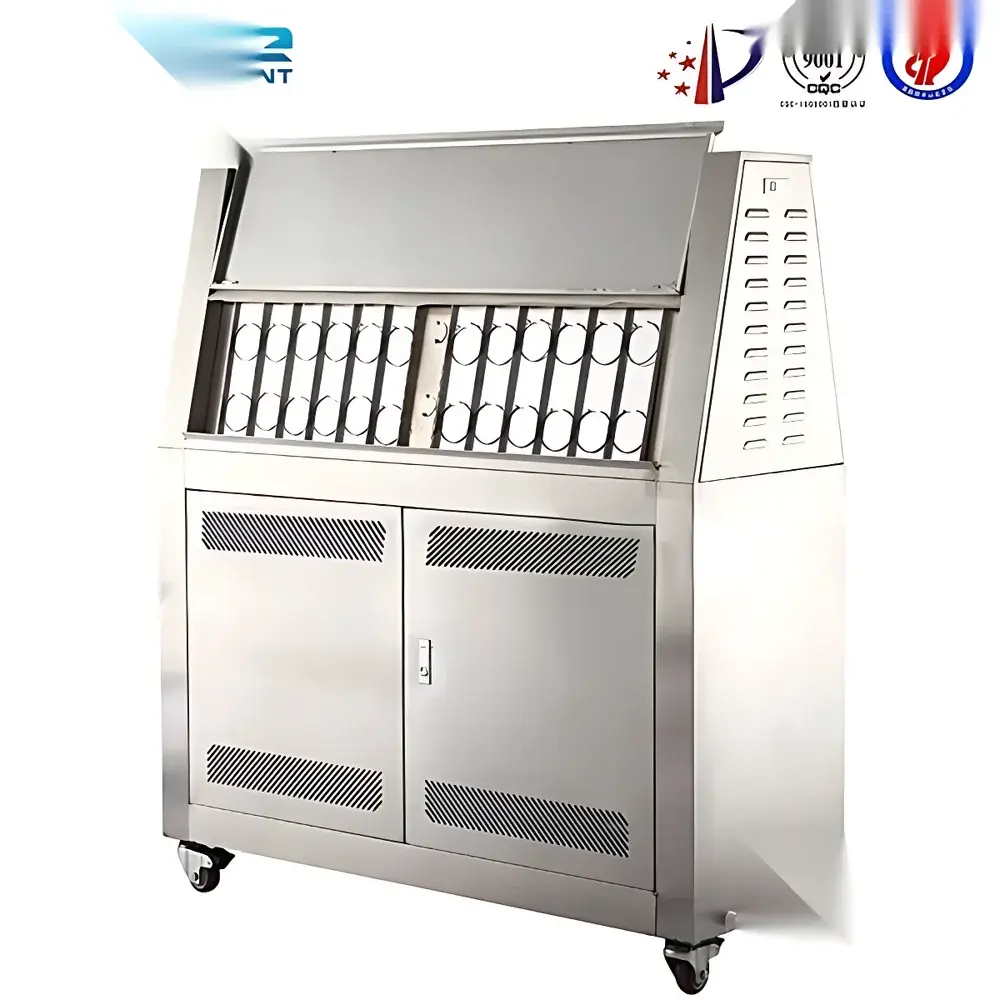
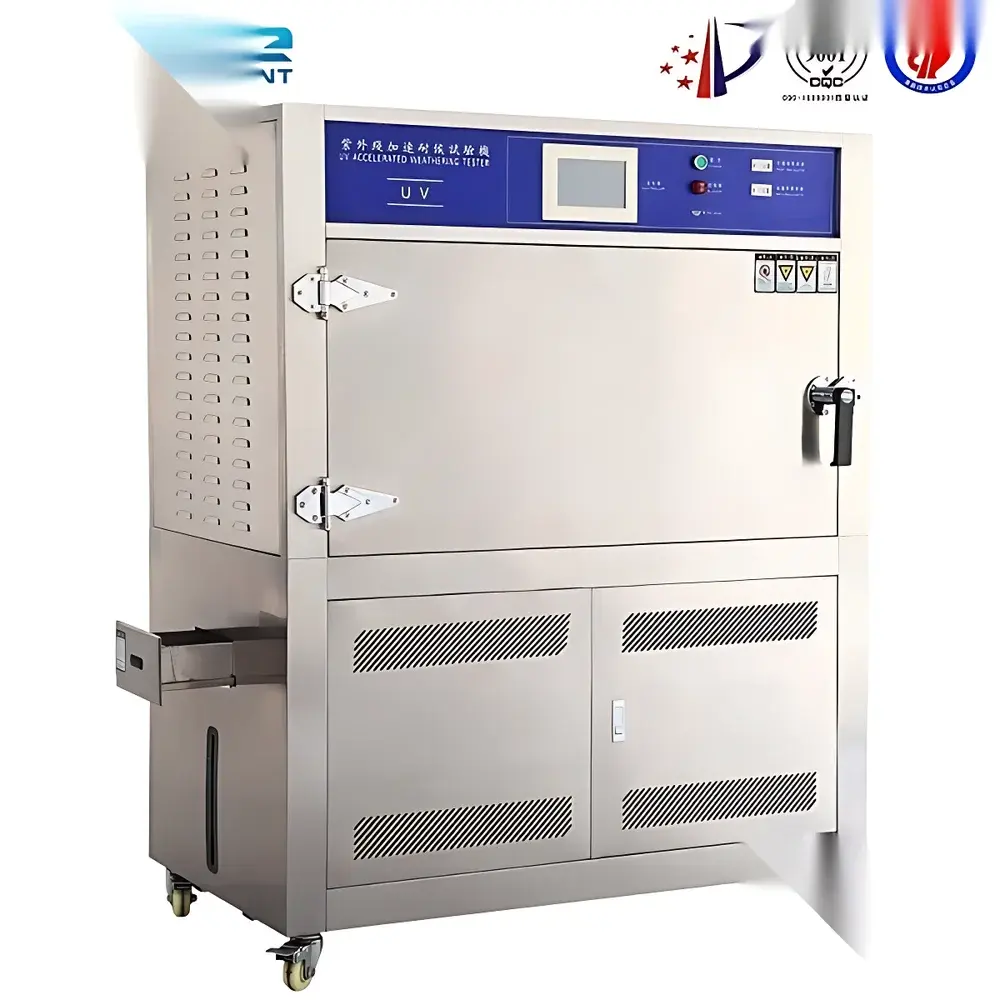
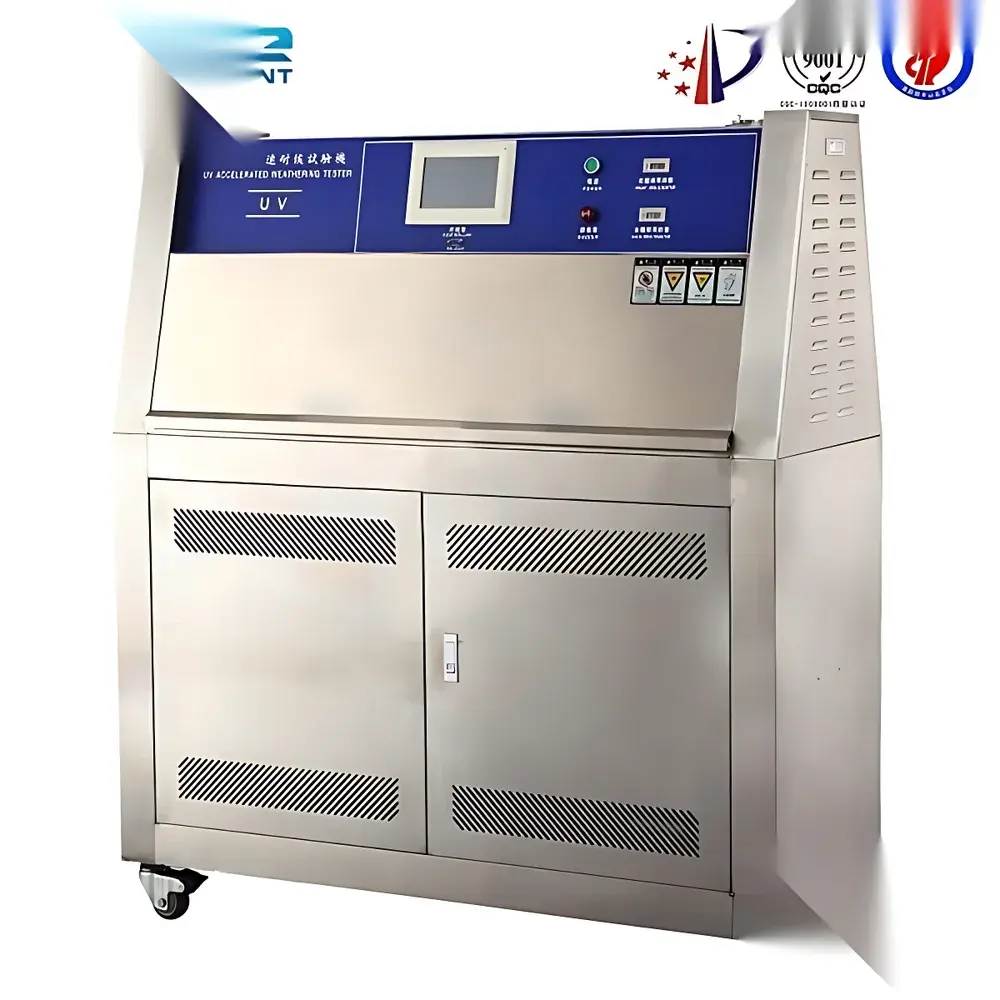
UV Aging Test Chamber OK-UV-290
| Brand | Other Brands |
|---|---|
| Origin | Imported |
| Manufacturer Type | General Distributor |
| Price | USD 3,150 (FOB) |
| Internal Chamber Dimensions (W×H×D) | 114 × 40 × 40 cm |
| External Dimensions (W×H×D) | 135 × 140 × 65 cm |
| Temperature Range | Ambient to 70 °C |
| Humidity Range | ≥95% RH |
| Temperature Control Accuracy | ≤±0.5 °C |
| Temperature Uniformity | ≤±2 °C or ≤±3% |
| UV Lamp Type | Fluorescent UV Lamps (UVA-340 or UVB-313 equivalent) |
| UV Wavelength Range | 280–400 nm |
| Lamp Lifetime | ~2,000 hours |
| Exposure Time Range | 0–999 hours (adjustable) |
| Construction Material | SUS#304 Stainless Steel (inner & outer chamber) |
| Heating System | U-shaped Titanium Alloy High-Speed Heating Elements |
| Safety Features | Interlocked UV lamp cutoff upon door opening, Over-temperature Protection, Low-water Level Cut-off |
| Power Supply | AC 220 V ±5%, 50 Hz ±0.5 Hz |
Overview
The OK-UV-290 UV Aging Test Chamber is an engineered environmental test system designed to simulate and accelerate the photochemical degradation effects of sunlight, moisture, and thermal cycling on polymeric, coated, and composite materials. It operates on the principle of controlled ultraviolet radiation exposure—primarily within the critical 280–400 nm spectral band—combined with condensation humidity and precise temperature regulation. Unlike full-spectrum solar simulation, this chamber emphasizes the most damaging short-wavelength UV region (UVA and UVB), enabling accelerated evaluation of surface chalking, gloss loss, color fading, cracking, and embrittlement under repeatable laboratory conditions. Its architecture conforms to the physical constraints and operational logic defined in ASTM G154, ISO 4892-3, and SAE J2020, making it suitable for comparative aging studies in R&D, quality assurance, and regulatory pre-compliance testing.
Key Features
- Fluorescent UV lamp array with selectable spectral output (UVA-340 for daylight simulation or UVB-313 for aggressive degradation), compliant with ASTM G154 Cycle 1–4 protocols
- Integrated condensation system generating 100% RH dark-cycle moisture via controlled water vapor saturation on specimen surfaces
- Precise PID-controlled heating system using U-shaped titanium alloy elements for rapid thermal response and stability within ±0.5 °C
- Double-wall SUS#304 stainless steel construction with insulated cavity, ensuring corrosion resistance and long-term dimensional integrity
- Interlocked safety circuit that instantly de-energizes UV lamps upon door opening, preventing operator UV exposure and enabling safe specimen access
- Dual protection architecture: independent over-temperature cut-off and low-water-level sensor with audible/visual alarm and automatic shutdown
- Front-panel digital controller with real-time display of exposure time, chamber temperature, and lamp operating hours
Sample Compatibility & Compliance
The OK-UV-290 accommodates flat or moderately contoured specimens up to 114 cm wide, with standard mounting fixtures supporting panels, films, coatings on metal or plastic substrates, and small molded parts. Its design enables direct alignment with industry-standard sample holders per ASTM D4329 and ISO 4892-3. The chamber satisfies functional requirements for conformance testing against ASTM G153 (for xenon arc reference comparison), ASTM D4587 (UV fluorescent exposure of coatings), and SAE J2020 (automotive exterior material durability). While not certified as a GLP-compliant instrument out-of-the-box, its stable thermal-humidity-irradiance coupling supports data traceability when operated with calibrated UV radiometers and documented SOPs aligned with ISO/IEC 17025 principles.
Software & Data Management
The OK-UV-290 operates via a dedicated microprocessor-based controller with non-volatile memory for program storage (up to 10 user-defined test cycles). Although it does not include PC connectivity or cloud-based reporting, all exposure parameters—including elapsed time, setpoint temperature, and cumulative lamp-on hours—are logged internally and displayed in real time. For laboratories requiring audit-ready records, integration with external data loggers (e.g., Campbell Scientific CR1000X or Omega OM-DAQPRO-5300) is supported via analog 0–5 V outputs for temperature and digital status signals. When used in regulated environments, users may implement manual logbooks or Excel-based tracking aligned with FDA 21 CFR Part 11 requirements through procedural controls—such as dual-operator verification and timestamped printouts.
Applications
- Accelerated weathering validation of automotive clearcoats, interior trim plastics, and elastomeric seals per SAE J2020 and GMW14124
- Gloss retention and color shift analysis of architectural paints and industrial coatings per ASTM D4329 and ISO 11341
- UV stability screening of adhesives, laminating films, and packaging polymers (e.g., PET, PP, PVC)
- Pre-qualification testing of wood finishes, veneers, and bamboo composites exposed to subtropical climates
- Stability assessment of medical device housings and pharmaceutical packaging materials under ICH Q1B photostability guidelines (as a supplementary tool)
- Material selection support for outdoor signage, solar panel encapsulants, and agricultural mulch films
FAQ
What UV lamp types are compatible with the OK-UV-290?
The chamber accepts standard 40 W fluorescent UV tubes conforming to UVA-340 (peak 340 nm, simulating terrestrial sunlight) or UVB-313 (peak 313 nm, for high-stress qualification). Replacement lamps must meet IEC 60081 electrical specifications and be installed with proper quartz sleeve alignment.
Can the OK-UV-290 perform cyclic testing with alternating UV and condensation phases?
Yes. It supports programmable multi-phase cycles—for example, 4 h UV irradiation at 60 °C followed by 4 h condensation at 50 °C—as defined in ASTM G154 Cycle 1 and ISO 4892-3 Method A.
Is calibration documentation provided with the unit?
No factory calibration certificate is included; however, the controller is pre-adjusted at manufacture. Users are advised to verify temperature uniformity and UV irradiance annually using NIST-traceable thermocouples and a calibrated UV radiometer (e.g., Eppley TUVR or Gigahertz-Optik X1).



