
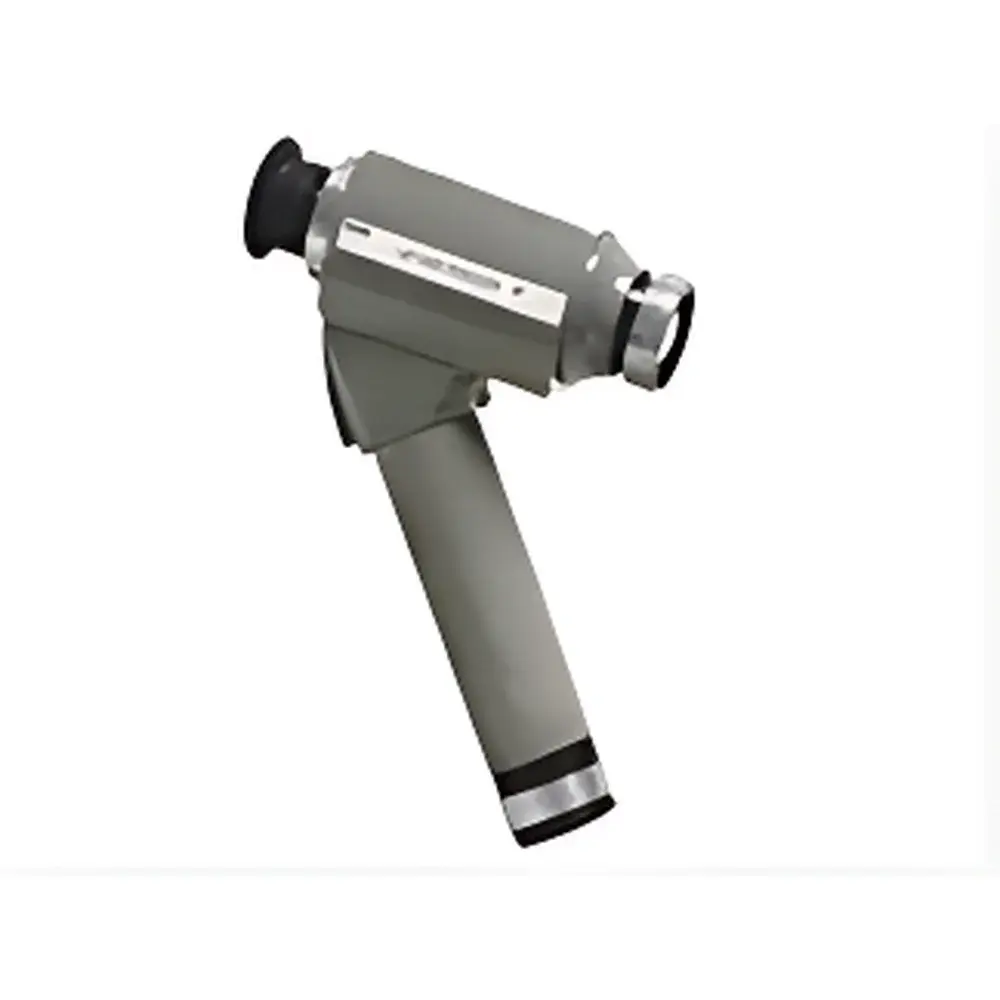
UV Observation System – NewOpto Model 85300 & 85300-5
| Key | Brand: FJW |
|---|---|
| Origin | USA |
| Distributor Type | Authorized General Distributor |
| Import Status | Imported |
| Model | NewOpto 85300 / 85300-5 |
| Spectral Range | 180–1350 nm / 180–1550 nm |
| Spectral Regions Displayed | Deep UV, Visible, Near-IR |
| Peak Sensitivity | 300 nm |
| Focal Range | 4.5″ to ∞ |
| Resolution | 50 line pairs/mm |
| Field of View | 40° |
| Magnification | ~1:1 |
| Lens | Custom Uvagon 25 mm, f/3.0, UV-grade fused silica |
Overview
The NewOpto UV Observation System (Models 85300 and 85300-5) is a high-fidelity, optically engineered visual inspection instrument designed for real-time detection and qualitative assessment of ultraviolet radiation across deep-ultraviolet (DUV), visible, and near-infrared (NIR) spectral bands. Unlike conventional fluorescence viewers or filtered CCD-based imagers, this system employs a multi-layer, broadband UV-transmissive optical path—built around UV-grade fused silica lenses and proprietary Uvagon™ coating technology—to deliver direct, eye-safe, analog visualization without electronic amplification or digital latency. Its core principle relies on phosphor-conversion optics: incident photons in the 180–1550 nm range excite a stabilized, non-hygroscopic phosphor screen that emits visible light proportional to UV intensity, enabling spatially resolved, high-contrast observation of UV-emitting sources, beam profiles, fluorescence patterns, and material defects. Engineered for laboratory, cleanroom, and field-deployable use, it supports critical workflows where temporal fidelity, spectral breadth, and operator ergonomics are prioritized over quantitative photometry.
Key Features
- Broadband Spectral Coverage: Dual-model configuration—Model 85300 covers 180–1350 nm; Model 85300-5 extends to 1550 nm—enabling unified observation of DUV laser harmonics (e.g., 266 nm, 213 nm), VIS fluorescence (400–700 nm), and NIR telecom wavelengths (1310 nm, 1550 nm).
- Optimized Optical Design: Custom Uvagon 25 mm f/3.0 lens assembly with AR-coated UV-grade fused silica elements ensures minimal chromatic aberration and >92% transmission from 190 nm through 1500 nm.
- High Spatial Fidelity: Resolves ≥50 line pairs per millimeter across the full 40° field of view, supporting precise alignment of UV optics, fiber coupling verification, and micro-scale defect localization.
- Ergonomic & Safe Operation: Fixed 1:1 magnification and adjustable focus (4.5 inches to infinity) eliminate parallax error and accommodate varied working distances—from wafer-level inspection to free-space beam profiling.
- Passive, Maintenance-Free Architecture: No batteries, power supplies, or cooling systems required; operates entirely via photon-to-phosphor conversion—ideal for Class 100 cleanrooms and ESD-sensitive environments.
Sample Compatibility & Compliance
The system is compatible with a wide range of sample geometries and emission conditions: bare semiconductor wafers, coated optical components, biological tissue sections under UV excitation, polymer films exhibiting UV-induced fluorescence, and fiber-coupled laser delivery systems. It does not require sample preparation or contrast agents. While not a calibrated radiometric instrument, its consistent phosphor response enables comparative analysis across batches and timepoints. The optical train complies with ANSI Z87.1-2020 for impact resistance and UV filtration integrity. All materials—including housing, lens mounts, and viewing screen substrate—are RoHS-compliant and certified for use in ISO 14644-1 Class 5 cleanrooms. Documentation includes traceable calibration certificates for lens transmission spectra (measured per ISO 9050) and phosphor activation thresholds (per ASTM E259-22 Annex A2).
Software & Data Management
This is a purely optical, analog observation tool—no embedded firmware, drivers, or software dependencies. However, it integrates seamlessly into regulated workflows requiring auditability: when used alongside digital documentation systems (e.g., LabArchives, Veeva Vault QMS), operators may annotate timestamped images captured via external DSLR/microscope cameras mounted on the included C-mount adapter. For GLP/GMP environments, standard operating procedures (SOPs) may reference the device’s model-specific spectral response curves (provided in NIST-traceable PDF format) to justify its suitability for specific inspection tasks—such as verifying UV LED uniformity per IEC 62471 or assessing photoresist exposure homogeneity per SEMI F20-0218. No 21 CFR Part 11 functionality is applicable, as no electronic records are generated internally.
Applications
- Laser alignment and mode profiling for excimer (193 nm, 248 nm), frequency-tripled Nd:YAG (355 nm), and supercontinuum sources
- Non-destructive inspection of UV-curable adhesives, conformal coatings, and anti-counterfeit inks
- Fluorescence-guided surgical tool verification and endoscope channel validation
- Fiber optic connector end-face inspection under 254 nm germicidal UV
- Quality control of UV-transmissive optics (CaF₂, MgF₂, synthetic quartz) and solar-blind detector windows
- Academic research in photochemistry, photocatalysis, and UV-VIS-NIR spectroscopy education labs
FAQ
Is this device suitable for quantitative irradiance measurement?
No. It provides qualitative, relative intensity visualization only. For radiometric quantification, pair with a NIST-calibrated spectroradiometer (e.g., Ocean Insight HDX or StellarNet Black-Comet).
Can it be used with pulsed UV lasers?
Yes—its phosphor persistence is <10 µs, enabling accurate observation of nanosecond-pulsed sources without image smearing, provided average power remains within EN 60825-1 Class 3B limits.
Does it require dark adaptation or ambient light shielding?
Optimal contrast is achieved in subdued ambient lighting (<50 lux); however, the high-brightness phosphor allows functional use even under typical lab overhead illumination.
What is the expected lifetime of the phosphor screen?
Rated for >10,000 hours of continuous operation at ≤10 mW/cm² broadband UV flux; degradation is gradual and linear, with output stability monitored via quarterly reference checks using a stabilized deuterium lamp.
Is OEM integration supported?
Yes—custom mounting flanges, threaded lens adapters (M25.5×0.75, M30.5×0.5), and vacuum-compatible variants (Model 85300-V) are available under FJW’s industrial OEM program.



