
UVJLY-1 UV Crosslinker
| Origin | Beijing, China |
|---|---|
| Manufacturer Type | Distributor |
| Origin Category | Domestic |
| Model | UVJLY-1 |
| Price | ¥12,800 |
| Instrument Type | Benchtop |
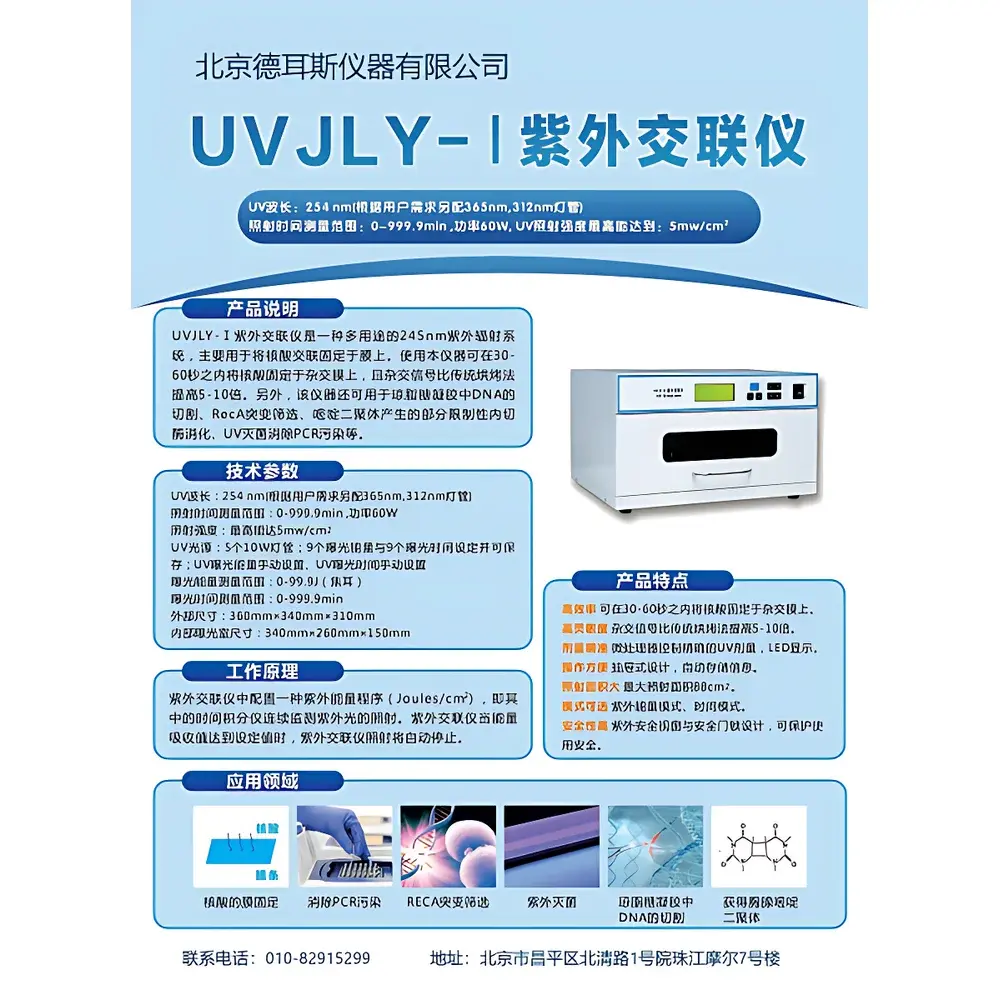
| Wavelength Options | 254 nm (standard), optional 312 nm and 365 nm |
| UV Lamp Configuration | Five 10 W low-pressure mercury lamps |
| Total Power Consumption | 60 W |
| Exposure Time Range | 0–999.9 min |
| Energy Dose Range | 0–99.99 J/cm² |
| Exposure Chamber Dimensions | 34 × 26 × 15 cm |
| External Dimensions | 36 × 34 × 31 cm |
| Display | Backlit Chinese LCD with non-volatile memory |
| Control Interface | Touch-sensitive keypad with UV-blocking viewing window |
| Chamber Material | Stainless steel |
Overview
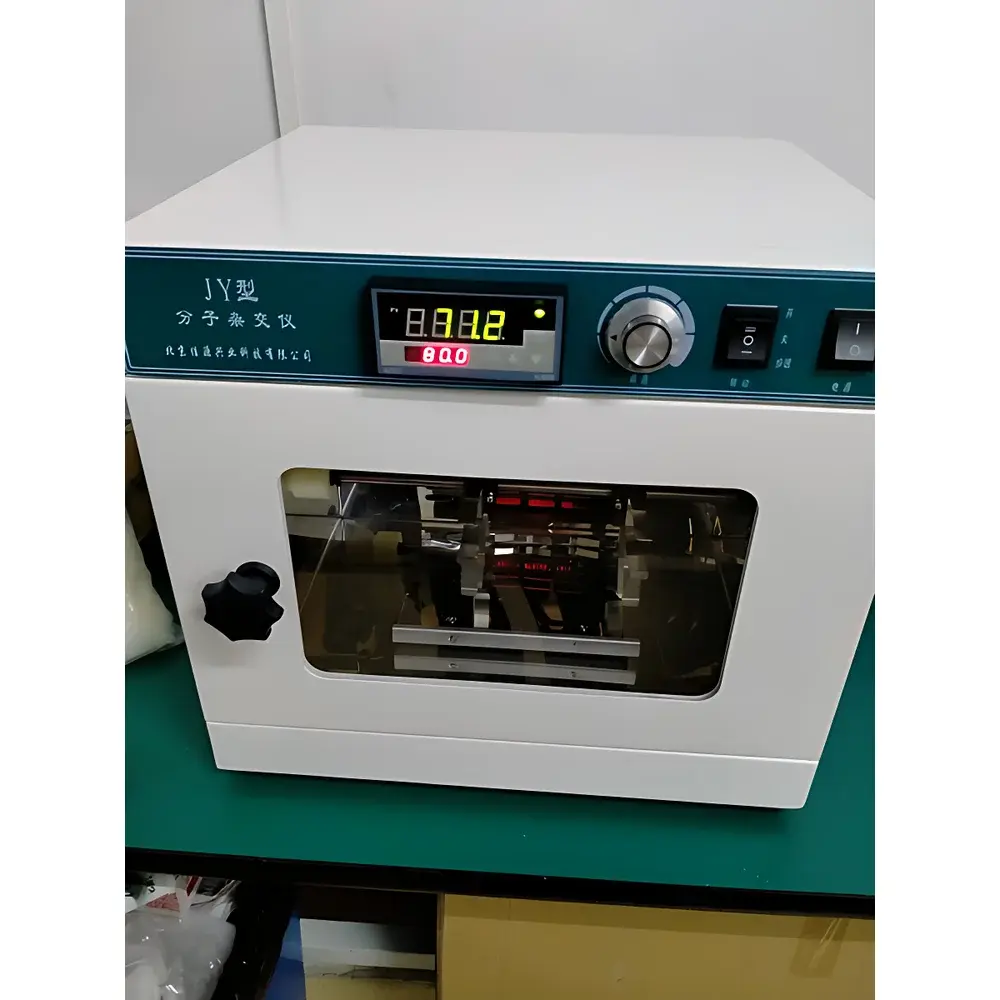
The UVJLY-1 UV Crosslinker is a benchtop ultraviolet irradiation system engineered for precise nucleic acid immobilization on solid supports—primarily nitrocellulose and nylon membranes—during molecular hybridization workflows. It operates via germicidal short-wavelength UV-C radiation at 254 nm, generated by five low-pressure mercury vapor lamps (10 W each), delivering controlled, reproducible energy doses in joules per square centimeter (J/cm²). Unlike thermal fixation methods requiring 2-hour vacuum baking at 80 °C, UV crosslinking achieves covalent bonding of DNA or RNA to membrane surfaces within seconds, significantly enhancing probe binding efficiency and signal intensity by 5–10×. The instrument’s core design principle follows the photochemical mechanism of thymine dimer formation and direct UV-induced covalent attachment between nucleic acids and amine-functionalized membrane matrices—a process widely adopted in Northern, Southern, and dot blot protocols per ISO/IEC 17025-aligned laboratory practices.
Key Features
- Programmable energy dosing: Integrated time-integrated radiometer continuously monitors real-time UV irradiance and terminates exposure automatically upon reaching user-defined energy thresholds (0–99.99 J/cm²), ensuring assay-to-assay reproducibility regardless of lamp aging or ambient temperature fluctuations.
- Dual-mode operation: Supports both time-based (0–999.9 min) and energy-based (J/cm²) exposure control, with nine preset protocols stored in non-volatile memory for rapid recall without configuration loss after power cycling.
- Optimized optical chamber: Stainless steel exposure chamber (34 × 26 × 15 cm) minimizes UV reflection losses and prevents ozone accumulation; equipped with a safety-interlocked, UV-absorbing acrylic viewing window enabling real-time sample monitoring without exposure interruption.
- Human-centered interface: Backlit Chinese-language LCD display with intuitive touch-sensitive keypad allows precise parameter entry, status feedback, and error logging—designed for routine use in GLP-compliant molecular biology labs where bilingual operator support is required.
- Modular wavelength capability: Standard 254 nm configuration meets standard nucleic acid crosslinking requirements per ASTM D7251 and USP ; optional 312 nm and 365 nm lamp sets available for alternative applications including UV-induced protein-DNA crosslinking (e.g., ChIP-seq pre-crosslinking) and fluorescent dye activation.
Sample Compatibility & Compliance
The UVJLY-1 accommodates standard Western/Northern/Southern blot membranes (up to 20 × 20 cm), mini-gels (e.g., 10 × 10 cm agarose or polyacrylamide), and custom-cut substrates placed directly on the chamber floor. Its 254 nm output conforms to IEC 62471 Photobiological Safety classification for UV-C devices and complies with occupational exposure limits defined in ACGIH TLV® guidelines. While not certified to FDA 21 CFR Part 11 out-of-the-box, audit-ready usage logs—including timestamped exposure parameters, operator ID fields (via manual entry), and energy calibration records—can be maintained externally to support GMP/GLP documentation requirements during method validation.
Software & Data Management
The UVJLY-1 operates as a standalone hardware platform with embedded firmware—no external PC or proprietary software required. All operational data (exposure duration, cumulative energy dose, selected protocol ID, start/stop timestamps) are retained in EEPROM memory across power cycles. For laboratories integrating crosslinking into validated workflows, raw exposure metadata can be manually transcribed into electronic lab notebooks (ELNs) compliant with 21 CFR Part 11 when paired with appropriate signature controls. Optional RS-232 serial output (available on request) enables basic telemetry logging to third-party LIMS systems for traceability in regulated environments.
Applications
- Nucleic acid immobilization on positively charged nylon or nitrocellulose membranes prior to hybridization (Southern/Northern blotting)
- In situ UV cleavage of DNA within agarose gels for excision of specific fragments under blue-light-safe conditions
- RecA-mediated recombination assays requiring controlled UV-induced DNA damage
- Generation of cyclobutane pyrimidine dimers (CPDs) to modulate restriction enzyme accessibility in methylation-sensitive digestion studies
- UV decontamination of PCR workstations and reusable electrophoresis combs to eliminate carryover amplicons
- Preliminary surface functionalization of polymer substrates (e.g., PDMS, polystyrene) in microfluidic device fabrication
FAQ
What is the typical energy dose required for efficient DNA-membrane crosslinking?
For most standard nylon membranes, 0.12–0.25 J/cm² at 254 nm delivers optimal signal-to-noise ratios in hybridization assays—values validated against reference protocols in Molecular Cloning: A Laboratory Manual (4th ed.).
Can the UVJLY-1 be used for RNA crosslinking?
Yes—though RNA exhibits lower UV absorption than DNA, empirical optimization (typically 0.15–0.3 J/cm²) is recommended due to increased susceptibility to strand breakage.
Is lamp replacement user-serviceable?
Yes—lamps are standardized G10q base low-pressure mercury tubes; replacement requires only screwdriver access and adherence to UV safety precautions during handling.
Does the instrument include radiometric calibration certification?
Factory calibration is performed using NIST-traceable UV-C sensors; a certificate of conformance is supplied with each unit, though periodic recalibration (annually or after 500 h of operation) is advised for ISO 17025 compliance.
How does the energy-integration system compensate for lamp output decay over time?
By measuring irradiance in real time and integrating it over exposure duration, the system inherently corrects for declining lamp intensity—ensuring consistent delivered dose independent of lamp age or voltage fluctuation.




