
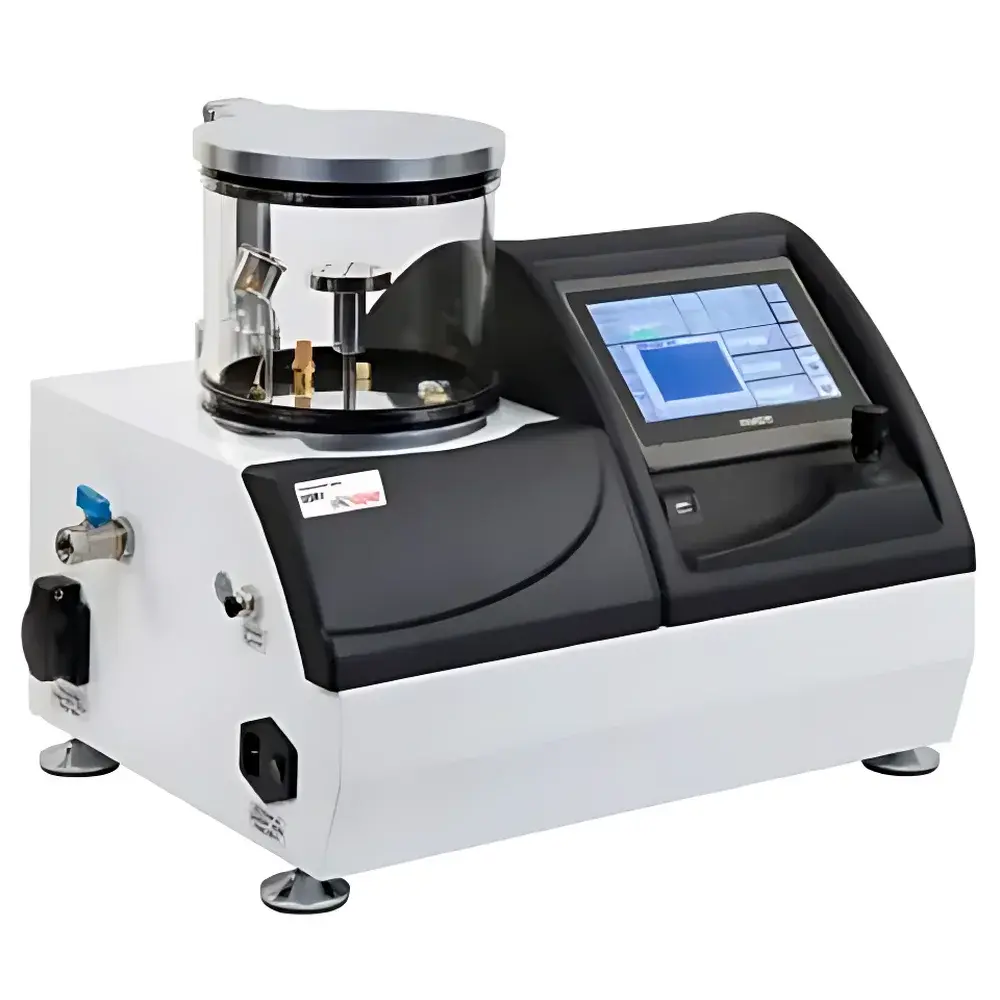
Vac Coat DSR/DST Advanced Ion Sputter Coater
| Brand | Vac Coat |
|---|---|
| Origin | United Kingdom |
| Model Series | DSR, DST |
| Control System | Fully Automatic |
| Chamber Diameter | 170 mm |
| Sputtering Gas | Argon or Compressed Air |
| Application Domain | SEM/TEM/EBSD/EDS Sample Preparation |
| Compliance Context | Designed for GLP-compliant laboratories and ISO 14644-1 Class 5 cleanroom-compatible operation |
Overview
The Vac Coat DSR and DST series are high-performance, fully automated ion sputter coaters engineered for reproducible, ultra-thin conductive film deposition on non-conductive specimens prior to electron microscopy analysis. Based on magnetron-enhanced DC glow discharge sputtering, these instruments operate under high-vacuum conditions (typically <5 × 10⁻² mbar) to generate uniform, nanoscale metallic coatings—primarily gold, gold/palladium, platinum, or chromium—without thermal damage or grain agglomeration. Developed by Vac Coat Ltd., a UK-based specialist with over three decades of expertise in physical vapor deposition (PVD), the DSR/DST platforms integrate precision vacuum architecture, real-time pressure monitoring, and programmable sputtering parameters to meet the stringent requirements of high-resolution scanning electron microscopy (SEM), transmission electron microscopy (TEM), electron backscatter diffraction (EBSD), and energy-dispersive X-ray spectroscopy (EDS) sample preparation.
Key Features
- Robust stainless-steel vacuum chamber with 170 mm internal diameter, enabling accommodation of standard 32 mm SEM stubs and multi-specimen holders
- Integrated turbomolecular pumping system backed by a diaphragm pump, achieving base pressures ≤5 × 10⁻² mbar within <90 seconds
- Programmable sputtering time (0.1–300 s), current (5–40 mA), and argon gas flow (5–50 sccm) via intuitive touchscreen interface
- Optional air-sputtering mode for rapid carbon-free conductive coating using filtered compressed air—ideal for EBSD and low-kV SEM applications
- Electromagnetically shielded target assembly with water-cooled anode and dual-target configuration (DSR) or single-target optimized geometry (DST)
- Real-time vacuum gauge feedback with automatic interlock shutdown upon pressure deviation or arcing detection
Sample Compatibility & Compliance
The DSR/DST coaters accommodate a broad range of non-conductive and beam-sensitive specimens—including biological tissues, polymers, ceramics, geological sections, and nanomaterials—without requiring pre-drying or chemical fixation beyond standard preparation protocols. Chamber geometry supports simultaneous coating of up to six 12.7 mm pin-mount samples or four 32 mm stubs. All models conform to IEC 61000-6-3 (EMC emission standards) and IEC 61000-6-2 (immunity). The control firmware supports audit trail logging and user-access levels, facilitating compliance with GLP and GMP documentation requirements. While not FDA 21 CFR Part 11-certified out-of-the-box, the system architecture permits integration with validated LIMS environments through RS-232 or Ethernet interfaces.
Software & Data Management
Vac Coat’s proprietary coating management software (v4.2+) runs on embedded Linux OS and provides full parameter logging—including timestamped sputtering cycles, chamber pressure profiles, target current/voltage traces, and gas flow history. Each session generates a CSV-formatted report compliant with ASTM E1558-22 (Standard Guide for Electron Microscopy Specimen Preparation). Exported data is compatible with common laboratory informatics systems. Optional remote diagnostics enable secure technician access for calibration verification and vacuum integrity assessment. Firmware updates are delivered via USB or network, with version-controlled release notes traceable per ISO/IEC 17025 clause 5.9.2.
Applications
- High-fidelity SEM imaging of insulating materials at accelerating voltages ≤1 kV, minimizing charging artifacts and edge enhancement
- EBSD pattern acquisition on oxide ceramics and multiphase alloys where surface conductivity must be preserved without amorphous carbon interference
- TEM grid coating for cryo-FIB lift-out support films, leveraging sub-2 nm grain size and minimal topographic roughness (Ra <0.3 nm)
- Routine quality control in semiconductor packaging labs for leadframe and mold compound inspection
- Forensic fiber and paint chip analysis requiring elemental fidelity during EDS mapping
FAQ
What sputtering gases are supported, and how does gas choice affect coating morphology?
Argon is recommended for optimal grain refinement and deposition rate control; compressed air may be used for rapid, low-cost carbon-free coating—though with slightly higher grain size and lower conductivity.
Can the DSR/DST be integrated into an automated SEM workflow?
Yes—via TTL trigger input and RS-232/Ethernet communication, enabling synchronization with stage loading sequences and microscope startup routines.
Is routine maintenance required between coating runs?
No consumables require replacement per run; however, target cleaning and chamber venting with dry nitrogen are recommended after every 50 hours of cumulative sputtering time.
Does Vac Coat provide installation qualification (IQ) and operational qualification (OQ) documentation?
Yes—standard IQ/OQ protocols aligned with ISO 13485 and ASTM F2624-21 are available upon request for regulated environments.



