
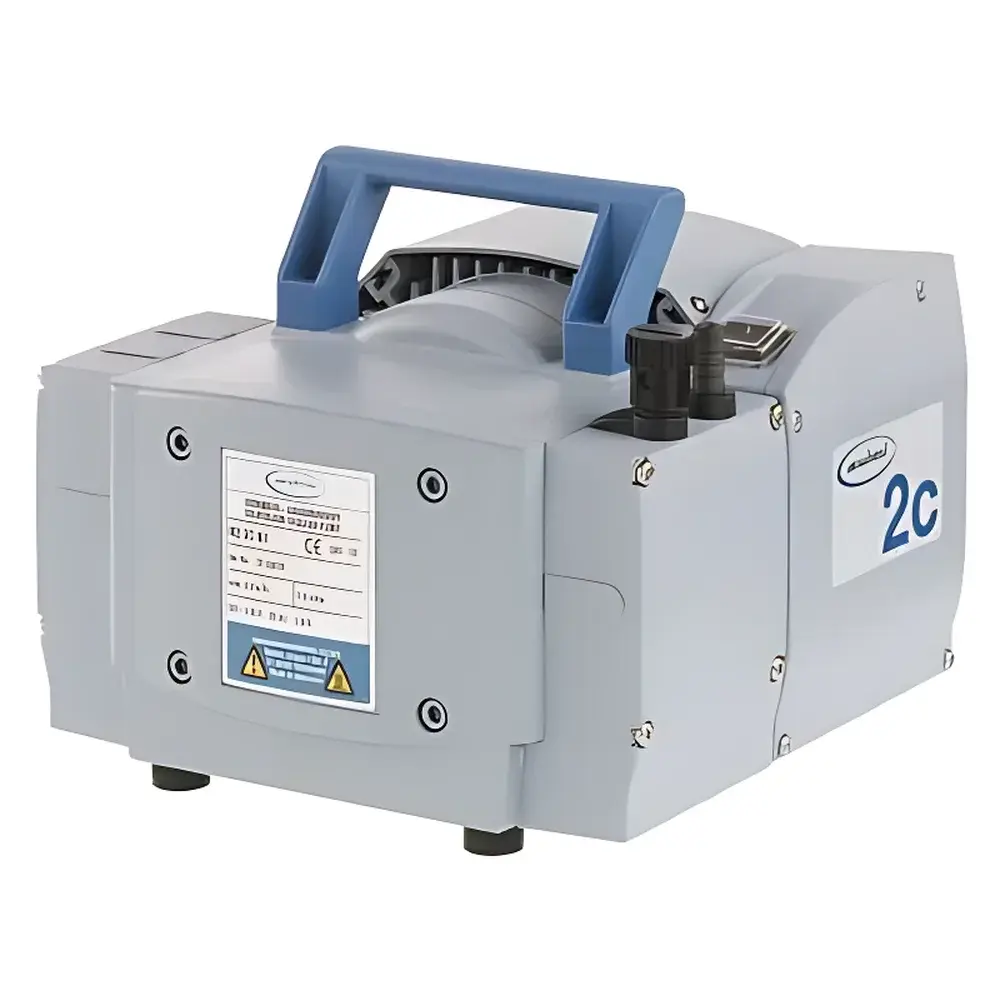
VACUUBRAND® MC 2C NT / MD 4C NT / MD 12C NT Chemical-Resistant Diaphragm Vacuum Pump
| Brand | VACUUBRAND® |
|---|---|
| Origin | Germany |
| Pump Type | Chemically Resistant Diaphragm Vacuum Pump |
| Models | MC 2C NT, MD 4C NT, MD 12C NT |
| Ultimate Vacuum | ≤ 2 mbar (abs) |
| Flow Rate | 2.0–12.0 m³/h (depending on model) |
Overview
The VACUUBRAND® MC 2C NT, MD 4C NT, and MD 12C NT series are chemically resistant, oil-free diaphragm vacuum pumps engineered for demanding laboratory and pilot-scale applications involving aggressive vapors and corrosive gases. Based on positive displacement principle via oscillating PTFE-sandwich diaphragms, these pumps generate vacuum without lubricating oil—eliminating risk of sample contamination, oil backstreaming, or hazardous waste generation. Their robust architecture integrates full chemical inertness across the entire gas path—from inlet to exhaust—including fluoropolymer-lined pump chambers, FKM or PTFE check valves, and ETFE/ECTFE tubing. Designed for continuous duty in vacuum distillation, rotary evaporation, freeze drying, solvent removal, and vacuum filtration, they deliver stable performance even under condensable vapor loads thanks to integrated gas ballast valves and thermally decoupled drive mechanisms.
Key Features
- Oil-free operation ensures zero hydrocarbon contamination—critical for analytical sample integrity and GLP/GMP-compliant workflows.
- PTFE-sandwich diaphragm construction provides exceptional resistance to acids, bases, halogenated solvents, and oxidizing agents; validated for >10,000 operating hours under typical lab conditions.
- Gas ballast valve standard on all models enables efficient handling of condensable vapors (e.g., acetone, ethanol, chloroform), preserving pumping speed and ultimate vacuum over extended use.
- Hermetically sealed drive compartment isolates motor and mechanical components from the chemically exposed pumping chamber—extending service life and reducing failure risk.
- NT-series enhancements include a low-inertia electromagnetic drive system delivering <45 dB(A) sound pressure level and sub-1 µm peak-to-peak vibration amplitude—ideal for vibration-sensitive instrumentation (e.g., mass spectrometers, optical tables).
- Modular valve assembly with tool-free access simplifies maintenance; fluoropolymer-coated pump head and clamping plate feature metal-reinforced cores for dimensional stability under thermal cycling.
- Enhanced sealing architecture reduces base leak rate to <5 × 10⁻³ mbar·L/s, enabling ultimate vacuum levels down to 2 mbar (abs) — sufficient for most solvent removal and drying protocols per ASTM D2879 and ISO 21620.
Sample Compatibility & Compliance
These pumps are compatible with a broad spectrum of organic and inorganic vapors encountered in synthetic chemistry, pharmaceutical processing, and materials science labs—including HCl, HF, NO₂, SO₂, acetic anhydride, THF, DMF, and dichloromethane. All wetted materials comply with USP Class VI and FDA 21 CFR 177.1550 for fluoropolymer contact surfaces. The absence of oil eliminates need for oil disposal per EPA 40 CFR Part 261, supporting sustainability goals. Units conform to IEC 61000-6-3 (EMC) and IEC 61000-6-2 (immunity), and meet CE marking requirements for laboratory equipment under Directive 2014/35/EU (LVD) and 2014/30/EU (EMC).
Software & Data Management
While inherently analog devices, the NT-series pumps integrate seamlessly into digitally monitored environments via optional analog 0–10 V or 4–20 mA output interfaces (available as factory-configured options). When paired with VACUUBRAND’s VARIO control modules or third-party SCADA systems, real-time status monitoring—including motor temperature, runtime hours, and fault codes—is achievable. Audit trails for maintenance events and operational parameters can be logged in accordance with FDA 21 CFR Part 11 when deployed with compliant LIMS or ELN platforms. Firmware updates (where applicable) follow controlled change management procedures aligned with ISO/IEC 17025 Clause 5.9.
Applications
- Rotary evaporation of acid-labile or oxidation-prone compounds
- Vacuum drying of hygroscopic or catalytically sensitive materials
- Concentration of biological extracts under mild vacuum to preserve thermolabile analytes
- Evacuation of glove boxes and Schlenk lines handling air-sensitive reagents
- Support vacuum for HPLC degassing, GC sample introduction, and vacuum-assisted filtration in QA/QC labs
- Pilot-scale solvent recovery systems requiring corrosion-resistant, low-maintenance vacuum sources
FAQ
Can these pumps handle hydrogen chloride (HCl) gas continuously?
Yes—wetted components are fully compatible with dry or saturated HCl vapor at ambient temperatures; however, prolonged exposure to liquid-phase HCl condensate requires optional cold trap integration.
What is the recommended maintenance interval for the NT-series pumps?
Under typical lab usage (≤8 hrs/day, non-condensing load), diaphragm replacement is advised every 12–18 months; valve inspection every 6 months. Full service kits and OEM-certified replacement parts are available globally.
Do these pumps meet ISO 8573-1 Class 0 air purity requirements?
As vacuum generators—not compressed air sources—they are not classified under ISO 8573-1; however, their oil-free design guarantees Class 0 hydrocarbon purity in the evacuated space, satisfying critical requirements for trace analysis and semiconductor R&D.
Is remote monitoring supported out-of-the-box?
Standard units operate standalone; digital monitoring requires optional analog interface modules or integration with VACUUBRAND’s VARIO controllers, which support Modbus RTU and Ethernet/IP protocols.
How does the gas ballast valve affect ultimate vacuum performance?
When open, the gas ballast introduces atmospheric air to dilute condensable vapors before compression, preventing liquefaction in the pump chamber—sacrificing ~1–2 mbar in ultimate vacuum to sustain long-term pumping speed and reliability.



