
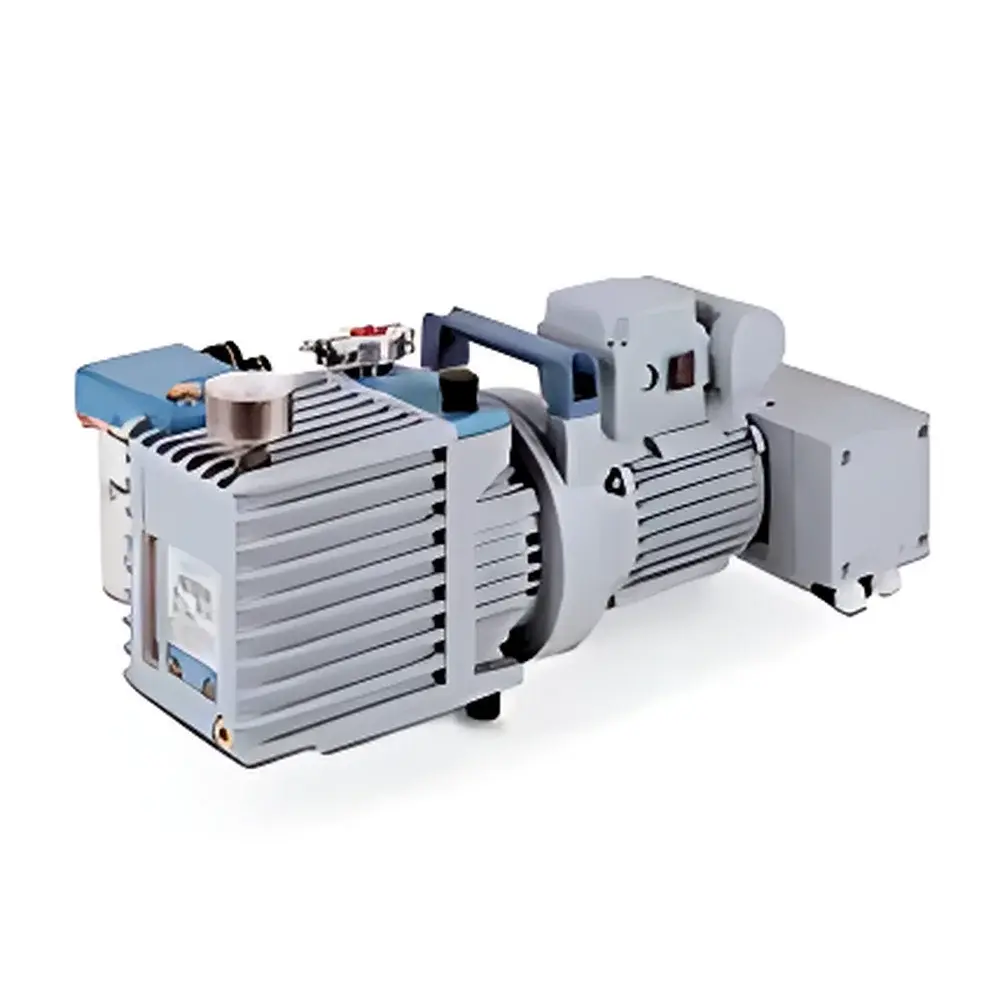
VACUUBRAND RC 6 Chemical Hybrid Vacuum Pump
| Brand | VACUUBRAND® |
|---|---|
| Origin | Germany |
| Model | RC 6 |
| Type | Oil-Free Hybrid Vacuum Pump (Dual-Stage Rotary Vane + Dual-Stage Chemical Diaphragm) |
| Max. Pumping Speed (50/60 Hz) | 5.9 / 6.9 m³/h |
| Ultimate Pressure (Absolute) | 2 × 10⁻³ mbar |
| Ultimate Partial Pressure (Absolute) | 4 × 10⁻⁴ mbar |
| Water Vapor Tolerance (with Gas Ballast) | >40 mbar |
| Motor Power | 0.37 kW |
| Noise Level (50 Hz) | 50 dBA |
| Dimensions (L×W×H) | 510 × 305 × 230 mm |
| Weight | 24.2 kg |
| Inlet | KF DN 16 |
| Outlet | Hose Nozzle DN 8–10 mm |
| Operating Temperature Range | 12–40 °C |
| IP Rating | IP 40 |
| Oil Capacity (B-type oil) | 0.34–0.53 L |
Overview
The VACUUBRAND RC 6 Chemical Hybrid Vacuum Pump is an engineered solution for laboratories requiring reliable, corrosion-resistant vacuum generation in aggressive chemical environments. Unlike conventional single-technology pumps, the RC 6 integrates two independent pumping stages in a single compact chassis: a dual-stage rotary vane pump and a dual-stage chemically resistant diaphragm pump. This hybrid architecture enables continuous operation under high solvent vapor loads—particularly during rotary evaporation, distillation, freeze drying, and vacuum filtration—without oil degradation or internal corrosion. The diaphragm stage actively maintains low partial pressure within the rotary vane oil chamber, suppressing condensation of volatile organic compounds (VOCs), acids, and halogenated solvents well below their dew points. As a result, the RC 6 delivers long-term stability in vacuum performance while minimizing oil consumption by over 90% compared to standard rotary vane pumps operating under identical conditions.
Key Features
- Hybrid dual-pump architecture: Combines the high ultimate vacuum capability of a dual-stage rotary vane pump with the chemical inertness and vapor-handling robustness of a dual-stage PTFE-coated diaphragm pump.
- Reduced oil consumption and extended service intervals: Diaphragm-assisted oil chamber vacuum control suppresses solvent condensation, preserving oil integrity and reducing maintenance frequency.
- Integrated gas ballast system: Enables stable operation in the presence of water vapor and other condensable vapors; water vapor tolerance exceeds 40 mbar when activated.
- Mirror-tube modular design: Facilitates rapid access to critical components—including diaphragms, valves, and oil reservoir—without disassembling the full pump housing.
- Low-noise, energy-efficient motor: 0.37 kW IE2-class motor operating at 1500 rpm (50 Hz) or 1800 rpm (60 Hz), compliant with IEC 60034 standards and rated IP 40 for laboratory ambient protection.
- Pre-filled and ready-to-operate: Supplied with 0.5 L of VACUUBRAND B-type synthetic vacuum oil; requires no initial oiling prior to first use.
Sample Compatibility & Compliance
The RC 6 is validated for continuous duty with common laboratory solvents including acetone, methanol, dichloromethane, ethyl acetate, and hydrochloric acid vapors (at low concentrations). Its PTFE-sealed diaphragm head, stainless-steel valve plates, and chemically stabilized pump oil ensure compatibility with moderately aggressive media per ISO 8573-1 Class 4 air purity requirements. While not certified for explosive atmospheres (ATEX), the pump conforms to EN 61000-6-3 (EMC emission) and EN 61000-6-2 (immunity) standards. It supports GLP-compliant workflows through traceable maintenance logs and optional vacuum regulation packages (e.g., Paket Feinvakuumregelung KF DN 16, Art. No. 683201), enabling reproducible setpoint control across multiple users and instruments.
Software & Data Management
The RC 6 operates as a standalone analog vacuum source and does not include embedded digital controllers or firmware. However, it is fully compatible with external vacuum monitoring and regulation systems via its standardized KF DN 16 inlet and hose nozzle outlet. When integrated with VACUUBRAND’s PC 8 vacuum system or third-party pressure transducers (e.g., capacitance manometers), it supports real-time vacuum logging, automated process sequencing, and audit-trail generation in accordance with FDA 21 CFR Part 11 requirements—provided the host system implements electronic signature, data integrity, and change-control protocols. Optional accessories such as the RC oil mist filter (Art. No. 640187) and fine vacuum regulation kit enable compliance with ISO 27425 and ASTM D3924 specifications for analytical vacuum applications.
Applications
- Routine rotary evaporation of acid-sensitive or halogenated samples where oil contamination must be avoided.
- Vacuum concentration of biological extracts containing volatile organic acids or phenolic compounds.
- High-throughput solvent recovery setups using the PC 8 cold trap kit (Art. No. 699949), achieving >92% condensate capture efficiency at −20 °C.
- Long-duration vacuum drying of polymer precursors exposed to residual moisture or monomer vapors.
- Support vacuum for glovebox antechambers where hydrocarbon-free exhaust is required for inert atmosphere integrity.
- Backup or primary vacuum for mass spectrometry sample introduction lines handling thermally labile analytes.
FAQ
Is the RC 6 suitable for continuous operation with concentrated HCl or HF vapors?
No. While the RC 6 handles low-concentration acidic vapors encountered in standard rotary evaporation, it is not rated for sustained exposure to concentrated hydrogen chloride or hydrofluoric acid. For such applications, a fully fluoropolymer-lined dry scroll or turbomolecular system is recommended.
Can the RC 6 be used without the gas ballast valve?
Yes, but only in low-vapor-load conditions (e.g., rough vacuum for degassing). Continuous operation without gas ballast under high solvent load will accelerate oil oxidation and reduce ultimate vacuum performance.
What is the expected service life of the diaphragm modules under typical lab usage?
With proper maintenance and operation within specified temperature and vapor limits, PTFE diaphragms typically last 6,000–8,000 operating hours—approximately 18–24 months in a standard 8-hr/day academic lab environment.
Does the RC 6 meet ISO 8573-1 Class 0 for oil-free air?
No. Although the diaphragm stage is oil-free, the rotary vane stage uses synthetic oil; therefore, the RC 6 is classified as “oil-lubricated with oil vapor suppression,” meeting ISO 8573-1 Class 3 for total oil content (≤0.1 mg/m³) when equipped with the optional oil mist filter.
Is remote start/stop or analog signal control available?
Not natively. The RC 6 lacks built-in communication interfaces. Integration with programmable logic controllers (PLCs) or LabVIEW systems requires external relays and pressure feedback sensors.



