
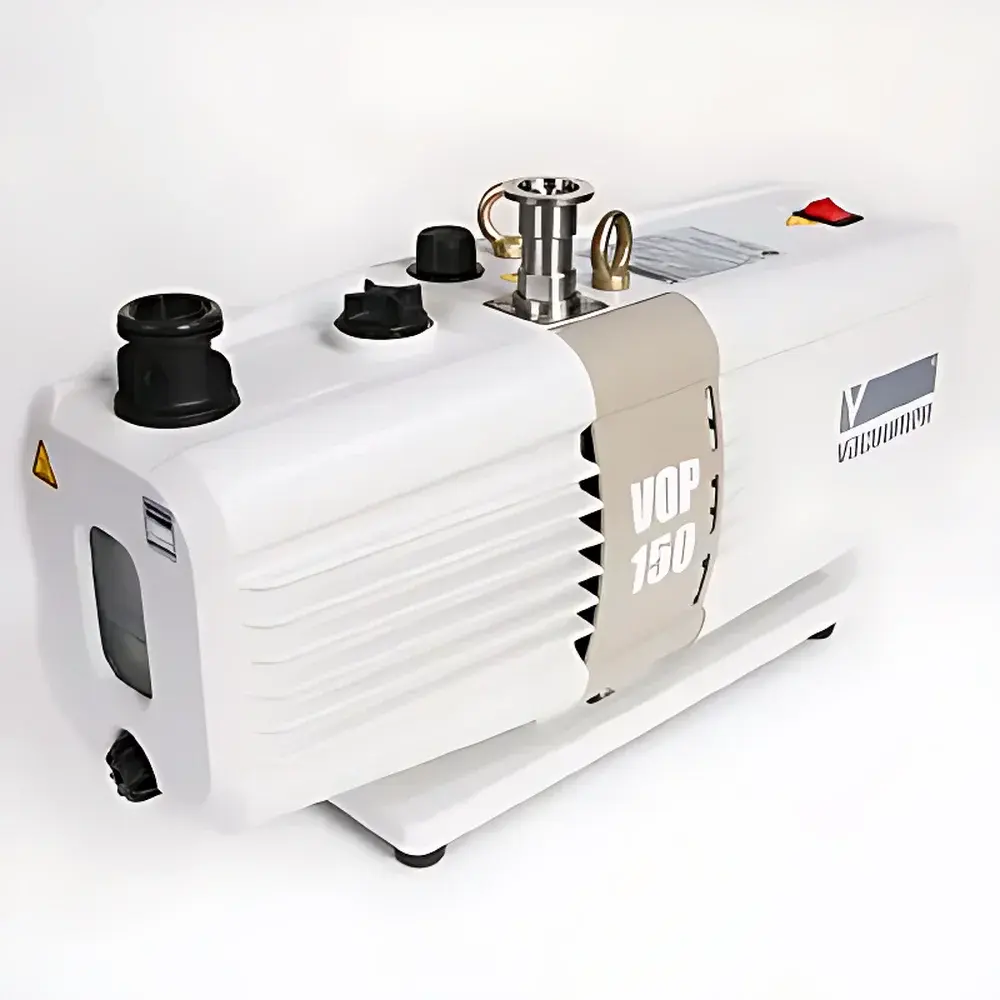
Vacuumer VOP 150 Direct-Drive Rotary Vane Vacuum Pump
| Brand | Vacuumer |
|---|---|
| Origin | South Korea |
| Pump Type | Oil-Lubricated Rotary Vane |
| Model | VOP 150 |
| Motor | Single-phase 220 V, 550 W, 4-pole |
| Speed (50/60 Hz) | 1430 / 1730 rpm |
| Pumping Speed | 170 / 200 L/min |
| Ultimate Vacuum Pressure | 6.7 × 10⁻² Pa (with gas ballast open: 6.7 × 10⁻¹ Pa) |
| Oil Capacity | 1000 mL |
| Recommended Oil | COSMA-100 |
| Suction Port | NW25 |
| Operating Temperature Range | 7–40 °C |
| Dimensions (W × L × H) | 189 × 504 × 253 mm |
| Weight | 28.5 kg |
| Built-in Features | Thermal overload protection, gas ballast valve, anti-backflow check valve, forced oil circulation cooling system |
Overview
The Vacuumer VOP 150 is a direct-drive, oil-lubricated rotary vane vacuum pump engineered for stable, continuous operation in demanding laboratory and light industrial environments. Based on the proven principles of positive displacement via rotating vanes within an eccentrically mounted rotor, the VOP 150 achieves high volumetric efficiency and consistent ultimate vacuum performance. Its design emphasizes mechanical robustness, thermal stability, and operational safety—critical attributes when supporting time-sensitive or contamination-sensitive processes such as solvent removal, freeze-drying, thin-film deposition, and vacuum-assisted analytical sample preparation. Unlike belt-driven alternatives, the direct-coupled motor eliminates slippage, reduces maintenance intervals, and improves long-term speed fidelity across both 50 Hz and 60 Hz power systems.
Key Features
- Direct-coupled induction motor (550 W, 4-pole) ensures precise rotational synchronization and minimizes energy loss.
- Integrated gas ballast valve enables controlled admission of atmospheric air during pumping of condensable vapors—reducing oil contamination and extending service life in applications involving solvents or moisture.
- Built-in non-return (anti-backflow) valve prevents reverse rotation and oil backstreaming upon shutdown, protecting downstream vacuum chambers and instrumentation.
- Forced oil circulation cooling system maintains optimal operating temperature under sustained load, enhancing bearing longevity and dimensional stability of internal clearances.
- Thermal overload protection circuit automatically de-energizes the motor if winding temperature exceeds safe thresholds, complying with IEC 60034-11 safety standards.
- Low-vibration mounting base and precision-balanced rotor assembly contribute to sound pressure levels below 62 dB(A) at 1 m—suitable for shared lab spaces requiring acoustic discretion.
Sample Compatibility & Compliance
The VOP 150 is compatible with standard ISO-KF (NW25) vacuum fittings and integrates seamlessly with common laboratory vacuum systems including vacuum ovens, lyophilizers, mass spectrometers, electron microscopes, and PVD/CVD deposition chambers. It meets electromagnetic compatibility requirements per EN 61326-1 (laboratory equipment) and conforms to RoHS Directive 2011/65/EU. While not certified for ATEX or IECEx hazardous area use, its oil-sealed architecture complies with ISO 21360-1 for base pressure verification methodology and supports GLP-aligned documentation protocols when paired with validated vacuum gauges and loggers.
Software & Data Management
As a standalone mechanical vacuum source, the VOP 150 does not incorporate embedded digital controls or communication interfaces. However, it is fully compatible with external vacuum monitoring systems—including capacitance manometers, Pirani gauges, and PLC-based supervisory controllers—that support analog (0–10 V or 4–20 mA) or digital (RS-485 Modbus RTU) output. When deployed in regulated environments (e.g., pharmaceutical R&D or contract manufacturing), users may integrate the pump into electronic batch records using third-party SCADA platforms that enforce audit trails per FDA 21 CFR Part 11 requirements.
Applications
- Primary vacuum source for benchtop and mid-scale vacuum drying ovens used in polymer characterization, catalyst activation, and residual solvent analysis.
- Backing pump for turbomolecular and diffusion pumps in surface science laboratories performing XPS or AES.
- Vacuum generation for freeze-dryers in biopharmaceutical process development where reproducible sublimation kinetics depend on stable base pressure.
- Process vacuum supply in R&D-scale physical vapor deposition (PVD) systems for optical coating, MEMS fabrication, and metallization studies.
- Evacuation of gas chromatography sample introduction lines and purge-and-trap concentrators where hydrocarbon-free foreline conditions are maintained via periodic oil changes and gas ballast use.
FAQ
What type of vacuum oil is recommended for the VOP 150?
COSMA-100 synthetic mineral oil is specified by Vacuumer for optimal viscosity index, oxidation resistance, and vapor pressure characteristics. Substitution with non-approved oils may compromise ultimate vacuum performance and void warranty coverage.
Can the VOP 150 operate continuously for 24/7 duty cycles?
Yes—provided ambient temperature remains within 7–40 °C, oil level is maintained at the designated mark, and gas ballast is engaged during vapor-laden operation. Routine oil replacement every 500–1000 operating hours is advised for sustained reliability.
Is the VOP 150 suitable for pumping corrosive gases?
No. The standard VOP 150 is not constructed with corrosion-resistant materials (e.g., stainless steel internals or fluoropolymer coatings) and is not rated for chlorine, ammonia, or acidic vapors. For such applications, consult Vacuumer’s chemically resistant pump variants.
Does the pump include a vacuum gauge or pressure readout?
No. The VOP 150 is a mechanical vacuum source only. Accurate pressure measurement requires integration with an externally mounted vacuum gauge calibrated per ISO 20487 or ASTM E1809 standards.
How often should the oil be changed under typical lab usage?
Under normal operation with non-condensable loads, oil change intervals range from 500 to 1000 hours. In high-moisture or solvent-rich environments, oil inspection and replacement should occur every 200–300 hours—or whenever discoloration, emulsification, or increased noise is observed.



