
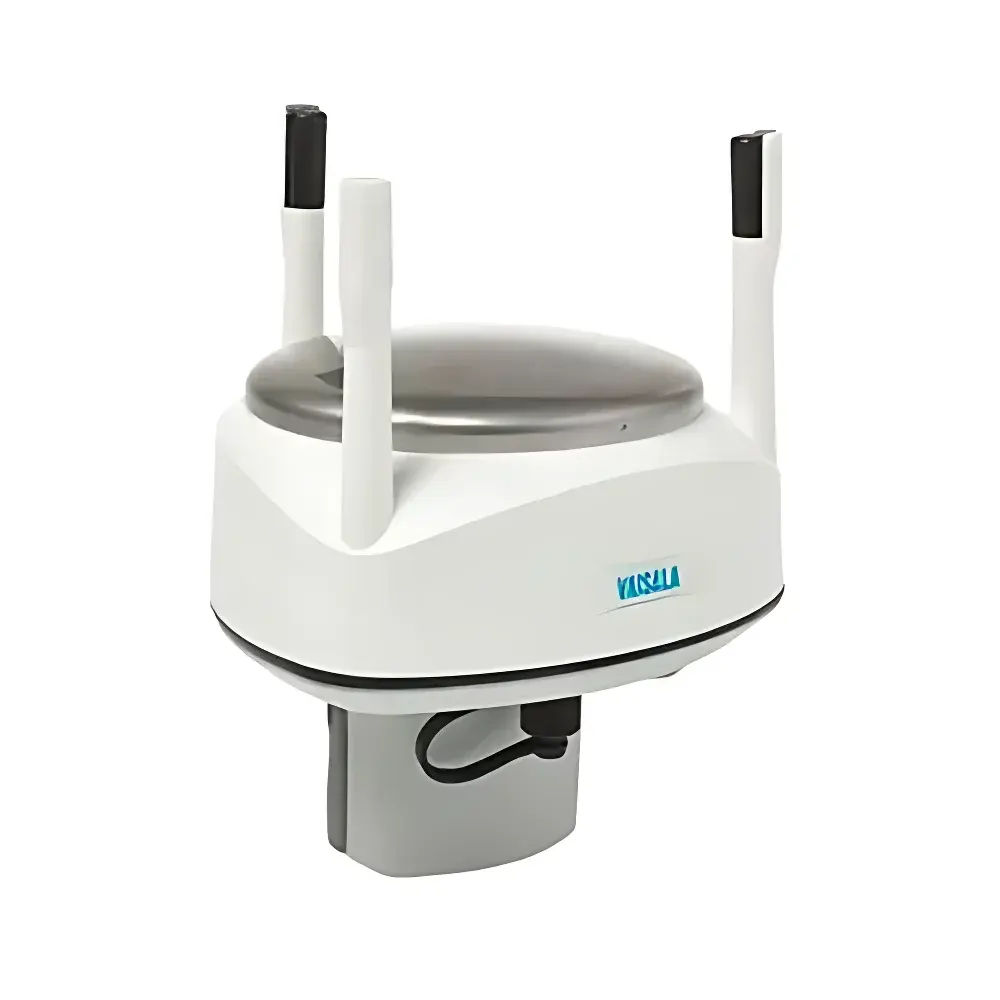
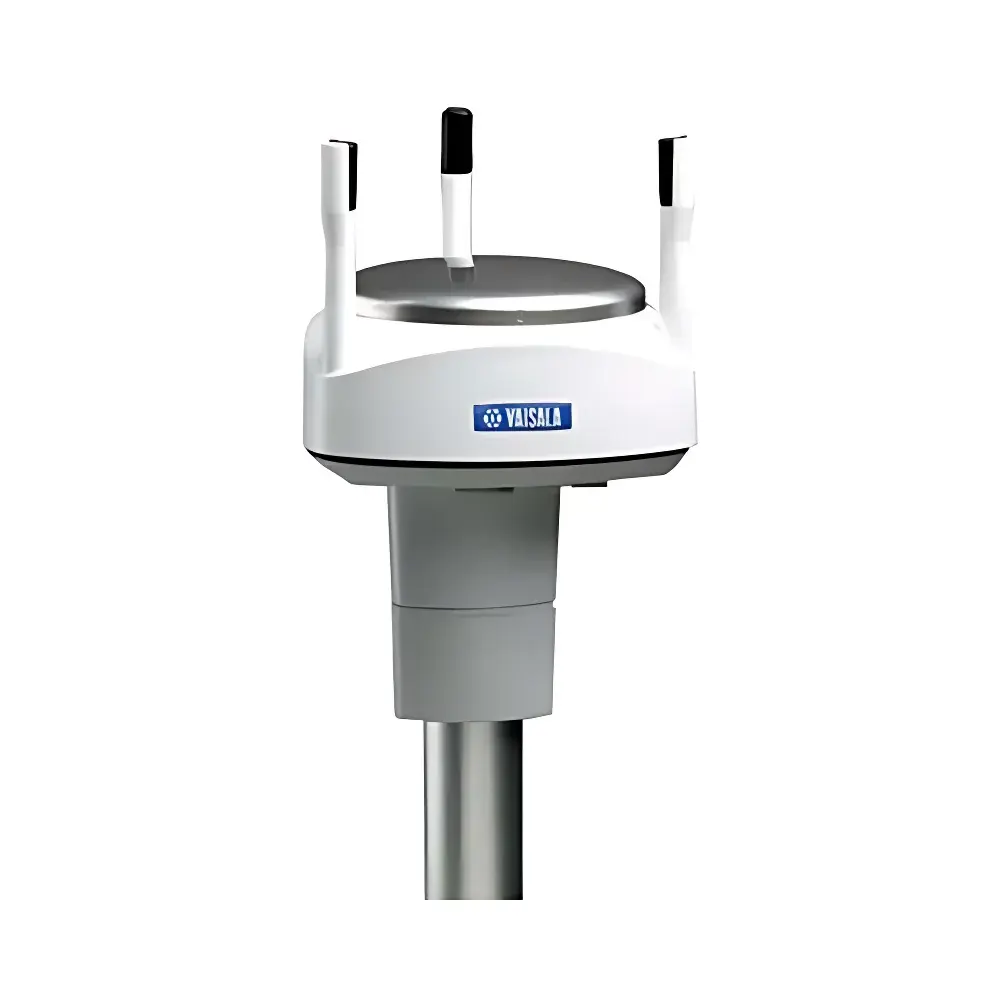
Vaisala WXT533 Ultrasonic Weather Transmitter
| Brand | Vaisala |
|---|---|
| Origin | Finland |
| Model | WXT533 |
| Instrument Type | Portable Weather Station |
| Enclosure Rating | IP65 (without mounting adapter), IP66 (with mounting adapter) |
| Operating Temperature | -52 to +60 °C |
| Storage Temperature | -60 to +70 °C |
| Power Supply | 6–24 VDC |
| Typical Current Consumption | 3 mA @ 12 VDC |
| Heating Option | 12–24 VDC / 12–17 VAC, 0.8 A @ 12 VDC |
| Wind Speed Range | 0–60 m/s |
| Wind Speed Accuracy | ±3% @ 10 m/s |
| Wind Speed Resolution | 0.1 m/s |
| Wind Direction Range | 0–360° |
| Wind Direction Accuracy | ±3° @ 10 m/s |
| Wind Direction Resolution | 1° |
| Rainfall Measurement Principle | Ultrasonic (RAINCAP®) |
| Rainfall Accumulation Range | 0–200 mm/h |
| Rainfall Accuracy | ±5% (weather-dependent) |
| Rainfall Resolution | 0.01 mm |
| Rain Event Duration Resolution | 10 s |
| Output Options | SDI-12 v1.3, RS-232, RS-485, RS-422 |
| Communication Protocols | SDI-12, ASCII Polling/Automatic, NMEA 0183 v3.0 |
| Analog Outputs | Optional current (4–20 mA) or voltage (0–1/5/10 V) for wind speed/direction |
Overview
The Vaisala WXT533 Ultrasonic Weather Transmitter is a compact, low-power, maintenance-free environmental monitoring instrument engineered for continuous, high-reliability measurement of three core meteorological parameters: wind speed, wind direction, and precipitation. Unlike traditional mechanical anemometers and tipping-bucket rain gauges, the WXT533 employs solid-state ultrasonic sensing technology—Vaisala’s proprietary WINDCAP® and RAINCAP® modules—to eliminate moving parts, mechanical wear, and common failure modes such as clogging, freezing, evaporation loss, or overflow. Its measurement architecture is based on time-of-flight ultrasonic transit analysis for wind vector determination and acoustic resonance detection for raindrop impact quantification. Designed for deployment in demanding outdoor environments—from remote field stations and transportation infrastructure to industrial process monitoring and smart city networks—the WXT533 operates across an extended temperature range (–52 °C to +60 °C) and meets stringent ingress protection standards (IP65/IP66). As a member of the modular WXT530 series, it shares firmware compatibility, communication flexibility, and system integration capabilities with its siblings, enabling seamless scalability within heterogeneous sensor networks.
Key Features
- Ultrasonic wind sensing: Dual-axis WINDCAP® transducer array provides simultaneous, contactless measurement of horizontal wind speed (0–60 m/s) and direction (0–360°) with <0.25 s response time and no moving parts.
- Acoustic rainfall detection: RAINCAP® technology measures precipitation accumulation (0–200 mm/h) and event duration without mechanical components—immune to undercatch, splashing, or evaporation artifacts inherent in tipping-bucket designs.
- Low-power architecture: Typical operating current of only 3 mA at 12 VDC supports long-term solar-powered deployments; standby consumption drops to 0.1 mA in SDI-12 sleep mode.
- Integrated heating option: Optional heater (12–24 VDC / 12–17 VAC) prevents snow/ice accumulation on transducers, ensuring operational continuity in sub-zero conditions.
- Multi-protocol digital interface: Native support for SDI-12 v1.3, RS-232, RS-485, and RS-422 enables direct integration with data loggers, SCADA systems, and IoT gateways.
- Industrial-grade analog outputs: Configurable 4–20 mA or 0–1/5/10 V outputs for wind speed and direction facilitate connection to PLCs and legacy control systems without signal conditioning.
- Modular ecosystem compatibility: Firmware and physical mounting are fully compatible with other WXT530-series sensors (e.g., PTU modules for pressure/temperature/humidity), allowing mixed-parameter station configurations.
Sample Compatibility & Compliance
The WXT533 is certified to meet IEC 60945 maritime environmental requirements, confirming robustness against salt mist, vibration, and wide thermal cycling. Its IP65 (unmounted) / IP66 (mounted) enclosure rating ensures protection against dust ingress and powerful water jets, making it suitable for unsheltered outdoor installation. While the WXT533 itself does not measure pressure, temperature, or humidity, its design allows integration with third-party analog sensors via built-in ADC channels—enabling full meteorological parameter aggregation without external signal conditioning hardware. The device complies with electromagnetic compatibility standards per EN 61326-1 (industrial environment) and is CE-marked. For applications requiring regulatory traceability (e.g., environmental reporting under EU Directive 2008/50/EC or EPA Method 21), the WXT533 supports timestamped, protocol-structured output with configurable averaging intervals—facilitating audit-ready data export.
Software & Data Management
Vaisala provides free configuration and diagnostic software (Vaisala Insight PC Suite) supporting real-time parameter monitoring, firmware updates, calibration verification, and custom output scheduling. All communication protocols—including SDI-12 and NMEA 0183 v3.0—deliver ASCII-formatted, human-readable data strings with embedded timestamps, checksums, and status flags. The device supports both polled and autonomous transmission modes, with user-defined intervals (1 s to 1 h) for each measured variable. For compliance-critical deployments, raw sensor outputs can be logged with millisecond-level timing precision. Though the WXT533 does not include onboard storage or GLP/GMP audit-trail functionality, its deterministic output structure and stable serial framing enable straightforward integration with validated data acquisition platforms compliant with FDA 21 CFR Part 11 when paired with appropriate middleware and metadata logging.
Applications
- Transportation safety monitoring: Real-time wind and precipitation data for highway avalanche warning systems, bridge sway mitigation, and airport runway condition assessment.
- Renewable energy site assessment: Long-term wind resource characterization for small-scale turbine feasibility studies and microgrid planning.
- Environmental compliance networks: Distributed air quality and weather co-monitoring nodes satisfying EPA, EEA, or national ambient air monitoring program (NAAQS) auxiliary meteorological requirements.
- Industrial process environmental controls: Ventilation optimization, stack emission correction, and outdoor material handling safety triggers based on wind-driven particulate dispersion risk.
- Educational and research fieldwork: Low-cost, rugged platform for undergraduate atmospheric science labs, citizen science initiatives, and ecological microclimate studies.
- Smart infrastructure telemetry: Integration into municipal IoT platforms for flood early warning, urban heat island mapping, and adaptive streetlight control logic.
FAQ
Does the WXT533 require periodic recalibration?
No routine field recalibration is required. Vaisala calibrates all WXT530-series sensors at the factory using traceable metrological standards. Long-term stability is ensured by drift-compensated ultrasonic transducers and sealed capacitive PTU modules. Field verification can be performed using known reference conditions or cross-comparison with co-located instruments.
Can the WXT533 operate without external power during winter?
Yes—when equipped with the optional heater and powered by a sufficiently sized battery bank or solar-charged system, the WXT533 maintains operation down to –52 °C. Heater duty cycle should be configured to balance ice prevention with energy budget constraints.
Is analog output available for rainfall measurement?
No. Rainfall is reported digitally only (SDI-12, RS-232, etc.) as cumulative depth (mm), intensity (mm/h), and event duration (s). Wind speed and direction are the only parameters supported on analog output channels.
How does RAINCAP® handle light drizzle versus heavy downpour?
RAINCAP® uses adaptive acoustic signal processing to distinguish between individual drop impacts and continuous sheet flow. It applies dynamic thresholding and pulse-width discrimination to maintain ±5% accuracy across intensities from 0.01 mm/h to 200 mm/h, validated per WMO Guide to Meteorological Instruments and Methods of Observation (CIMO Guide).
Related Products







