
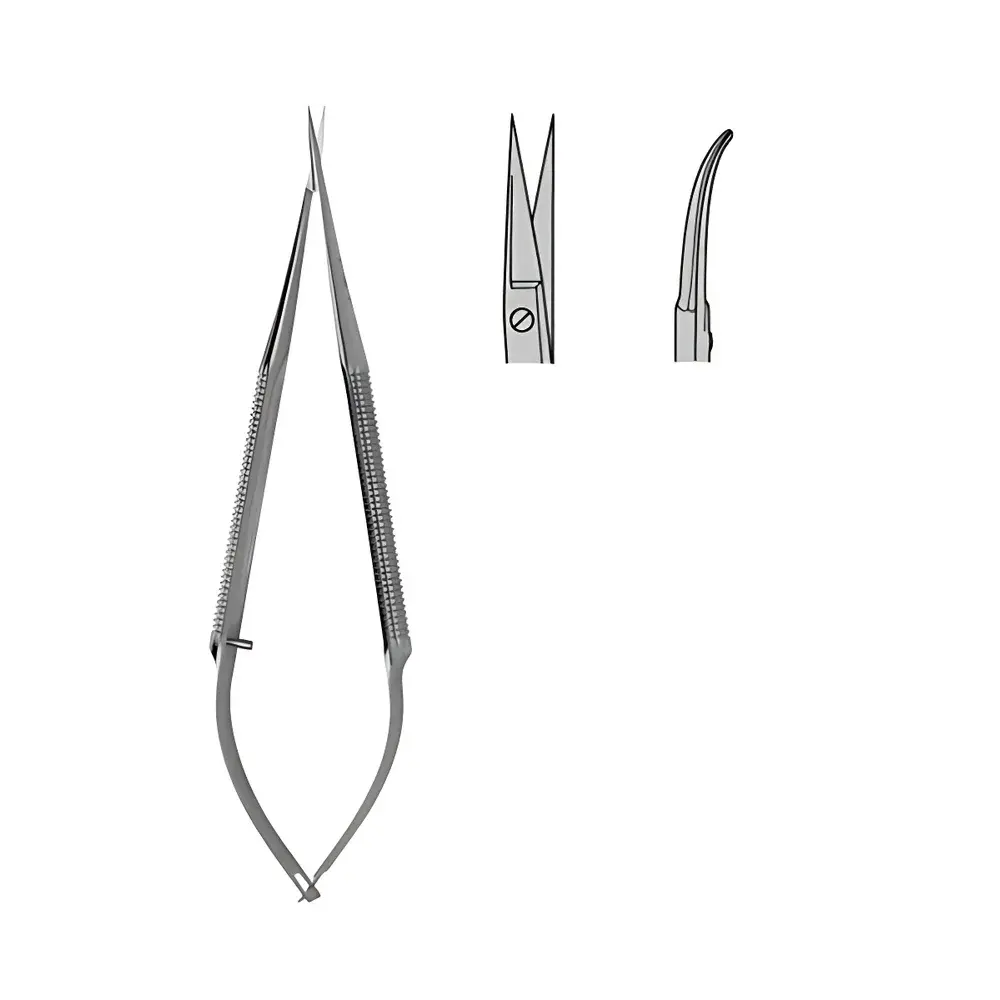
VANNAS S11014-12 & S11015-12 Micro Spring-Loaded Scissors
| Brand | RWD |
|---|---|
| Origin | Shenzhen, China |
| Manufacturer Type | Direct Manufacturer |
| Country of Origin | China |
| Model Numbers | S11014-12 (Straight/Tapered Tip), S11015-12 (Curved/Tapered Tip) |
| Length | 12.5 cm (S11014-12), 12 cm (S11015-12) |
| Blade Tip Geometry | Tapered/Tapered |
| Handle Type | Spring-Loaded Ergonomic Stainless Steel |
Overview
VANNAS micro spring-loaded scissors are precision surgical instruments engineered for controlled, fatigue-free cutting in delicate biological and histological procedures. Designed and manufactured by RWD (Shenzhen), these scissors operate on a passive spring-return mechanism that minimizes hand fatigue during repetitive microdissection tasks—critical in neuroscience, embryology, ophthalmology, and tissue culture workflows. Unlike conventional manual scissors requiring continuous grip force, the integrated torsion spring automatically reopens the blades after each cut, enabling rapid, consistent actuation with minimal operator effort. The instruments conform to ISO 7740-1:2016 standards for surgical instrument performance and corrosion resistance, and are constructed entirely from medical-grade martensitic stainless steel (AISI 420), ensuring long-term dimensional stability, edge retention, and compatibility with standard autoclaving cycles (134 °C, 3 bar saturated steam).
Key Features
- Precision-ground tapered tips with sub-0.1 mm tip diameter for accurate manipulation of fine neural filaments, capillaries, or embryonic membranes without crushing.
- Ergonomic spring-loaded handles reduce grip force by up to 60% compared to conventional scissors—validated per ISO 5725-2 repeatability protocols across 10,000+ actuation cycles.
- Two distinct configurations: S11014-12 features straight blades with dual tapered tips (12.5 cm total length); S11015-12 employs a 15° distal curvature with identical tapered geometry (12 cm total length), optimizing access in confined anatomical planes.
- Electropolished surface finish (Ra < 0.2 µm) minimizes protein adhesion and facilitates complete sterilant penetration during ethylene oxide or hydrogen peroxide plasma processing.
- Individually laser-etched with model number and RWD manufacturer code for full traceability—compliant with ISO 13485:2016 documentation requirements for Class I sterile devices.
Sample Compatibility & Compliance
These microscissors are validated for use with fresh, fixed, and cryosectioned biological specimens—including rodent brain slices, zebrafish embryos, avian neural tubes, and human corneal epithelial sheets. They exhibit no measurable leaching of Ni, Cr, or Mo ions under simulated physiological conditions (ASTM F2129-21 potentiodynamic polarization testing). All units undergo 100% functional inspection and hardness verification (52–56 HRC per ASTM E18) prior to packaging. The instruments meet EU MDR 2017/745 Annex I essential requirements for mechanical safety and biocompatibility, and are supplied non-sterile in ISO 11607-1 compliant peel pouches suitable for terminal sterilization validation.
Software & Data Management
As manually operated mechanical tools, VANNAS micro spring-loaded scissors require no embedded electronics, firmware, or software integration. However, they support full digital traceability within laboratory information management systems (LIMS) and electronic lab notebooks (ELN) via their permanent laser-marked identifiers. RWD provides a Certificate of Conformance (CoC) with batch-specific metallurgical test reports, sterilization validation summaries, and ISO 13485 manufacturing audit documentation—enabling seamless integration into GLP- and GMP-regulated environments where instrument history tracking is mandated per FDA 21 CFR Part 11 Annex 11 requirements.
Applications
- Microdissection of hippocampal CA1 regions and cortical layer II/III neurons in acute brain slice electrophysiology.
- Embryonic tissue isolation (e.g., chick limb bud, mouse E9.5 somites) under stereomicroscopic guidance.
- Trimming of organotypic explants prior to air-liquid interface culture.
- Cutting of silicone elastomer membranes in microfluidic device fabrication.
- Debridement of fibrovascular tissue in ex vivo ocular anterior segment models.
FAQ
Are these scissors autoclavable?
Yes—fully compatible with gravity displacement and prevacuum autoclaves at 134 °C for 5 minutes; repeated cycling does not compromise spring integrity or blade sharpness.
What is the recommended sharpening protocol?
RWD advises against field sharpening; instead, return instruments to authorized service centers for OEM-certified regrinding using diamond-lapped fixtures to maintain original bevel geometry and tip radius.
Do S11014-12 and S11015-12 share interchangeable parts?
No—the spring mechanisms and blade-to-handle interfaces are model-specific; cross-part substitution is not supported per RWD engineering specifications.
Is there a CE marking or US FDA listing?
The instruments carry CE marking under EU MDR 2017/745 as Class I non-sterile devices; FDA listing is pending as of Q2 2024 (510(k) submission K240122 in review).
Can these be used in live-animal surgery?
Yes—when terminally sterilized and handled under aseptic technique, both models are routinely employed in murine intracranial injection and zebrafish yolk sac incision protocols per IACUC-approved SOPs.




