
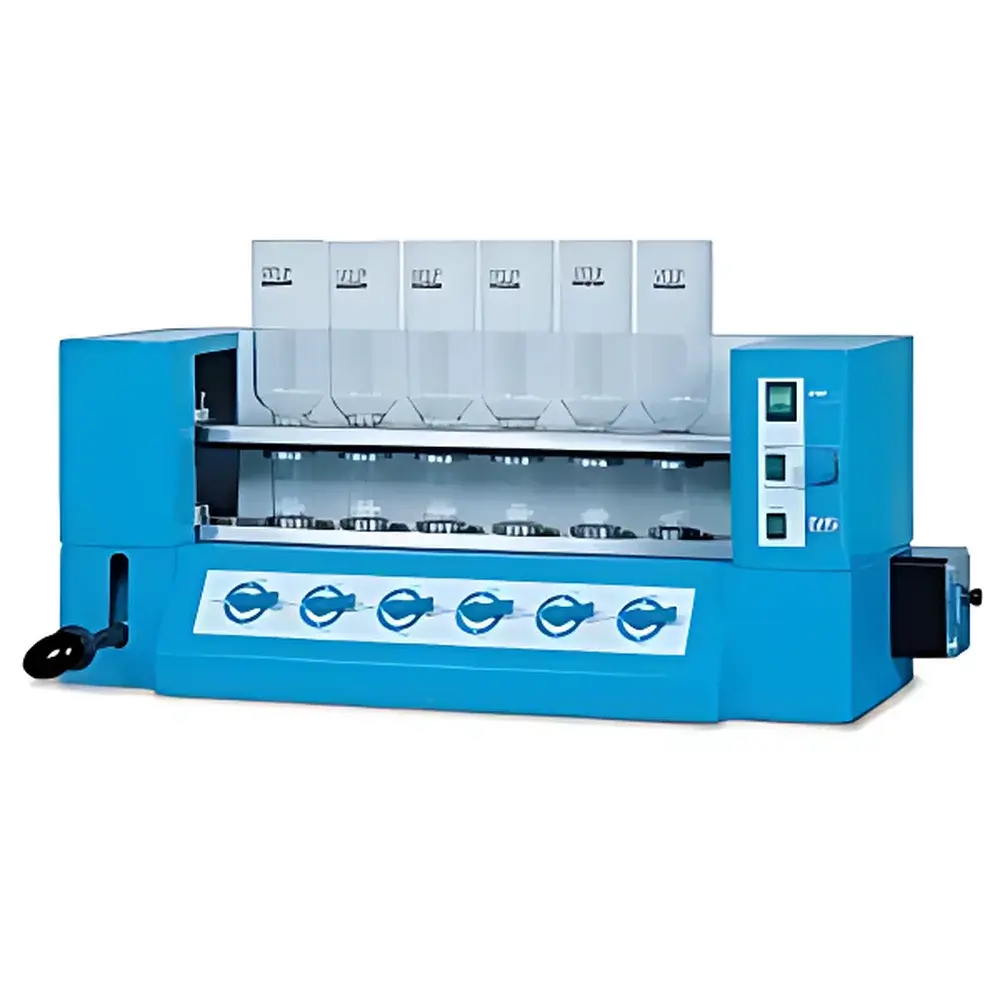
VELP CSF6-GDE Dietary Fiber Analyzer
| Brand | VELP |
|---|---|
| Country of Origin | Italy |
| Model | CSF6-GDE |
| Application Principle | Enzymatic-gravimetric method per AOAC 991.43 and AOAC 2009.01 |
| Sample Capacity | 6 independent positions (CSF6) + 6-position magnetic stirring (GDE) |
| Filtration System | Vacuum-assisted with adjustable vacuum control and gas-backflush |
| Digestion System | Immersion-heated water bath with ±0.2 °C temperature stability, programmable time/temperature profiles |
| Compliance | AOAC Official Methods 991.43 (Total Dietary Fiber), 2009.01 (Soluble/Insoluble Dietary Fiber), and ISO 13905 |
Overview
The VELP CSF6-GDE Dietary Fiber Analyzer is a fully integrated, dual-module system engineered for precise, standardized determination of total, soluble, and insoluble dietary fiber in food and feed matrices. It implements the enzymatic-gravimetric principle defined in AOAC Official Methods 991.43 and 2009.01—widely recognized as the international reference for regulatory compliance and nutritional labeling. The system comprises two functionally synchronized units: the CSF6 High-Efficiency Washing and Filtration Unit and the GDE Enzymatic Digestion Incubator. Together, they replicate key physiological stages of human and monogastric animal digestion—including α-amylase hydrolysis, protease digestion, and amyloglucosidase treatment—followed by controlled ethanol precipitation, vacuum filtration, and gravimetric quantification. This architecture ensures high reproducibility across laboratories and alignment with global food safety and labeling requirements, including EU Regulation (EC) No 1924/2006 and FDA 21 CFR Part 101.
Key Features
- Dual-module synchronization: CSF6 and GDE operate in sequence with minimal manual intervention, reducing analyst error and inter-batch variability.
- Six independent sample processing channels on the CSF6 unit enable parallel handling without cross-contamination; each position features isolated tubing paths and dedicated peristaltic pump heads calibrated for consistent flow rates.
- Gas-backflush filtration system enhances residue recovery from filter crucibles (e.g., Gooch-type or fritted glass), minimizing fiber loss during washing—critical for low-fiber matrices such as refined grains or dairy products.
- GDE incubator integrates a precision immersion heater, PID-controlled water bath (±0.2 °C over 37–100 °C range), and six-position magnetic stirrer with variable speed control (0–1200 rpm), ensuring uniform enzyme-substrate contact under strictly defined thermal conditions.
- Programmable timer with audible alarm supports unattended operation during multi-step digestion protocols (e.g., 30 min α-amylase at 95 °C → 60 min protease at 60 °C → 30 min amyloglucosidase at 60 °C).
- Stainless-steel construction, chemical-resistant fluid pathways, and IP22-rated electronics ensure durability in routine QC environments compliant with GLP and ISO/IEC 17025 laboratory standards.
Sample Compatibility & Compliance
The CSF6-GDE accommodates standard AOAC-compliant sample vessels—including 600-mL borosilicate digestion beakers and pre-weighed sintered-glass crucibles (porosity P100). It is validated for diverse matrices: cereal-based foods, legumes, fruits, vegetables, infant formulas, pet food, and animal feedstuffs. All operational parameters align with AOAC 991.43 (total dietary fiber), AOAC 2009.01 (soluble/insoluble fractionation), and ISO 13905 (determination of dietary fiber as non-digestible carbohydrates). The system supports full traceability for audits under FDA 21 CFR Part 11 when paired with compliant LIMS or electronic lab notebook (ELN) integration via RS-232 or optional USB interface.
Software & Data Management
While the CSF6-GDE operates as a hardware-centric platform with tactile controls, its protocol-driven workflow is designed for seamless documentation within regulated environments. Temperature setpoints, digestion durations, vacuum levels, and backflush cycles are manually logged per run—but the system’s deterministic repeatability enables robust SOP adherence. For laboratories requiring digital audit trails, VELP provides optional calibration certificates traceable to NIST standards and supports third-party data capture solutions compatible with 21 CFR Part 11-compliant signature workflows. All thermal and timing parameters meet ISO/IEC 17025 clause 7.8.2 requirements for equipment performance verification.
Applications
- Nutritional labeling compliance for packaged foods sold in North America, EU, and ASEAN markets.
- Raw material qualification in flour mills, cereal manufacturers, and functional food R&D centers.
- QC testing in contract laboratories accredited to ISO/IEC 17025 for dietary fiber certification.
- Feed formulation validation for monogastric livestock (swine, poultry) where insoluble fiber content impacts gut motility and nutrient digestibility.
- Method validation studies supporting submission of novel fiber ingredients to EFSA or FDA GRAS dossiers.
FAQ
Does the CSF6-GDE comply with current AOAC Official Methods?
Yes—it is explicitly designed and validated for AOAC 991.43 and AOAC 2009.01, including all required reagent sequences, temperature/time profiles, and filtration criteria.
Can the system be used for resistant starch analysis?
No—the CSF6-GDE is configured exclusively for dietary fiber determination per AOAC definitions; resistant starch requires separate enzymatic protocols (e.g., AOAC 2012.02) and is not supported.
Is operator training provided with installation?
VELP offers on-site commissioning and foundational operator training covering safety protocols, maintenance routines, and AOAC workflow execution—customizable to ISO/IEC 17025 documentation needs.
What crucible types are recommended for gravimetric weighing?
Sintered-glass crucibles (porosity grade P100, 25–30 mL capacity) or Gooch crucibles with acid-washed asbestos substitutes are recommended; pre-ashing and tare weight recording must follow AOAC procedural guidelines.
How often does the peristaltic pump tubing require replacement?
Under standard usage (≤50 runs/month), tubing should be inspected weekly and replaced every 3–6 months depending on reagent aggressiveness (e.g., ethanol, acetone) and flow rate settings.
Related Products






