
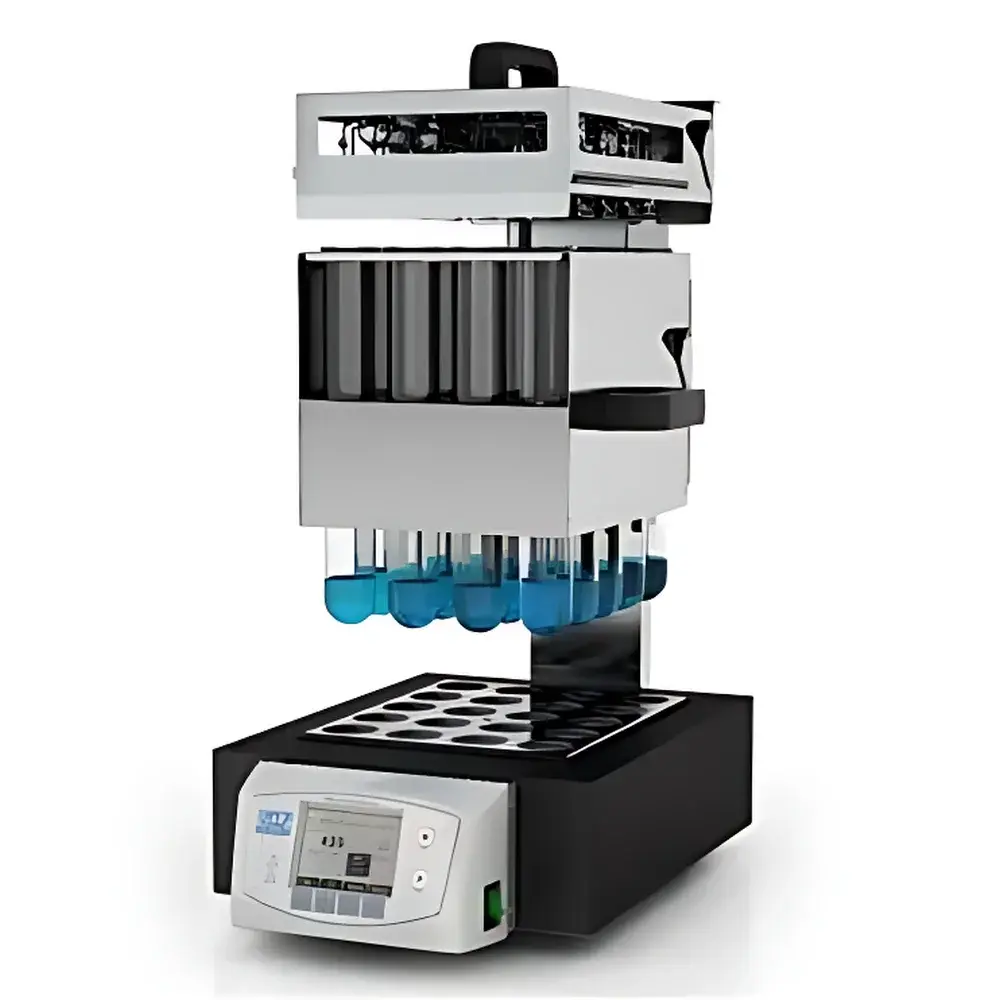
VELP DKL Series Automated Digestion System
| Brand | VELP |
|---|---|
| Origin | Italy |
| Model | DKL Series |
| Instrument Type | Kjeldahl Digestion Unit |
| Max Operating Temperature | 450 °C |
| Temperature Accuracy | ±0.5 °C |
| Ramp Time to 450 °C | 22 min |
| Programmable Steps | 54 |
| Heating Module | Anodized Aluminum Block |
| Digestion Tube Compatibility | DKL8 (250 mL, Ø42 mm), DKL12 (250/400 mL, Ø42 mm), DKL20 (250 mL, Ø42 mm), DKL42 (100 mL, Ø26 mm) |
| Automation Level | Fully Automatic (Digestion + Cooling + End-of-Process Alert) |
| User Interface | Detached LCD Display |
| Unique Technology | VELP TEMS™ (Time, Energy, Money, Space Optimization) |
Overview
The VELP DKL Series Automated Digestion System is a precision-engineered, fully programmable thermal digestion platform designed exclusively for sample preparation in Kjeldahl nitrogen analysis workflows. Developed by VELP Scientifica — an Italian manufacturer with over four decades of expertise in analytical instrumentation — the DKL system implements controlled, reproducible acid digestion under standardized conditions compliant with ISO 8968, AOAC 981.10, and ASTM D5142. It operates on the principle of wet-chemical oxidation using concentrated sulfuric acid and catalysts (e.g., CuSO4, K2SO4) at elevated temperatures up to 450 °C, converting organic nitrogen into ammonium sulfate. The system’s core function is to replace manual, labor-intensive digestion steps with a deterministic, auditable, and thermally stable process — ensuring uniform sample decomposition while minimizing operator exposure to hazardous fumes and thermal hazards.
Key Features
- Fully automated digestion cycle including heating ramp, hold, cooling, and end-of-process acoustic alert — eliminating manual intervention during critical thermal phases.
- High-precision temperature control with ±0.5 °C accuracy across the full 0–450 °C range, enabled by PID-regulated anodized aluminum heating blocks offering superior thermal homogeneity and corrosion resistance.
- Modular design supporting four configurations (DKL8, DKL12, DKL20, DKL42) with distinct tube capacity and geometry options — optimized for diverse sample matrices ranging from viscous slurries to low-volume liquid standards.
- Detached LCD interface physically isolated from the heating module, ensuring long-term display reliability and operator safety in high-temperature laboratory environments.
- VELP-exclusive TEMS™ technology — a systems-level optimization framework that reduces average digestion time by up to 30%, cuts energy consumption by 25% per batch, minimizes benchtop footprint, and lowers reagent usage through intelligent thermal profiling.
- 54-step programmable method storage, enabling precise replication of multi-stage digestion protocols (e.g., gradual ramping, extended holds at intermediate temperatures, controlled cooldown rates) required for complex matrices like polymers or digested sludge.
Sample Compatibility & Compliance
The DKL Series accommodates solid, semi-solid, and liquid samples across food & feed (cereals, dairy, meat products, pet food), environmental (wastewater, sediments, oils, soils), and industrial sectors (textiles, rubber, paper, pharmaceutical excipients). Digestion tubes are constructed from borosilicate glass rated for sustained exposure to hot H2SO4 and oxidative catalysts. The system meets CE marking requirements and adheres to IEC 61010-1 for electrical safety in laboratory equipment. When integrated with VELP UDK distillation units, the complete Kjeldahl workflow satisfies GLP documentation requirements, supports 21 CFR Part 11-compliant electronic records when paired with validated LIMS interfaces, and enables traceable audit trails for regulatory submissions under ISO/IEC 17025-accredited laboratories.
Software & Data Management
While the DKL Series operates via embedded firmware with local LCD control, method parameters (ramp profiles, hold durations, final temperature setpoints) are stored internally with timestamped execution logs. For enterprise integration, optional RS-232 or USB-to-serial connectivity allows synchronization with laboratory information management systems (LIMS) or custom SCADA platforms. All methods support user-defined naming, version control, and password-protected access levels — essential for multi-user QA/QC environments. Raw thermal event data (time vs. temperature) can be exported for post-run validation and root-cause analysis of digestion anomalies. No cloud dependency or proprietary subscription software is required for basic operation.
Applications
- Quantitative total nitrogen determination in cereal grains and flour according to ICC Standard Method 105/2.
- Crude protein estimation in animal feed formulations per AOAC Official Method 984.13.
- Monitoring nitrogen removal efficiency in municipal wastewater treatment plants (EPA Method 351.2).
- Quality control of nitrogen-containing additives in polymer synthesis and pharmaceutical intermediates.
- Validation of digestion completeness prior to ICP-MS or ICP-OES elemental analysis — particularly for phosphorus, sulfur, and heavy metals co-digested with nitrogen.
FAQ
Is the DKL Series compatible with non-VELP distillation systems?
Yes — digestion tubes conform to standard Kjeldahl geometry and volume specifications; output digests are chemically identical and directly transferable to third-party UDK-compatible or generic steam distillation units.
What safety features prevent overheating or acid splashing?
The system includes dual independent thermal cutoffs, real-time block temperature monitoring, automatic power-down after cooling completion, and a fail-safe lid interlock mechanism that halts heating if digestion tube access is attempted mid-cycle.
Can digestion methods be validated for ISO 17025 accreditation?
Yes — each DKL unit provides method traceability, temperature calibration certificates (NIST-traceable), and repeatable thermal profiles suitable for inclusion in method validation packages covering accuracy, precision, robustness, and detection limits.
Does the DKL require external exhaust or fume hood integration?
Yes — although the system includes internal condensation channels and reflux design, it must be operated within a certified chemical fume hood meeting ANSI/AIHA Z9.5 standards to manage SO2/NOx off-gassing during digestion.
How often does the heating block require recalibration?
VELP recommends annual verification using a calibrated reference thermometer; field recalibration is not user-serviceable and must be performed by authorized service technicians using factory-certified equipment.





