
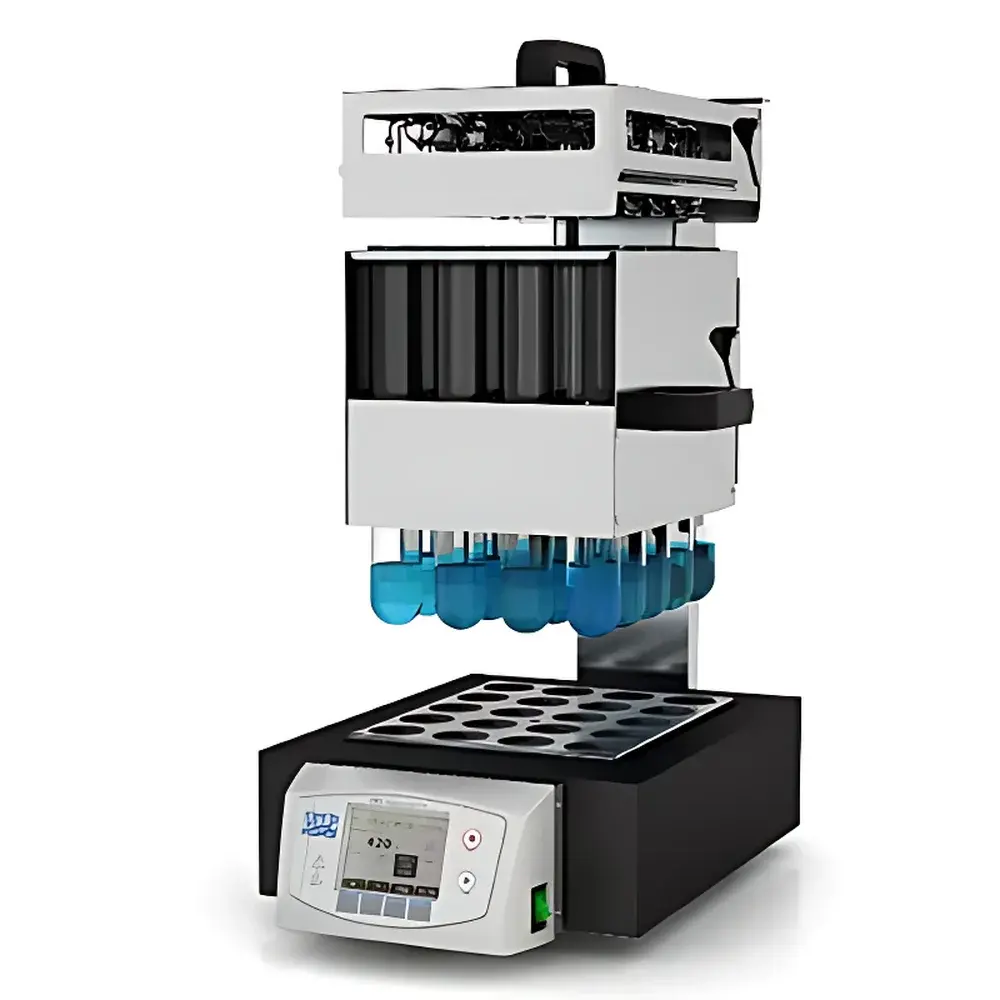
VELP DKL Series Fully Automated Electric Heating Digestion System
| Brand | VELP |
|---|---|
| Origin | Italy |
| Model | DKL |
| Instrument Type | Electric Heating Digestion System |
| Automation Level | Fully Automated |
| Digestion Positions | 20 |
| Max Heating Temperature | 450 °C |
| Temperature Control Accuracy | ±0.5 °C |
| Heating Module | Aluminum Block |
| Reagent Channels | 20 |
Overview
The VELP DKL Series Fully Automated Electric Heating Digestion System is an advanced, benchtop digestion platform engineered for high-throughput, reproducible sample preparation in environmental, food, agricultural, and clinical laboratories. Based on precise electric resistive heating of a monolithic aluminum block, the system delivers exceptional thermal uniformity across all digestion positions—critical for consistent acid decomposition of organic matrices prior to elemental analysis (e.g., ICP-OES, ICP-MS, AAS). Unlike open-flame or ceramic-heater-based digesters, the DKL’s integrated aluminum heating module ensures rapid heat transfer, minimal thermal lag, and long-term stability under aggressive acid conditions (HNO₃, H₂SO₄, HClO₄, HF). The system operates under programmable temperature ramps and holds, enabling full compliance with standardized digestion protocols including ISO 11885, EPA Method 3050B/3051A/3052, and ASTM D3682. Its fully automated architecture—including motorized lift-and-seal fume extraction cover, position-synchronized reagent addition, and real-time thermal monitoring—eliminates manual intervention during digestion cycles, reducing operator exposure and inter-run variability.
Key Features
- Fully automated digestion workflow: motorized lift-and-seal fume extraction cover, auto-positioning reagent delivery (20 independent channels), and synchronized tube rack elevation.
- High-precision aluminum heating block with ±0.5 °C temperature control accuracy across the full range (ambient to 450 °C), validated per ISO/IEC 17025 traceable calibration procedures.
- 54 preloaded digestion programs—30 standardized (aligned with EPA, ISO, and AOAC methods) and 24 user-editable protocols supporting up to 4 sequential temperature ramps and hold steps.
- LCD touchscreen interface with multilingual support (English, Italian, Spanish, French, German, Russian, Chinese) and intuitive program navigation; all parameters logged with timestamps.
- Energy-optimized design: achieves 420 °C from ambient in ≤22 minutes and reduces power consumption by 35% versus conventional digestion systems, contributing to lower CO₂ footprint and operational cost.
- Corrosion-resistant stainless-steel chassis with chemically resistant coating; compliant with IP20 electrical safety rating and CE/UKCA marking for laboratory use.
Sample Compatibility & Compliance
The DKL 20 supports simultaneous digestion of up to 20 samples in borosilicate glass or PTFE-lined tubes (Φ42 × 300 mm, 250 mL standard; optional Φ50 × 300 mm, 400 mL or Φ26 × 300 mm, 100 mL formats). Tube geometry and volume selection are compatible with COD, total Kjeldahl nitrogen (TKN), heavy metal, and nutrient analysis workflows. The system meets critical regulatory requirements for method validation and data integrity: it supports GLP/GMP-compliant operation via optional IQ/OQ documentation package (Order Code A00000186), USB data export (CSV format) for audit-ready record retention, and time-stamped event logging. While not inherently 21 CFR Part 11–compliant, its data export architecture enables integration with validated LIMS or ELN platforms meeting FDA electronic record requirements.
Software & Data Management
No proprietary software installation is required—the DKL operates as a standalone instrument with embedded firmware controlling all thermal, mechanical, and safety functions. Digestion run data—including setpoints, actual temperatures, elapsed time, reagent dispensing events, and error flags—are stored internally and accessible via the touchscreen history menu. Data can be exported directly to a PC via USB 2.0 interface (1.8 m cable included) in comma-separated values (CSV) format for post-processing in Excel, statistical packages, or LIMS. All exported files contain unique run IDs, operator tags (manually entered), and ISO 8601-formatted timestamps. Optional validation documentation (IQ/OQ) provides test protocols and acceptance criteria for laboratory accreditation audits (e.g., ISO/IEC 17025, CAP, CLIA).
Applications
The DKL Series is routinely deployed in accredited testing laboratories performing regulated analyses such as: determination of total metals (As, Cd, Cr, Pb, Hg) in soils and sediments (EPA 3050B); phosphorus and nitrogen speciation in wastewater and fertilizers (ISO 11885, EN 15971); digestible mineral content in feedstuffs (AOAC 985.25); and total organic carbon (TOC)-correlated digestion in pharmaceutical excipients. Its programmable multi-step ramp profiles accommodate both rapid microwave-compatible protocols and extended low-temperature charring sequences for high-fat or high-sugar matrices. The system is also widely used in teaching laboratories for hands-on training in analytical sample preparation best practices, method development, and QA/QC procedure implementation.
FAQ
What safety mechanisms prevent overheating or uncontrolled acid reactions?
The DKL integrates dual redundant temperature sensors, hardware-based overtemperature cutoff (>460 °C), automatic lift-and-seal cover activation upon exceeding preset fume thresholds, and audible/visual alarms triggered by probe disconnection or thermal deviation beyond ±1.0 °C.
Can the DKL be validated for GxP environments?
Yes—optional IQ/OQ documentation (Order Code A00000186) includes equipment specifications, installation checks, operational tests, and performance verification against manufacturer tolerances; users must complete PQ (Performance Qualification) using in-house reference standards.
Is remote monitoring or network connectivity supported?
No Ethernet or Wi-Fi interface is built-in; however, USB-exported CSV logs may be ingested into networked LIMS or SCADA systems via scheduled batch import scripts.
What maintenance is required to sustain temperature accuracy?
Annual verification of block uniformity and sensor calibration using NIST-traceable reference thermometers is recommended; VELP-certified service technicians perform this during scheduled maintenance visits.
Are consumables like digestion tubes and reagent lines available through VELP?
Yes—original VELP digestion tubes (borosilicate glass, PTFE-coated variants), custom-fit racks, fume extraction gaskets, and reagent tubing kits are stocked globally with documented lot traceability and CoA issuance.



