
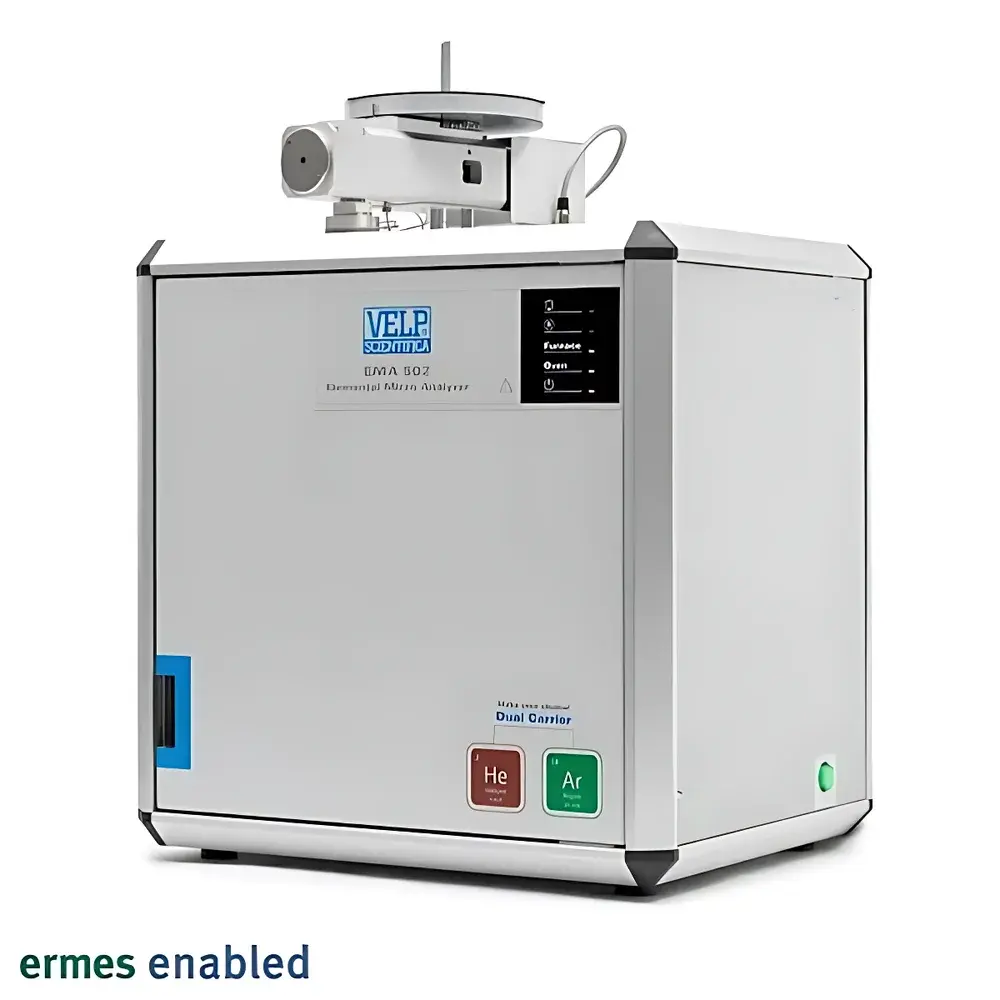
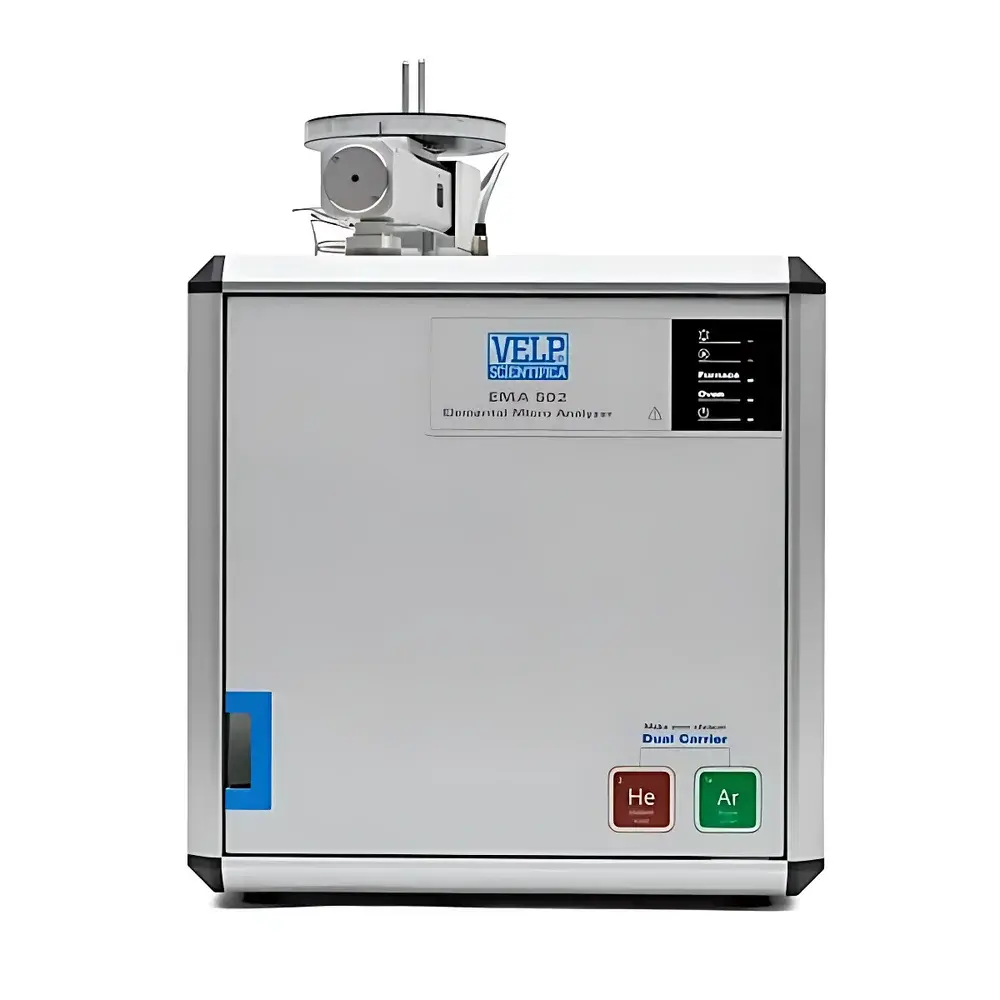
VELP EMA 502 CHNS-O Organic Elemental Analyzer
| Brand | VELP |
|---|---|
| Origin | Italy |
| Model | EMA 502 |
| Detection Elements | C, H, N, S, O |
| Sample Forms | Solid, Paste, Liquid |
| Carrier Gases | Helium, Argon |
| Compliance | AOAC, AACC, ASBC, ISO, DIN, IFFO, OIV, ASTM, EPA |
| Software | EMASoft |
| Cloud Integration | VELP Ermes Platform |
| Automation | Optional Autosampler |
Overview
The VELP EMA 502 CHNS-O Organic Elemental Analyzer is a high-precision combustion-based instrument engineered for the quantitative determination of carbon (C), hydrogen (H), nitrogen (N), sulfur (S), and oxygen (O) in organic matrices. It operates on the principle of high-temperature catalytic combustion (for C, H, N, S) and pyrolytic reduction (for O), followed by gas chromatographic separation and thermal conductivity detection (TCD) or infrared detection (IR), depending on configuration. Designed for laboratories requiring regulatory-grade data integrity and method reproducibility, the EMA 502 delivers trace-level accuracy across diverse sample types—from pharmaceutical active ingredients and excipients to soil extracts, biofuels, feedstuffs, and polymer additives. Its dual-mode furnace architecture enables seamless switching between combustion and pyrolysis protocols without hardware reconfiguration, ensuring operational continuity in multi-method workflows.
Key Features
- Integrated combustion and pyrolysis furnace system—no external modules required for O analysis
- Multi-element capability (CHNS-O) in a single platform with independent calibration paths per element
- Robust ceramic combustion tube with proprietary catalyst bed, optimized for complete oxidation of refractory organics and sulfur-rich samples
- Gas management system supporting helium and argon as carrier gases, with integrated flow control and leak-tight manifold design
- Direct sample introduction for solids, pastes, and liquids—no derivatization or pre-treatment needed
- Modular autosampler option (up to 100 positions) with programmable weighing integration and sample cup recognition
- Real-time combustion efficiency monitoring via CO2/H2O ratio validation and post-combustion oxygen surplus assessment
Sample Compatibility & Compliance
The EMA 502 accommodates heterogeneous organic materials including powders, granules, freeze-dried tissues, viscous oils, and aqueous suspensions. Sample mass range spans 0.1–500 mg, with automatic weighing compensation applied during sequence execution. Method validation aligns with internationally recognized protocols: AOAC Official Methods 993.13 (N in feeds), 984.27 (protein), AACC 46–40A (total N in cereals), ASTM D5291 (C/H/N in petroleum), ISO 16968 (soil organic carbon), and EPA Method 9060A (TOC in environmental matrices). Instrument qualification supports GLP and GMP environments through documented IQ/OQ/PQ procedures, and all analytical runs generate audit-trail-enabled metadata compliant with FDA 21 CFR Part 11 requirements when used with EMASoft’s secure user authentication and electronic signature modules.
Software & Data Management
EMASoft v4.x provides a validated, Windows-based interface for method setup, calibration curve generation (linear, quadratic, or multipoint), real-time signal visualization, and automated quantification using internal standard or external calibration strategies. Raw chromatograms, peak integration logs, and elemental mass balance reports are stored in encrypted SQLite databases with configurable retention policies. The software supports LIMS export via ASTM E1384-compliant XML and CSV formats. When connected to the VELP Ermes cloud platform, users gain remote diagnostics, firmware update notifications, predictive maintenance alerts, and secure offsite backup of method libraries and historical results—enabling cross-site method harmonization and centralized instrument fleet oversight.
Applications
- Pharmaceutical QC/QA: Assay of elemental impurities per ICH Q3D, nitrogen content in APIs, residual solvent carbon profiling
- Food & Feed Safety: Crude protein estimation (Kjeldahl-equivalent N), adulteration screening (e.g., melamine detection via N spike), fat/oil oxidation stability (S-content tracking)
- Petrochemical R&D: Sulfur speciation in fuels per ISO 20846, carbon residue prediction, heteroatom mapping in heavy fractions
- Environmental Analysis: Total organic carbon (TOC) and total nitrogen (TN) in wastewater sludge, sediment C:N ratios for eutrophication modeling
- Agricultural Research: Nitrogen use efficiency studies, compost maturity assessment via C/N/O evolution kinetics, fertilizer formulation verification
FAQ
Does the EMA 502 require separate instruments for oxygen analysis?
No—the EMA 502 integrates pyrolysis functionality within its main furnace assembly, eliminating the need for add-on oxygen modules or external reactors.
Can EMASoft generate reports compliant with ISO/IEC 17025 accreditation requirements?
Yes—EMASoft includes customizable report templates with mandatory fields for analyst ID, instrument ID, calibration date, uncertainty statements, and measurement traceability to NIST SRMs.
Is helium the only acceptable carrier gas for CHNS analysis?
Helium is recommended for optimal resolution and sensitivity; however, argon may be substituted for specific applications where helium supply constraints exist, with documented method revalidation.
What level of operator training is required to achieve ISO 17025-compliant performance?
VELP provides certified on-site training covering instrument operation, preventive maintenance, system suitability testing, and data integrity practices aligned with ILAC-G8:2022 guidance.
How does the EMA 502 handle high-salt or halogen-rich samples?
The system incorporates a silver-coated copper oxide scrubber and alkali trap upstream of the detector to prevent halogen interference and chloride-induced TCD filament corrosion.







