
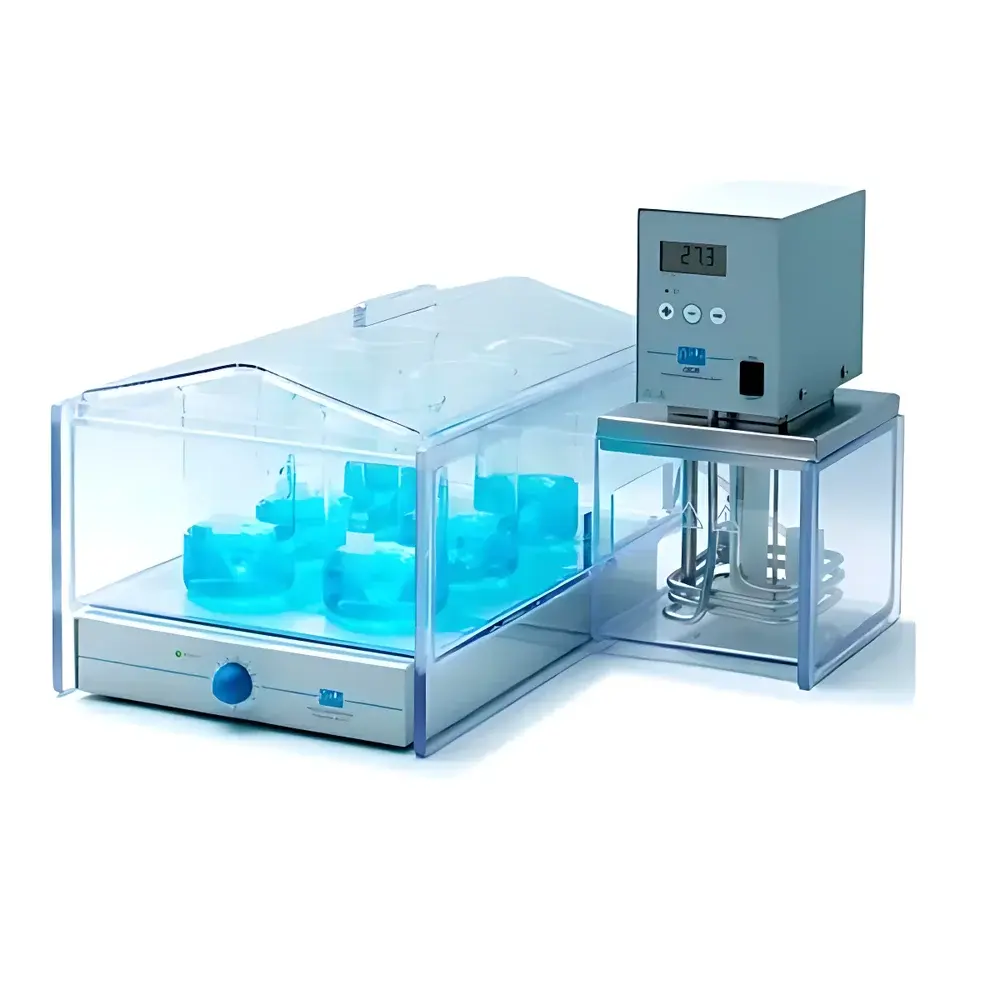
Velp GDE Dietary Fiber Analyzer
| Brand | VELP |
|---|---|
| Origin | Italy |
| Model | GDE |
| Temperature Control Accuracy | ±0.2 °C |
| Max Operating Temperature | 105 °C |
| Bath Material | Transparent Polycarbonate |
| Stirring Configuration | 6-Position Magnetic Stirring |
| Water Bath Type | Deionized-Water-Compatible Constant-Temperature Bath |
| Automation | Programmable Timer for Unattended Operation |
| Compliance | Designed for AOAC 991.43, AACC 32-05, and ISO 13905 Enzymatic-Gravimetric Methods |
Overview
The Velp GDE Dietary Fiber Analyzer is an engineered solution for standardized enzymatic-gravimetric determination of total, soluble, and insoluble dietary fiber in food and feed matrices. It operates on the principle of sequential enzymatic hydrolysis—mimicking human gastrointestinal digestion—to selectively degrade starch, protein, and sugars while preserving fiber fractions (e.g., cellulose, hemicellulose, pectins, β-glucans, and resistant starch). The undigested residue is then isolated via filtration or centrifugation, dried, and weighed to quantify total dietary fiber content. This methodology aligns with internationally recognized reference protocols including AOAC Official Method 991.43, AACC Method 32-05, and ISO 13905, ensuring methodological traceability and inter-laboratory comparability in nutritional labeling, product development, and regulatory compliance workflows.
Key Features
- Integrated 6-position magnetic stirring system ensures homogeneous sample suspension throughout enzymatic incubation—critical for reproducible enzyme–substrate interaction and prevention of localized thermal gradients or sedimentation.
- Precision temperature control with ±0.2 °C accuracy across a 30–105 °C operating range, digitally displayed and maintained via PID-regulated heating elements embedded within the bath chamber.
- Transparent polycarbonate water bath vessel provides full visual monitoring of reaction progress while offering superior chemical resistance and thermal stability compared to glass or acrylic alternatives.
- Deionized-water compatibility eliminates scale formation and minimizes maintenance downtime—essential for laboratories performing high-throughput fiber analysis over extended operational cycles.
- Programmable digital timer enables unattended operation for defined digestion durations (e.g., 30 min α-amylase step, followed by 60 min protease + amyloglucosidase incubation), supporting GLP-aligned workflow documentation and operator efficiency.
Sample Compatibility & Compliance
The GDE supports diverse solid and semi-solid food matrices—including cereals, legumes, fruits, bakery products, infant formulas, and animal feedstuffs—without requiring pre-grinding beyond standard laboratory milling (≤0.5 mm particle size). Its design accommodates standard fiber analysis crucibles (e.g., Gooch-type, fritted glass, or cellulose acetate filters) and conforms to volumetric and thermal requirements specified in AOAC 991.43 Annexes. Instrument architecture meets mechanical safety standards per IEC 61010-1 and is compatible with ISO/IEC 17025-accredited quality management systems. When operated with validated reagent kits and documented SOPs, the system supports audit readiness for FDA, EFSA, and national food authority inspections.
Software & Data Management
The GDE is a hardware-only platform without embedded software or data logging capability—consistent with its role as a regulated, stand-alone digestion module within validated analytical workflows. Temperature setpoints, timer durations, and bath fill levels are manually configured and recorded in laboratory notebooks or LIMS-integrated electronic batch records. This architecture avoids 21 CFR Part 11 validation burdens associated with automated data capture, while enabling full traceability when paired with instrument calibration logs (per ISO/IEC 17025 Clause 6.4.10) and routine performance verification using NIST-traceable thermistors.
Applications
- Nutritional labeling compliance for EU Regulation (EU) No 1169/2011 and US FDA 21 CFR §101.9, particularly for “Dietary Fiber” declarations on packaged foods.
- Product reformulation studies assessing fiber retention during thermal processing (e.g., extrusion, baking, retorting).
- Raw material qualification of functional fibers (e.g., inulin, resistant dextrin) in ingredient supply chains.
- Research applications in nutrition science, including in vitro fermentation modeling and prebiotic activity screening.
- Feed formulation support for monogastric and ruminant nutrition trials, where neutral detergent fiber (NDF) and acid detergent fiber (ADF) correlations are established.
FAQ
Is the GDE compliant with AOAC 991.43?
Yes—the GDE’s temperature uniformity, stirring consistency, and incubation time control meet all instrumental requirements specified in AOAC 991.43 for enzymatic digestion steps.
Can it be used for resistant starch analysis?
Yes, when integrated into AOAC Method 2017.16 or AACC Method 32-40 protocols, provided appropriate enzyme cocktails and cooling steps are implemented externally.
What maintenance is required for long-term accuracy?
Monthly verification of temperature uniformity using calibrated PT100 probes at multiple bath positions; annual recalibration of the digital controller against a reference thermometer traceable to NIST.
Does the system include filtration or gravimetric equipment?
No—the GDE performs only the enzymatic digestion phase; filtration, drying, and weighing require separate, validated laboratory equipment (e.g., vacuum filtration manifolds, desiccators, analytical balances).
Is deionized water mandatory?
Strongly recommended—use of deionized water prevents calcium/magnesium carbonate deposition that compromises heater efficiency and bath transparency over repeated cycles.
Related Products







