
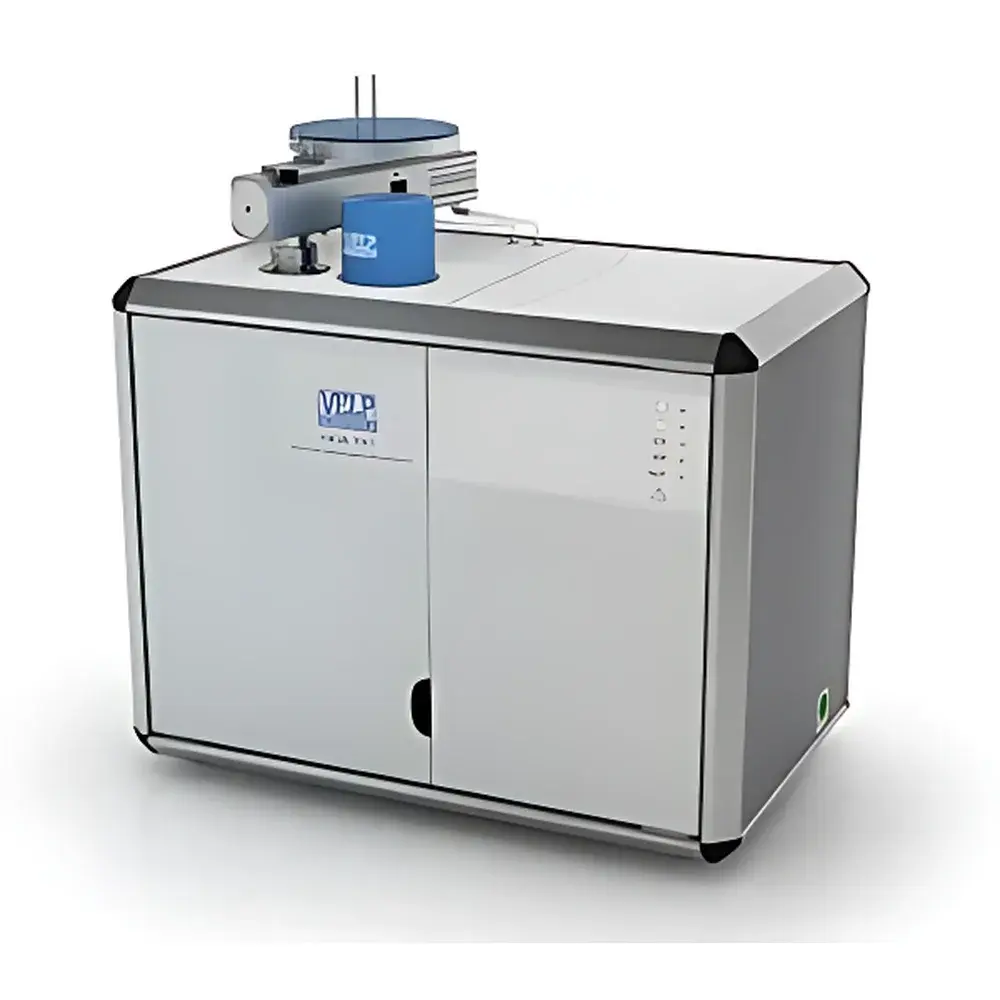
VELP NDA701 Dumas Combustion Nitrogen Determinator
| Brand | VELP |
|---|---|
| Origin | Italy |
| Model | NDA701 |
| Analysis Method | Dumas combustion |
| Automation Level | Fully automated |
| Detection Limit | 0.003 mg N |
| Reproducibility (RSD) | < 0.5% |
| Recovery | > 99.5% |
| Combustion Temperature | 1030 °C |
| Sample Weight Capacity | up to 1 g |
| Autosampler Capacity | up to 116 samples |
| Carrier Gas | Helium (99.999% purity, 3 bar) |
| Oxygen Supply | 99.999% purity, 3 bar |
| Auxiliary Gas | Compressed air or nitrogen (99.6%, oil- and water-free, 4 bar) |
| Power Consumption | 1400 W |
| Dimensions (W×H×D) | 655 × 510 × 410 mm (655 × 690 × 410 mm with autosampler) |
| Weight | 54 kg |
| Interfaces | USB, RS232 |
| Compliance | AOAC, AACC, ASBC, ISO 14891, OIV |
Overview
The VELP NDA701 is a fully automated Dumas combustion nitrogen determinator engineered for high-precision, high-throughput elemental nitrogen and protein quantification in diverse organic matrices. Based on the principle of flash combustion at controlled high temperature (1030 °C), the instrument converts all organic nitrogen in a sample into molecular nitrogen (N₂), which is then separated from combustion byproducts and quantified via an innovative autocalibrating thermal conductivity detector (TCD). Unlike classical Kjeldahl digestion—requiring strong acids, extended heating, and hazardous reagents—the NDA701 eliminates wet chemistry entirely, delivering results in under 4 minutes per analysis with no chemical waste generation. Its robust architecture, integrated autosampler (116-position capacity), and gas management system optimized for ultra-high-purity helium and oxygen ensure compliance with internationally recognized reference methods including AOAC 992.15, AACC 46–30, ASBC Beer–30, ISO 14891, and OIV-MA-AS313. Designed for routine operation in QC laboratories across food, feed, environmental, and pharmaceutical sectors, the NDA701 meets the functional and regulatory demands of GLP-compliant workflows and supports audit-ready data integrity.
Key Features
- Fully automated operation—from sample loading to report generation—with minimal user intervention and no manual calibration gas requirements.
- Autocalibrating TCD detector ensures long-term signal stability and eliminates drift-related recalibration cycles typical of conventional thermal conductivity systems.
- High-temperature ceramic combustion tube operating at 1030 °C guarantees complete oxidation of refractory nitrogen compounds, including nitro-, azo-, and heterocyclic species.
- Integrated 116-position autosampler enables unattended batch processing, supporting laboratory throughput optimization and reduced operator exposure.
- Gas delivery system with independent pressure regulation for helium (3 bar), oxygen (3 bar), and auxiliary gas (4 bar) ensures stoichiometric combustion efficiency and reproducible peak resolution.
- Compliance-ready firmware architecture with full audit trail logging, user access control, and electronic signature support aligned with FDA 21 CFR Part 11 and EU Annex 11 requirements.
Sample Compatibility & Compliance
The NDA701 accommodates solid, semi-solid, and powdered samples weighing up to 1 g—including cereals, dairy powders, meat homogenates, soil digests, plant tissues, wastewater sludge, polymer granules, and pharmaceutical excipients—provided they exhibit sufficient homogeneity for representative subsampling. No acid digestion, catalyst addition, or post-combustion chemical trapping is required. The method conforms to official standards governing nitrogen determination in regulated industries: AOAC 992.15 (food and feed), ISO 14891:2021 (milk and milk products), AACC 46–30 (flour and grain), ASBC Beer–30 (brewing), and OIV-MA-AS313 (wine and must). Instrument validation protocols include recovery testing using EDTA (9.57% N) and certified reference materials (CRMs) such as BCR-65 (wheat flour) and IAEA-326 (soil), all demonstrating >99.5% recovery and RSD < 0.5% (n = 10).
Software & Data Management
VELP’s proprietary NDA Control Software provides intuitive method setup, real-time chromatogram visualization, automatic peak integration, and customizable reporting templates compliant with ISO/IEC 17025 documentation requirements. All analytical events—including sample ID assignment, gas pressure logs, combustion temperature profiles, detector response curves, and calibration history—are timestamped and stored with immutable metadata. Data export options include CSV, PDF, and XML formats compatible with LIMS integration. The software supports multi-level user permissions, electronic signatures, and full 21 CFR Part 11 compliance features: audit trail activation, secure login, and tamper-proof record retention. Backup and restore functions are implemented via encrypted USB storage or network drive synchronization.
Applications
- Food & Feed Industry: Protein content in grains, soybean meal, infant formula, cheese, fishmeal, and pet food—aligned with Codex Alimentarius and EU Regulation (EC) No 152/2009.
- Beverage & Brewing: Total nitrogen and FAN (free amino nitrogen) assessment in malt, wort, and beer per ASBC guidelines.
- Environmental & Agricultural Labs: Organic nitrogen quantification in soils, composts, manure, sewage sludge, and aquatic sediments per EPA Method 440.1 and ISO 11261.
- Pharmaceutical & Polymer QA: Nitrogen impurity profiling in APIs, excipients, and synthetic polymers per USP & Ph. Eur. general chapters on elemental impurities.
- Research Institutions: High-volume screening for nitrogen-use efficiency (NUE) studies in crop science and biogeochemical cycling models.
FAQ
What detection technology does the NDA701 use?
It employs an autocalibrating Thermal Conductivity Detector (TCD), eliminating the need for reference gas streams and enabling stable baseline performance over extended operational periods.
Is helium the only carrier gas option?
Helium is the primary carrier gas due to its optimal thermal conductivity and inertness; however, the system can be configured for argon-based operation upon request, subject to method validation.
Can the NDA701 measure total organic carbon (TOC) simultaneously?
No—this instrument is dedicated to nitrogen quantification. TOC measurement requires separate instrumentation based on catalytic oxidation and NDIR detection.
How is method validation performed for regulatory submissions?
Validation follows ICH Q2(R2) guidelines and includes specificity, linearity (0.1–200 mg N), accuracy (recovery ≥99.5%), precision (RSD <0.5%), limit of detection (0.003 mg N), and robustness testing across gas flow, temperature, and sample matrix variables.
Does the system require daily maintenance?
Routine maintenance is limited to weekly ash removal from the combustion tube and quarterly replacement of the CO₂ absorber cartridge; no routine column conditioning or detector cleaning is required.




