
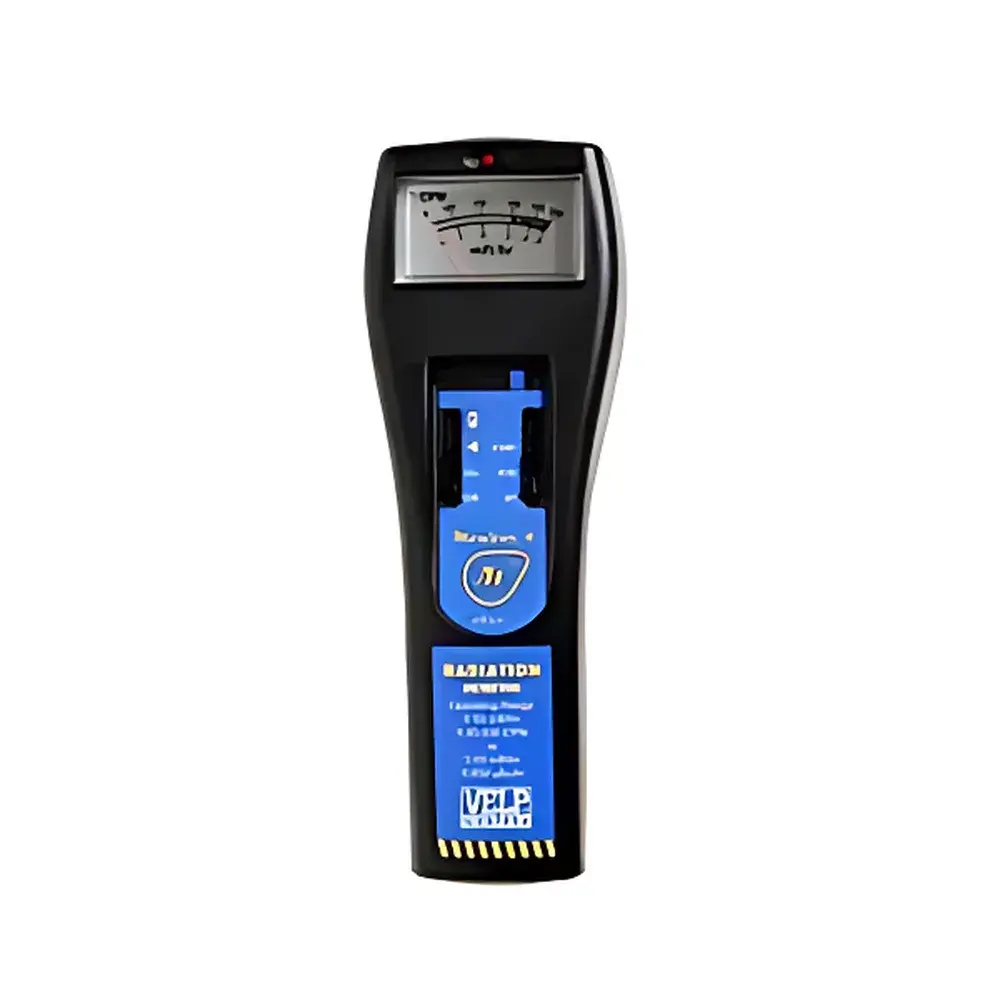
VELP Radiation Portable Geiger-Muller Detector
| Brand | VELP |
|---|---|
| Origin | Italy |
| Model | Radiation |
| Detection Principle | Geiger-Müller Tube with Mica End-Window |
| Measuring Ranges | 0.5–5.0–50 mR/h (three auto-ranging scales) |
| Alpha Energy Range | up to 2.5 MeV (≥80% detection efficiency at 3.5 MeV) |
| Beta Energy Threshold | ≥150 keV (75% efficiency) |
| Gamma/X-ray Sensitivity | ≥10 keV through mica window |
| Power Supply | 9 V alkaline battery (typical 2000 h operation) |
| Display | Analog needle meter with LED visual alarm and audible buzzer |
| Weight | 0.25 kg |
| Compliance | CE-marked, compliant with IEC 60846-1:2014 for portable radiation survey meters |
Overview
The VELP Radiation Portable Geiger-Müller Detector is a compact, field-deployable radiation survey instrument engineered for reliable detection and quantitative assessment of ionizing radiation in diverse operational environments. Built around a certified halogen-quenched Geiger-Müller tube with a thin 1.5–2.0 mg/cm² mica end-window, the device enables simultaneous detection of alpha particles, beta particles, gamma rays, and X-rays—leveraging the fundamental gas amplification principle of proportional ionization within the detector cavity. Its tri-range analog scale (0.5 / 5.0 / 50 mR/h) supports rapid on-site screening without digital calibration drift, while the analog meter provides immediate visual trend interpretation under variable lighting conditions. Designed for routine radiological safety verification—not spectroscopic identification—the instrument delivers high reproducibility in dose rate estimation across industrial, clinical, and environmental monitoring workflows.
Key Features
- True end-window GM tube with ultra-thin mica diaphragm (≤2.0 mg/cm²), optimized for low-energy alpha and beta particle entry
- Three-step manual range selection (0.5 / 5.0 / 50 mR/h) with automatic over-range protection to prevent tube saturation
- Analog needle display backed by dual-status LED indicator and adjustable audible alarm (buzzer), enabling hands-free alerting during walk-through surveys
- Low-power architecture: single 9 V alkaline battery sustains >2000 hours of intermittent use—no recharging infrastructure required
- Robust ABS housing rated IP54 for dust resistance and limited water splashing; ergonomic grip and belt clip for extended handheld operation
- Factory-calibrated traceable to national standards; includes calibration certificate with documented uncertainty (k=2)
Sample Compatibility & Compliance
The VELP Radiation Detector is validated for direct surface scanning of solid materials (e.g., granite slabs, ceramic glazes, scrap metal), liquid samples (groundwater, effluent), and ambient air via passive exposure. It meets the performance criteria defined in IEC 60846-1:2014 for portable radiation protection survey instruments, including energy dependence, angular response, and overload recovery time. While not intended for radionuclide identification, its response characteristics align with common regulatory reference points: e.g., alpha sensitivity supports radon progeny (²¹⁸Po, ²¹⁴Po) surface contamination checks per EPA Method 901.1; beta/gamma response covers typical NORM/TENORM screening requirements in oilfield pipe scale or phosphate processing residues. The unit is CE-marked and compatible with ISO/IEC 17025-accredited laboratories performing routine environmental radiological assessments.
Software & Data Management
This analog-dominant instrument does not feature onboard data logging or Bluetooth connectivity. However, it integrates seamlessly into GLP/GMP-compliant documentation systems via standardized manual recording protocols. Each measurement session can be logged using structured paper-based forms or LIMS-compatible digital templates (e.g., CSV export from spreadsheet-based audit trails). For organizations requiring electronic record integrity, the device supports 21 CFR Part 11-aligned procedural controls—including designated operator sign-off, timestamped range selection logs, and controlled access to calibration certificates. Optional accessories include a tripod mount adapter and calibrated check sources (²⁴¹Am, ⁹⁰Sr/⁹⁰Y) for daily operational verification per ANSI N42.22.
Applications
- Routine radiological surveys in pharmaceutical cleanrooms and nuclear medicine departments to verify shielding integrity and detect residual contamination
- In-field NORM screening at metal recycling facilities, quarry sites, and pipeline maintenance yards per IAEA Safety Standards Series No. WS-G-2.1
- Environmental baseline studies: radon flux mapping in residential basements, granite countertop radioactivity screening, and landfill leachate monitoring
- Regulatory compliance checks for consumer goods—including vintage ceramics, uranium glassware, and imported stone cladding—against EU Council Directive 2013/59/Euratom
- Emergency response triage: rapid localization of orphan sources or post-incident contamination gradients in civil defense scenarios
- Geological prospecting support: preliminary gamma activity profiling during mineral exploration campaigns
FAQ
Is this instrument suitable for measuring radon gas concentration directly?
No. The VELP Radiation Detector measures ambient dose rate from alpha/beta/gamma emissions but cannot quantify radon-222 gas concentration. It is appropriate for detecting radon progeny deposited on surfaces or in dust samples.
Does the device require annual recalibration?
Yes. Per IEC 60846-1 and national metrology guidelines, annual traceable recalibration is recommended. Users must retain calibration certificates demonstrating compliance with ±15% accuracy tolerance at reference energies (e.g., ⁶⁰Co, ¹³⁷Cs).
Can it distinguish between natural and artificial radioisotopes?
No. As a non-spectroscopic survey meter, it reports total ionizing dose rate only. Isotopic identification requires gamma spectrometry (e.g., HPGe or NaI(Tl) systems).
What is the minimum detectable activity for alpha emitters on a surface?
Under standard conditions (2 cm source-to-detector distance, 60 s count), the practical lower limit is ~0.4 Bq/cm² for ²⁴¹Am, assuming 20% geometric efficiency and background-subtracted net counts.
Is the mica window replaceable in the field?
No. The mica end-window is factory-sealed and not user-serviceable. Physical damage to the window voids calibration and compromises alpha/beta sensitivity; replacement requires return to an authorized service center.
Related Products







