
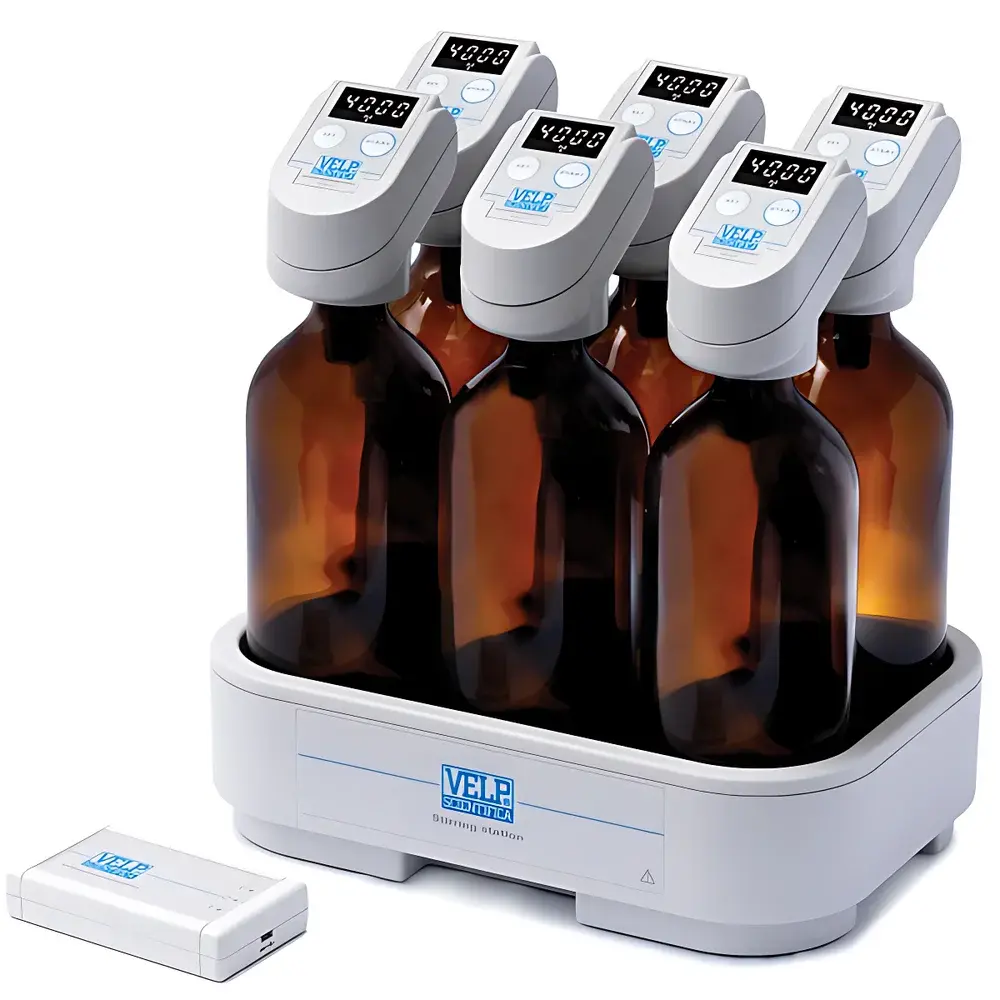
VELP RESPIROMETRIC BOD Measurement System
| Brand | VELP |
|---|---|
| Origin | Italy |
| Model | BOD |
| Pressure Range | 500–2000 mbar (hPa) |
| BOD Range | 90–4000 mg/L (dilutable) |
| Display | 4-digit LED |
| Interface | Dual-button |
| Wireless Data Transmission | Yes |
| Software | RESPIROSoft™ & DataBox™ |
| Cloud Integration | VELP Ermes Platform |
| Battery-Powered Operation | Yes |
| Compliance | Designed for ISO 5815-1, ASTM D5210, APHA 5210B |
Overview
The VELP RESPIROMETRIC BOD Measurement System is a precision-engineered, pressure-based respirometric instrument designed for the standardized determination of Biochemical Oxygen Demand (BOD) in water and wastewater samples. Unlike dilution-based manometric or titrimetric methods, this system quantifies BOD by continuously monitoring the partial pressure decrease in a sealed incubation vial resulting from microbial oxygen consumption during aerobic biodegradation of organic matter. Carbon dioxide produced as a metabolic byproduct is chemically absorbed by potassium hydroxide (KOH) or sodium hydroxide (NaOH) placed in the vial headspace—ensuring that only O₂ depletion drives the measurable pressure drop. The system converts this pressure differential into a direct BOD value (mg O₂/L), traceable to internationally recognized protocols including ISO 5815-1:2022, ASTM D5210-18, and Standard Methods 5210B. Its fully autonomous, battery-operated architecture enables unattended operation over standard 5-day (BOD₅) or extended incubation periods (up to 28 days), making it suitable for routine QC labs, municipal wastewater treatment facilities, and environmental research institutions requiring high reproducibility and regulatory alignment.
Key Features
- Respirometric pressure-sensing technology with ±1 mbar resolution and drift-compensated long-term stability
- Self-contained, portable design powered by replaceable alkaline batteries (typical >12 months operational life per set)
- Intuitive dual-button interface and bright 4-digit LED display showing real-time BOD (mg/L) and absolute pressure (mbar)
- Predefined BOD scales (90, 250, 600, 1000, 4000 mg/L) with automatic range scaling upon sample dilution
- Integrated wireless module enabling seamless data streaming to DataBox™ hub without cables or manual transfer
- Real-time curve visualization and multi-parameter logging (pressure, temperature, elapsed time, calculated BOD) via RESPIROSoft™ desktop software
- Support for customizable sampling intervals (from 15 min to 24 h), optimizing temporal resolution per experimental requirement
Sample Compatibility & Compliance
The system accommodates standard 60 mL or 250 mL BOD bottles with integrated KOH traps, compatible with raw influent, treated effluent, surface water, groundwater, and industrial process streams. Sample preparation follows ISO 5815-1 guidelines: appropriate dilution, pH adjustment (6.5–7.5), nutrient supplementation (if required), and nitrification inhibition (e.g., allylthiourea) where nitrogenous demand must be excluded. All firmware and software modules are developed under GLP-aligned design controls; RESPIROSoft™ supports audit-trail-enabled user authentication, electronic signatures, and data integrity features compliant with FDA 21 CFR Part 11 requirements when configured in validated environments. Instrument calibration is traceable to NIST-certified pressure standards, and validation reports—including system suitability, linearity, and repeatability—can be generated per laboratory SOPs.
Software & Data Management
RESPIROSoft™ is a dedicated Windows-based application enabling full lifecycle management of respirometric analyses. It provides synchronized acquisition from up to 48 sensors (via a single DataBox™ hub), automated BOD calculation using first-order kinetic models or linear regression of pressure decay, and export of raw time-series datasets in CSV, PDF, and XML formats. The software includes built-in tools for outlier detection, baseline correction, and comparative analysis across multiple runs or sample groups. When paired with the VELP Ermes cloud platform, users gain role-based remote access to live sensor status, historical datasets, and customizable alerting (e.g., deviation from expected decay slope, low battery warning, incubation timeout). All data stored in Ermes is encrypted at rest and in transit (AES-256 + TLS 1.3), meeting ISO/IEC 27001-aligned security expectations for regulated laboratories.
Applications
- Routine compliance monitoring of municipal and industrial wastewater discharges against national BOD limits (e.g., EU Urban Wastewater Directive, US EPA NPDES permits)
- Biodegradability screening of new chemical substances per OECD 301 series guidelines
- Optimization of activated sludge process efficiency through daily BOD load tracking
- Research on microbial kinetics in biofilm reactors, constructed wetlands, or anaerobic-aerobic sequencing batch systems
- Educational use in environmental engineering curricula for hands-on demonstration of aerobic respiration principles
FAQ
How does the respirometric method differ from traditional dilution-thiosulfate titration?
It eliminates manual endpoint detection and reagent handling by measuring O₂ consumption directly via pressure transduction—reducing analyst variability and improving inter-laboratory reproducibility.
Can the system measure BOD beyond 5 days?
Yes. The firmware supports programmable incubation durations up to 672 hours (28 days), enabling BODL (ultimate BOD) assessment for recalcitrant compounds.
Is temperature control integrated into the system?
No. The sensor operates inside externally controlled incubators (e.g., VELP’s JU-200 or equivalent 20 ± 1 °C units); temperature data must be logged separately or fed via optional external probe integration.
What happens if network connectivity is lost during cloud transmission?
DataBox™ stores all measurements locally (up to 48 sensors × 10,000 data points each) and automatically synchronizes upon reconnection—ensuring zero data loss.
Are method validations and IQ/OQ documentation available?
VELP provides comprehensive qualification templates (including Installation Qualification, Operational Qualification, and Performance Verification protocols) aligned with ISO/IEC 17025 and GMP Annex 11 expectations.



