
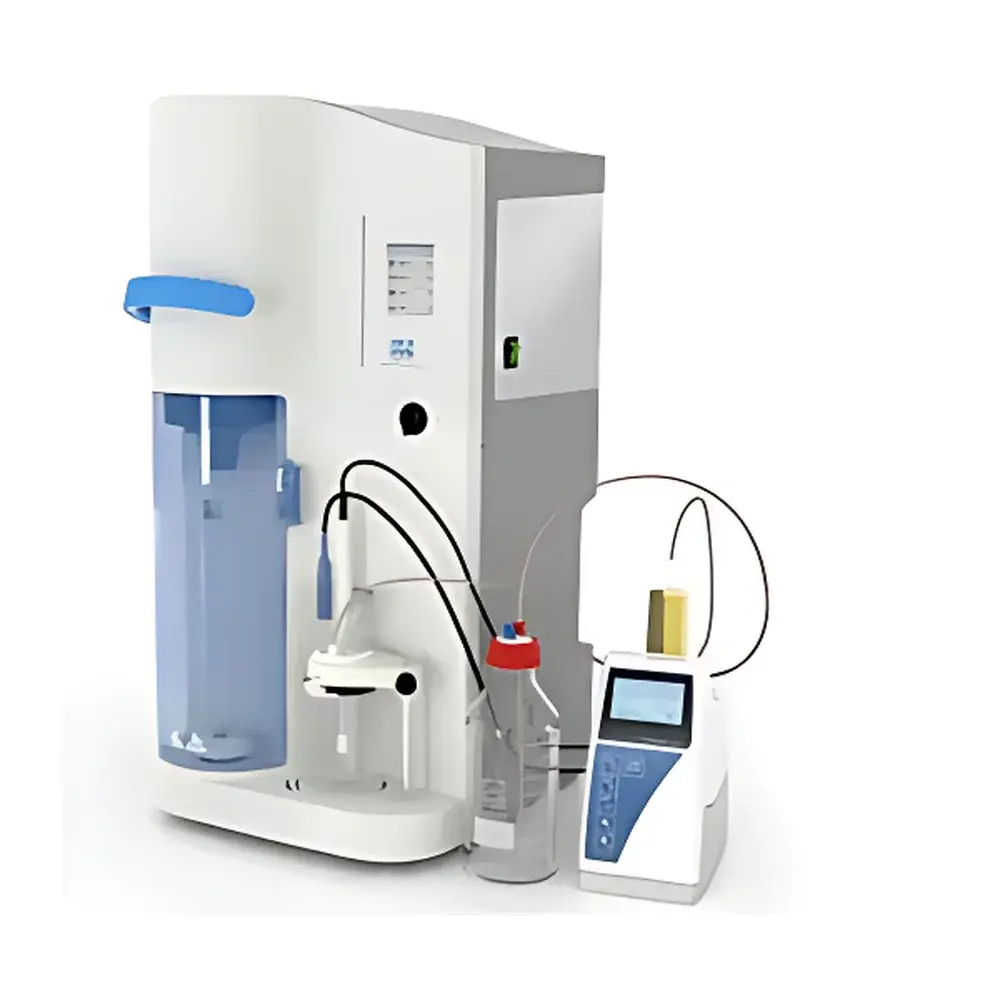
VELP UDK149 Automated Kjeldahl Nitrogen Determinator
| Brand | VELP |
|---|---|
| Origin | Italy |
| Model | UDK149 |
| Instrument Type | Automated Kjeldahl Nitrogen Determinator |
| Automation Level | Fully Automated |
| Nitrogen Determination Range | 0.1–200 mg N |
| Recovery Rate | ≥99.5% (for N content between 0.1–200 mg) |
| Power Consumption | 2100 W |
| Dimensions (W×H×D) | 385 × 780 × 416 mm |
| Touchscreen Display | 3.5-inch color LCD |
| Data Storage Capacity | 50,000 test records |
| Stored Methods | 20 pre-programmed SOPs |
| Repeatability (RSD) | ≤1% |
| Detection Limit | ≥0.1 mg N |
| Steam Output Control | 10–100% adjustable |
| Cooling Water Flow | 0.5 L/min at 15°C |
| Alkali/Water/Acid Dispensing Volume | 0–150 mL / 0–200 mL / 0–100 mL |
| Distillation Time for 100 mL Water | 3 minutes |
| Weight | 27 kg |
| Power Supply | 230 V, 50–60 Hz |
| Connectivity | RS232, USB, TTL, Ehmet interface |
Overview
The VELP UDK149 Automated Kjeldahl Nitrogen Determinator is a fully integrated, benchtop system engineered for precise and reproducible total nitrogen (TKN) quantification in accordance with ISO 8585, AOAC 984.13, and ASTM D1142 standards. Based on classical Kjeldahl digestion–distillation–titration methodology, the UDK149 performs automated alkaline distillation of ammonium salts liberated from digested samples, followed by quantitative titration of liberated ammonia. Its modular architecture supports seamless integration with external titrators—including the optional Titroline Easy K—enabling end-to-end automation from distillation to final nitrogen concentration reporting. Designed for high-throughput laboratories requiring regulatory compliance, the UDK149 delivers traceable, auditable results with full GLP/GMP alignment through electronic method storage, timestamped data logging, and user-access-level control.
Key Features
- Fully automated distillation cycle: programmable addition of NaOH, H3BO3, and rinse water with volumetric precision up to ±0.5 mL per dispense
- TEMS (Time-Energy-Money-Space) optimized thermal management: rapid steam generation with adjustable output (10–100%), reducing average distillation time to ≤3 minutes for 100 mL water blank
- Low-flow condenser design: consumes only 0.5 L/min cooling water at 15°C, minimizing utility dependency and operational cost without compromising condensation efficiency
- Compact footprint (385 × 780 × 416 mm) and corrosion-resistant polymer housing ensure compatibility with constrained lab environments and long-term chemical exposure resilience
- 3.5-inch color touchscreen interface with five-language support (including English, German, French, Spanish, and Chinese), intuitive navigation, and real-time parameter monitoring
- Onboard memory stores up to 20 validated standard operating procedures and retains 50,000 complete analytical records with timestamps, operator IDs, and method versions
Sample Compatibility & Compliance
The UDK149 accommodates solid, liquid, and semi-solid matrices across food, feed, environmental, pharmaceutical, and agrochemical sectors. It supports TKN analysis in cereals, dairy products, meat, fertilizers, wastewater sludge, soil extracts, and active pharmaceutical ingredients. For volatile nitrogen species, it enables TVBN (Total Volatile Basic Nitrogen) determination via modified distillation protocols. All operations comply with FDA 21 CFR Part 11 requirements when paired with validated titration software, offering full audit trails, electronic signatures, and data integrity safeguards. Method validation documentation aligns with ISO/IEC 17025 and EU Regulation (EC) No 882/2004 for official control laboratories.
Software & Data Management
Data capture and export are facilitated via RS232, USB, TTL, and Ehmet interfaces, enabling direct integration with LIMS, ERP, or third-party titration platforms. The embedded firmware logs every critical event—including reagent volumes, steam pressure profiles, distillation duration, endpoint detection signals, and temperature gradients—ensuring full traceability. Export formats include CSV and PDF reports compliant with ISO 17025 clause 7.8.2. Optional VELP LabLink software provides remote diagnostics, method synchronization across multiple instruments, and automated backup to network drives or cloud repositories with encryption (AES-256).
Applications
- Food & Feed Quality Control: Protein content calculation (N × 6.25), adulteration screening, shelf-life assessment via TVBN in fish and meat products
- Environmental Monitoring: TKN in wastewater influent/effluent, soil nitrogen mineralization studies, COD correlation analysis, Devarda reduction for nitrate/nitrite speciation
- Agricultural Research: Fertilizer efficacy trials, crop tissue nitrogen uptake quantification, compost maturity evaluation
- Pharmaceutical Development: Residual ammonium salt verification in APIs, nitrogen balance studies in formulation stability testing
- Chemical Manufacturing: Ammonia recovery efficiency in scrubber systems, catalyst poisoning assessment via nitrogen adsorption metrics
FAQ
What regulatory standards does the UDK149 support for method validation?
The system adheres to ISO 8585:2021, AOAC Official Methods 984.13 and 992.15, and EPA Method 351.2 for TKN determination. Full validation packages—including accuracy, precision, linearity, LOD/LOQ, and robustness—are available upon request.
Can the UDK149 operate without an external titrator?
Yes—it functions as a standalone distillation unit with manual titration capability. However, full automation and digital result generation require connection to a compatible titrator (e.g., Titroline Easy K, Metrohm 856, or Thermo Scientific Orion Star Titrator).
Is remote software update supported?
Firmware updates are performed via USB stick or network-connected PC using VELP’s certified update utility. Updates retain all stored methods and historical data without reset.
How is user access controlled for GLP compliance?
The system supports three hierarchical roles (Operator, Supervisor, Administrator) with password-protected access, configurable permissions, and mandatory electronic signature prompts for critical actions such as method modification or data deletion.
What maintenance intervals are recommended for optimal performance?
Daily: Condenser cleaning and drain line inspection. Quarterly: Steam generator descaling and pump calibration. Annually: Full preventive maintenance including pressure sensor verification and reagent line integrity testing—performed by VELP-certified field service engineers.






