
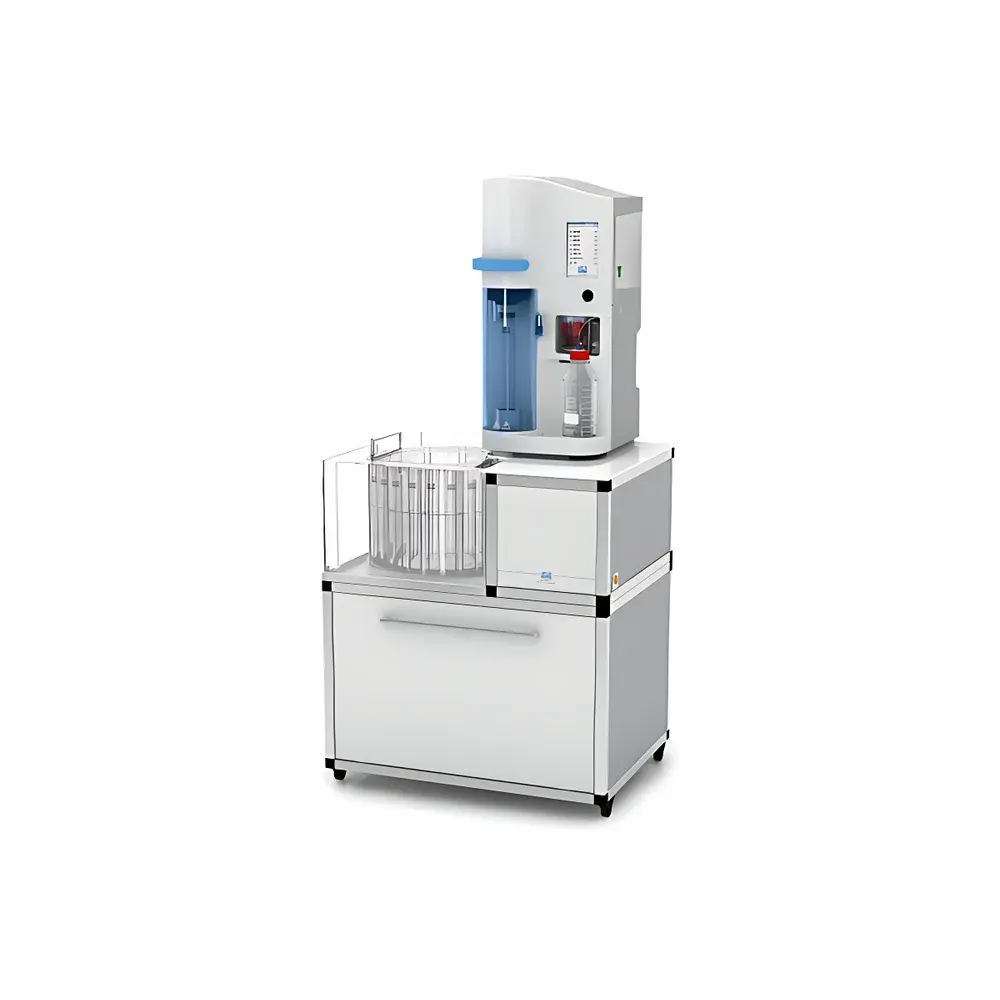
VELP UDK169 Automated Kjeldahl Nitrogen Determinator with AutoKjel Autosampler
| Brand | VELP |
|---|---|
| Country of Origin | Italy |
| Model | UDK169 |
| Power Supply | 230 V / 50–60 Hz |
| Distillation Time | 3–4 min |
| Dispensing Precision | ±2 µL per step |
| Sample Capacity | 24 × 250 mL tubes (Ø42 mm) or 21 × 400 mL tubes (Ø52 mm) |
| Nitrogen Recovery Rate | 99.5% |
| Rated Power | 2250 W |
| Dimensions (W×H×D) | 830 × 1730 × 640 mm |
| Weight | 170 kg |
Overview
The VELP UDK169 Automated Kjeldahl Nitrogen Determinator is a fully integrated, benchtop laboratory system engineered for precise, reproducible total Kjeldahl nitrogen (TKN) and protein quantification in compliance with AOAC, ISO 8968, ISO 5983, and USP methodologies. Based on classical Kjeldahl digestion followed by steam distillation and acid–base titration, the UDK169 combines a pressure-free steam generator, titanium condenser, and high-precision reagent dosing into a single compact unit. Unlike conventional systems requiring manual sample handling and external titration modules, the UDK169 performs complete distillation and titration autonomously — including automatic reagent addition (NaOH, H3BO3, rinse water), controlled steam intensity (10–100%), programmable reaction timing, and endpoint detection via colorimetric photometry. Its design eliminates preheating delays, reduces condenser water consumption to only 0.5 L/min, and ensures continuous operation without maintenance-intensive components.
Key Features
- Pressure-free TEMS™ steam generator: Operates at atmospheric pressure with zero risk of overpressure incidents; no warm-up time required between analyses.
- Titanium condenser: Corrosion-resistant alloy construction ensures long-term thermal stability and minimal water usage while maintaining distillate temperature below 20 °C — critical for accurate NH3 recovery and low blank values.
- Splash-proof titanium spray head: Replaces fragile glass components; prevents carryover and cross-contamination during distillation.
- 6-inch full-color touchscreen interface: Enables method editing for NaOH volume, boracic acid concentration, steam intensity, distillation duration, and titration parameters — all stored as user-defined protocols.
- High-accuracy peristaltic reagent pumps: Deliver ±2 µL/step precision for NaOH, boric acid, and rinse water, ensuring stoichiometric consistency across batches.
- AOAC-compliant colorimetric endpoint detection: Uses dual-wavelength photometry to identify the methyl red–bromocresol green transition point; includes automated titration cell cleaning cycle post-analysis.
- Integrated mobility system: Equipped with lockable swivel casters for safe relocation within the lab without compromising mechanical stability during operation.
Sample Compatibility & Compliance
The UDK169 accommodates standard Kjeldahl digestion tubes up to 400 mL (Ø52 mm), supporting routine analysis of solid, semi-solid, and liquid matrices following official digestion protocols (e.g., AOAC 984.13, ISO 1871). When coupled with the AutoKjel autosampler (optional), it handles up to 24 × 250 mL or 21 × 400 mL samples sequentially — enabling unattended overnight runs. The system meets GLP/GMP documentation requirements through built-in audit trail functionality, electronic signature support, and 21 CFR Part 11–compliant data export options (USB, Ethernet, RS232). All wetted parts contacting reagents or distillates are chemically inert (PP, PTFE, titanium), ensuring compatibility with aggressive alkaline and acidic solutions used in TKN workflows.
Software & Data Management
The embedded firmware supports multi-user access control, method versioning, and timestamped result logging with full traceability. Raw titration curves, reagent consumption logs, and calibration histories are stored internally and exportable in CSV or PDF formats. Data transfer is enabled via Ethernet (TCP/IP), USB host port (for flash drives and printers), and RS232 serial interface — the latter specifically configured for bidirectional communication with the AutoKjel autosampler. Integration with laboratory information management systems (LIMS) is facilitated through standardized ASCII protocol output. Optional VELP LabSoft software provides advanced reporting templates, statistical process control (SPC) charts, and instrument performance trending over time.
Applications
The UDK169 serves as a primary analytical platform for nitrogen determination across regulated sectors:
- Food & Feed Industry: Crude protein (×6.25 factor), TKN, TVBN (total volatile basic nitrogen), and alcohol content via distillative separation.
- Environmental & Agricultural Labs: Soil, sludge, wastewater, and sediment analysis for ammoniacal nitrogen, phenolic compounds, and organic nitrogen fractions.
- Pharmaceutical & Chemical QA/QC: Assay of nitrogen-containing APIs, excipients, and catalysts; verification of synthesis yields and purity profiles.
Its robust architecture and consistent recovery rate (>99.5%) make it suitable for accreditation under ISO/IEC 17025 and routine participation in interlaboratory proficiency testing schemes.
FAQ
Does the UDK169 require external cooling water circulation?
No — the titanium condenser operates efficiently with a continuous tap water flow of only 0.5 L/min, eliminating the need for chillers or recirculation units.
Can the UDK169 be validated for GMP environments?
Yes — it supports 21 CFR Part 11 compliance through electronic signatures, audit trails, and secure user authentication when paired with optional LabSoft software.
What sample throughput can be achieved with the AutoKjel autosampler?
With average distillation time of 3.5 minutes per sample and automated tube handling, the UDK169 + AutoKjel configuration achieves up to 240 determinations per 24-hour period in unattended operation.
Is the steam generator serviceable in-house?
The TEMS™ generator is sealed and maintenance-free; no periodic descaling, gasket replacement, or pressure vessel inspection is required during normal use.
How is reagent carryover prevented between analyses?
A dedicated rinse cycle flushes the distillation chamber and condenser tip with deionized water before each new sample, and the titanium spray head prevents droplet adhesion and aerosol formation.




