
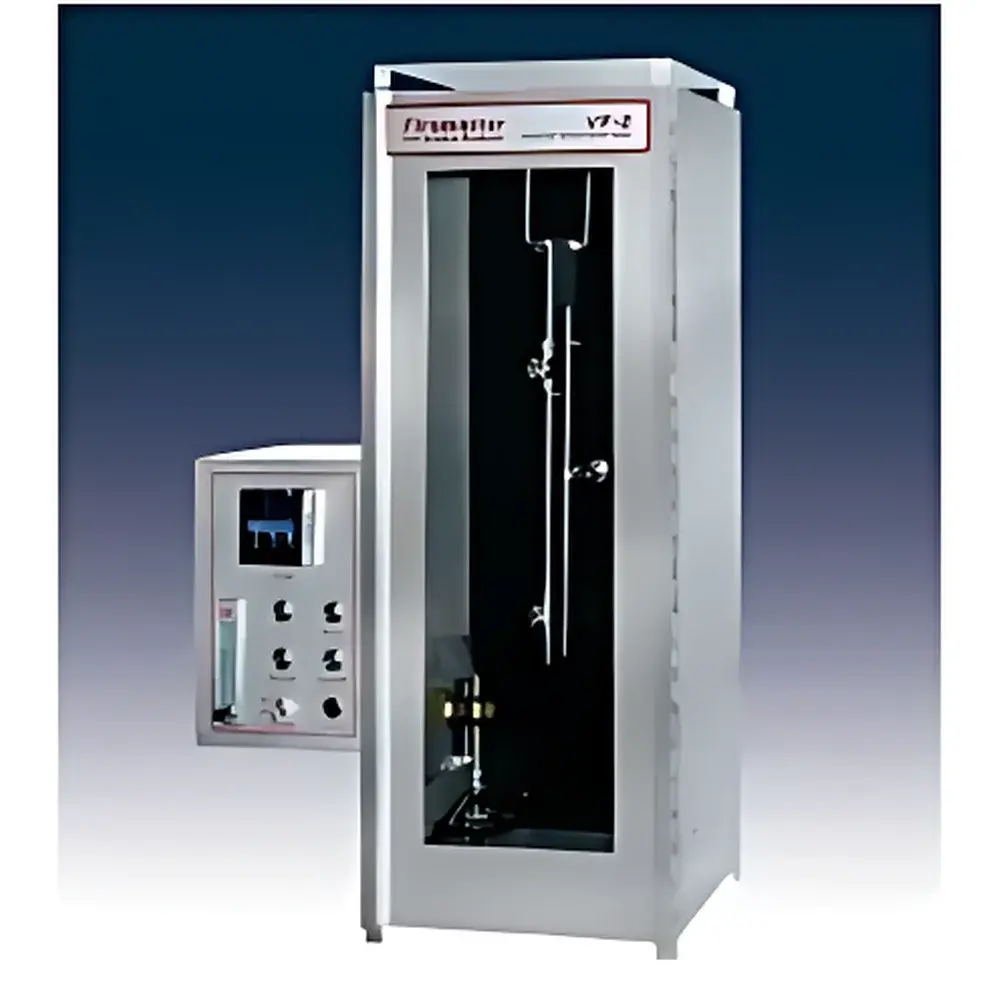
Vertical Flammability Tester VFTT
| Origin | Tianjin, China |
|---|---|
| Manufacturer Type | Authorized Distributor |
| Origin Category | Domestic (China) |
| Model | VFTT |
| Pricing | Available Upon Request |
Overview
The Vertical Flammability Tester VFTT is a precision-engineered instrument designed to evaluate the flame propagation behavior of textile and polymeric materials under controlled vertical orientation conditions. It operates on the principle of standardized radiant and convective ignition, where a calibrated flame source—typically a Bunsen burner conforming to ASTM D5025—is applied to the bottom edge of a vertically suspended specimen for a specified duration. The instrument quantifies critical fire response parameters including afterflame time, afterglow time, char length, and whether flaming or glowing combustion propagates beyond defined thresholds. Its core function supports regulatory conformance testing for flammability classification in consumer, transportation, and aerospace sectors—particularly where vertical orientation replicates real-world exposure geometry (e.g., drapery, upholstery, aircraft seat covers, and children’s sleepwear).
Key Features
- Robust 304 stainless steel test chamber with integrated tempered glass observation window for real-time visual monitoring of flame front progression and char development.
- High-precision digital timer with 0.1 s resolution, automatically triggered upon flame application and cessation; independently records afterflame and afterglow durations per test cycle.
- Motorized flame positioning system ensuring repeatable, zero-latency alignment of the burner tip relative to the specimen’s lower edge—eliminating manual operator variability during ignition and extinction phases.
- Interchangeable ASTM D5025-compliant Bunsen burner assembly with adjustable needle valve for precise control of propane/air mixture and flame height (typically 38 mm ± 2 mm for CA TB 117 and ASTM D6413).
- Modular stainless steel specimen holder system—including holders compliant with CA TB 117 Section A & B, ASTM D6413, CPSC 16 CFR 1615/1616, and Airbus AITM 2.0002—enabling rapid reconfiguration between test standards without hardware modification.
- Integrated safety interlocks, flame-out detection circuitry, and ventilation-compatible exhaust port (compatible with standard fume hood connections) to ensure operator protection and consistent ambient thermal management during repeated testing.
Sample Compatibility & Compliance
The VFTT accommodates flat, flexible specimens up to 300 mm × 89 mm (12″ × 3.5″), including woven/knitted fabrics, nonwovens, laminated composites, foam-backed textiles, and fiberfill assemblies. It supports both single-layer and multi-layer configurations as required by specific standards. The instrument is validated for full compliance with internationally recognized flammability protocols: CA TB 117 (Sections A and B), ASTM D6413, CPSC 16 CFR Part 1615 (size 0–6X) and 1616 (size 7–14), GB/T 5455, FAR 25 Appendix F Part I, Boeing BSS 7230, Airbus AITM 2.0002, and CPAI-84 (Wall & Top). All test procedures adhere to GLP-aligned documentation practices, and raw timing data are traceable to NIST-traceable time sources.
Software & Data Management
While the VFTT operates as a stand-alone electromechanical system, optional USB-connected data logging modules enable timestamped capture of ignition start/end events, afterflame/afterglow durations, and operator annotations. Exported CSV files comply with internal QA workflows and support integration into LIMS platforms. Audit trails—including user ID, test date/time, standard referenced, and specimen ID—are retained locally for minimum 12 months in accordance with ISO/IEC 17025 documentation requirements. No proprietary software installation is required for basic operation; all calibration and functional checks follow documented SOPs aligned with ASTM E178 and ISO/IEC 17025 clause 7.7.
Applications
- Quality assurance laboratories validating flame-retardant finishes on home furnishings and contract textiles prior to commercial release.
- Aerospace component suppliers conducting pre-certification testing for seat fabric systems per FAR 25.853 and OEM-specific specifications (Boeing, Airbus).
- Regulatory testing facilities performing third-party conformity assessments for CPSC-mandated children’s sleepwear flammability compliance.
- R&D departments evaluating comparative flame resistance of novel halogen-free flame retardants in polyester-cotton blends or bio-based fibers.
- Fire safety consultants generating technical evidence for building code submissions involving interior finish classifications (e.g., NFPA 701 correlation studies).
FAQ
What flame source is used in the VFTT, and is it interchangeable between standards?
The VFTT employs an ASTM D5025–compliant Bunsen burner with adjustable propane flow. Burner tips and mounting fixtures are modular, enabling quick replacement to meet distinct flame geometry requirements across CA TB 117, ASTM D6413, and FAR 25 Appendix F.
Does the instrument include calibration documentation traceable to national standards?
Yes—each unit ships with a factory calibration certificate verifying timer accuracy (±0.05 s at 10 s interval), burner flame height repeatability (±1 mm), and specimen clamp alignment tolerance (±0.5° verticality), all traceable to CNAS-accredited metrology labs.
Can the VFTT be integrated into an automated test suite or LIMS environment?
Via optional RS-232 or USB TTL interface, the VFTT supports external trigger input and serial output of pass/fail status, timing values, and test ID—enabling synchronization with robotic sample handlers or enterprise LIMS via standard Modbus RTU or ASCII protocol profiles.
Is operator training included with purchase?
Comprehensive on-site or virtual technician training is provided, covering safe propane handling, standard-specific specimen mounting, interpretation of char length measurement per ASTM D6413, and generation of CPSC-compliant test reports.



