
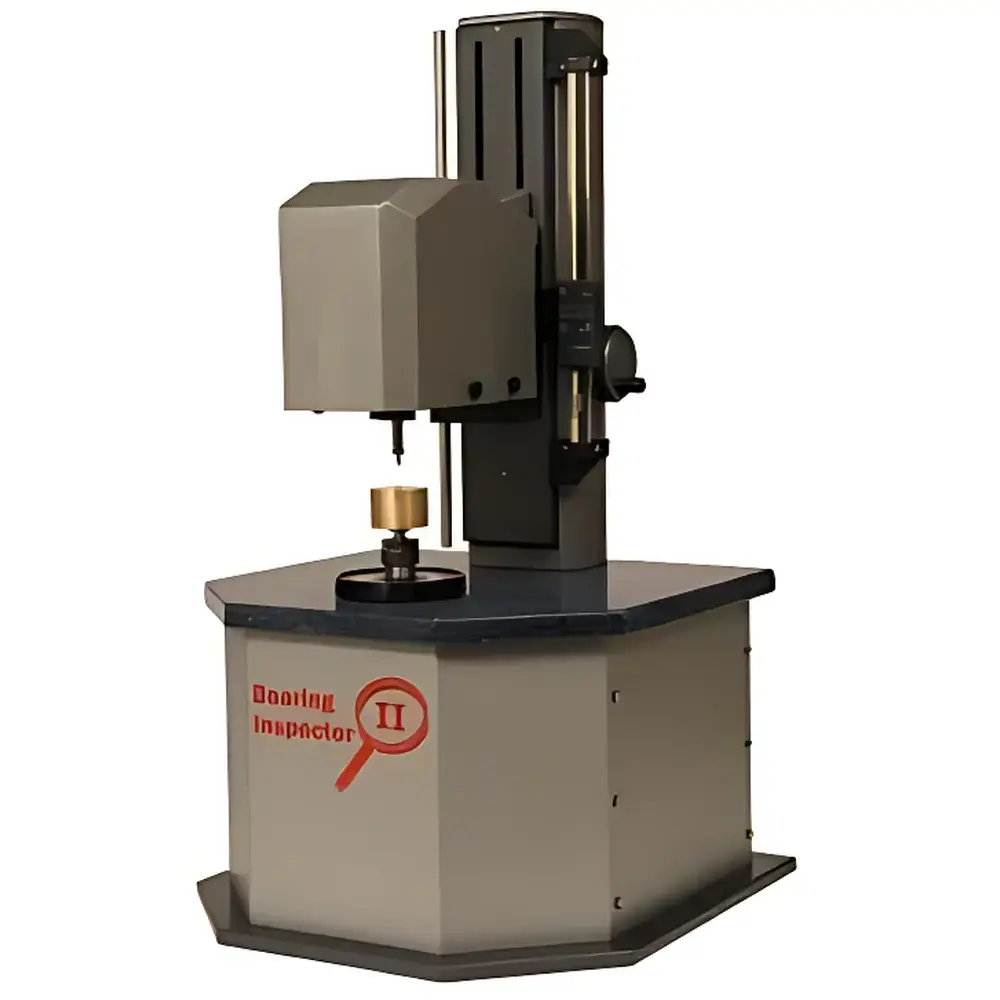
Vibrac BRG-3000 Bearing Torque Tester
| Brand | Vibrac |
|---|---|
| Origin | USA |
| Model | BRG-3000 |
| Input Voltage | 115 VAC (220 VAC / 50 Hz optional) |
| Operating Temperature | 60–90 °F |
| Relative Humidity | ≤95% non-condensing |
| Test Stand | Model 9405A |
| Torque Sensor Type | Mini-series static torque sensor |
| Encoder Resolution | 9000 counts/rev, ±0.02° accuracy |
| Drive Motor | Adjustable 0.5–10 RPM synchronous motor with stepless speed control |
| Torque Ranges | 0.05–10.0 oz-in (3.59–718.82 g-cm), selectable via interchangeable sensors |
| Torque Accuracy | ±0.5% of full scale |
| Compliance | MIL-STD-206B |
Overview
The Vibrac BRG-3000 Bearing Torque Tester is a precision-engineered benchtop system designed for the quantitative evaluation of static and dynamic torque characteristics in rolling-element bearings and bearing assemblies. It operates on the principle of controlled rotational excitation combined with high-fidelity static torque transduction, enabling measurement of both breakaway (starting) torque and running torque within a single, repeatable test cycle. The system integrates a calibrated optical torque sensor, high-resolution angular position feedback via a 9000-line optical encoder, and a low-speed, constant-velocity synchronous motor—ensuring minimal inertial disturbance and exceptional repeatability across torque ranges from 0.05 oz-in to 10.0 oz-in (3.59–718.82 g-cm). Its architecture is purpose-built for quality assurance laboratories, aerospace component suppliers, and bearing manufacturers requiring traceable, standards-compliant torque validation under controlled environmental conditions (60–90 °F, ≤95% RH non-condensing).
Key Features
- Modular torque sensing: Interchangeable Mini-series static torque sensors enable rapid range reconfiguration—from ultra-low-torque microbearings (0.05 oz-in) to larger industrial assemblies (10.0 oz-in)—with corresponding software calibration updates.
- MIL-STD-206B compliance: Fully validated design and test methodology aligned with U.S. Department of Defense requirements for bearing torque verification, including defined test sequences, environmental tolerances, and data integrity protocols.
- High-resolution motion control: Stepless 0.5–10 RPM synchronous motor delivers stable rotational velocity with negligible speed ripple; paired with ±0.02° encoder accuracy for precise angular positioning during torque profiling.
- LabVIEW-based operator interface: Intuitive, icon-driven GUI developed using National Instruments LabVIEW facilitates rapid operator training, parameter presetting, and one-click test execution without manual configuration per run.
- Active overload protection: Integrated sensor-level fault detection prevents mechanical or electrical damage during unexpected resistance events—critical for safeguarding delicate bearing geometries and fragile torque transducers.
- Expandable I/O architecture: Standard configuration includes two RS-232 serial ports, one parallel port, four USB 2.0 interfaces, and an internal CD/DVD drive—supporting legacy peripheral integration, firmware updates, and offline report archiving.
Sample Compatibility & Compliance
The BRG-3000 accommodates a broad spectrum of bearing types—including deep-groove ball bearings, angular contact bearings, needle roller bearings, and miniature thrust assemblies—via adaptable mounting fixtures compatible with industry-standard bore diameters (typically 3–50 mm). Sample loading is performed manually onto the Model 9405A test stand, which features rigid kinematic alignment to minimize parasitic bending moments. All torque measurements are traceable to NIST-calibrated reference standards, and the system supports audit-ready documentation required for ISO 9001, AS9100, and FAA Part 21 production approvals. Test reports may be configured to satisfy MIL-STD-206B Section 4.3 torque acceptance criteria, including maximum allowable starting torque limits and running torque consistency thresholds.
Software & Data Management
Data acquisition, real-time visualization, and post-test analysis are managed through a dedicated LabVIEW application with embedded calibration management and GLP-compliant metadata tagging. Each test record automatically logs timestamp, operator ID, sensor serial number, environmental readings (temperature/humidity), and full torque-vs-angle waveform data at ≥1 kHz sampling rate. Raw datasets export natively to CSV or TDMS formats; custom report templates allow filtering by customer-specific fields (e.g., part number, lot ID, inspection station) and output to screen, thermal strip chart printer, or networked laser printer. Audit trails comply with FDA 21 CFR Part 11 requirements when deployed in regulated manufacturing environments—supporting electronic signatures, user access controls, and immutable record retention.
Applications
- Pre-shipment QA for aerospace-grade bearings subject to MIL-B-7801, MIL-B-81820, and SAE-AS7928 specifications.
- Diagnostics of contamination-induced torque anomalies, raceway surface defects (pitting, spalling), cage misalignment, and lubricant degradation effects.
- Validation of assembly integrity following grease replenishment, shield installation, or preload adjustment procedures.
- Comparative benchmarking of competing bearing designs under identical test boundary conditions.
- Supporting root-cause analysis in failure investigations where torque hysteresis, stick-slip behavior, or abnormal peak-to-peak variation is observed.
- Process capability studies (Cp/Cpk) for high-volume bearing production lines requiring statistical process control of torque parameters.
FAQ
What torque ranges does the BRG-3000 support, and how are sensor changes performed?
The system supports seven factory-calibrated torque ranges (0.05–10.0 oz-in) via physically interchangeable Mini-series static torque sensors. Sensor replacement requires only mechanical unbolting of the test head assembly and software selection of the new sensor’s calibration file—no hardware rewiring or firmware flashing is needed.
Is the BRG-3000 suitable for testing sealed or shielded bearings?
Yes. The Model 9405A test stand accommodates both open and sealed configurations. Fixture tooling ensures axial preload is minimized during rotation to avoid false torque elevation from seal drag—consistent with MIL-STD-206B Clause 4.2.2.
Can test data be exported to statistical analysis platforms like Minitab or JMP?
Absolutely. All torque-angle waveforms and summary statistics (mean running torque, max breakaway torque, standard deviation) export directly to CSV or TDMS, enabling seamless import into third-party SPC software without format conversion.
Does the system meet requirements for FDA-regulated medical device component testing?
When deployed with validated user access controls, electronic signature workflows, and audit trail logging enabled, the BRG-3000 satisfies 21 CFR Part 11 for torque verification of orthopedic implant bearing components and surgical instrument mechanisms.
What maintenance intervals are recommended for long-term measurement stability?
Annual recalibration against NIST-traceable torque standards is recommended. Optical encoder alignment verification and motor brush inspection (if applicable) should occur every 12 months or after 5,000 test cycles—whichever comes first.



