
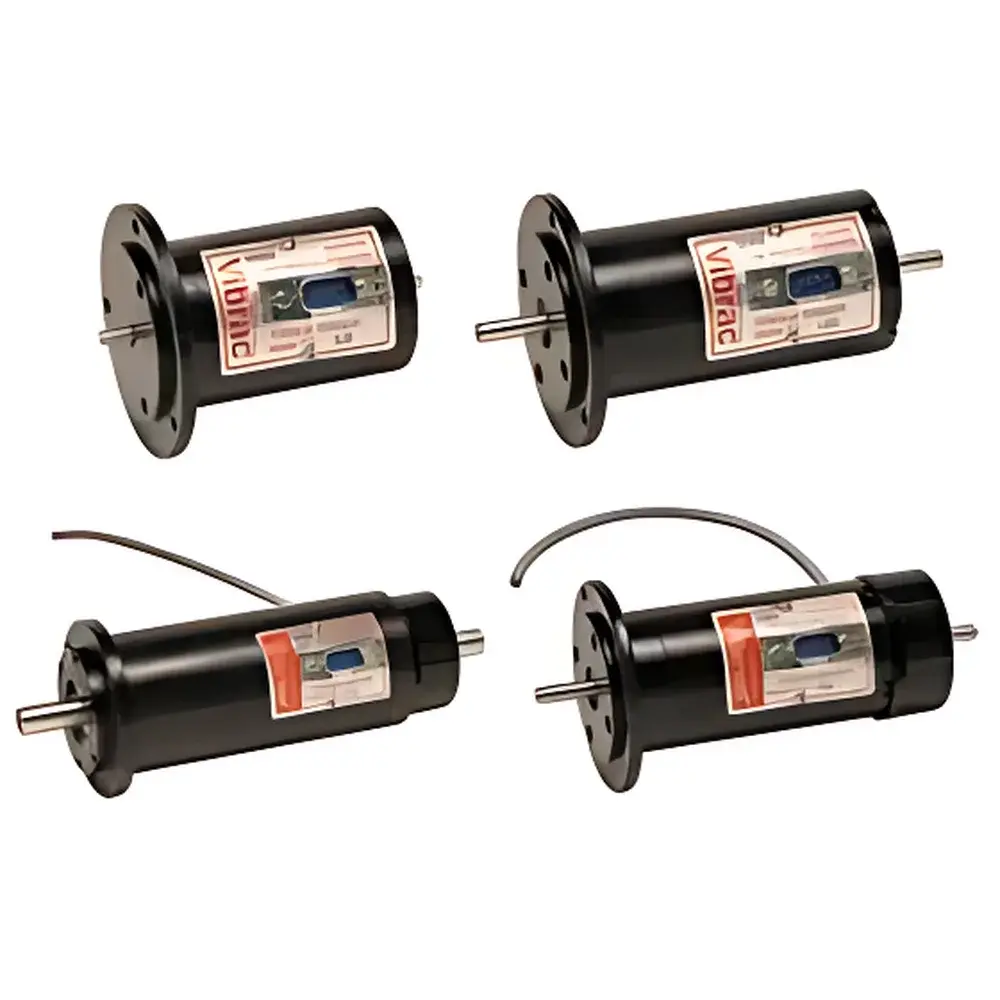
Vibrac TQ Optical Torque Sensor
| Brand | Vibrac |
|---|---|
| Origin | USA |
| Model | TQ |
| Torque Range | 0.05 oz·in to 400 in·lb (0.00035 N·m to 36 N·m) |
| Output Type | Analog current proportional to torque |
| Operating Principle | Non-contact optical encoder-based angular displacement transduction |
| Rotational Inertia | Low, optimized for dynamic measurement |
| Compliance | Suitable for ASTM E29, ISO/IEC 17025 environments with proper calibration traceability |
| Interface | Compatible with Vibrac 1312 Data Acquisition Board |
Overview
The Vibrac TQ Optical Torque Sensor is an engineered solution for high-fidelity torque measurement in both static and dynamic rotational systems. Based on a proprietary non-contact optical transduction principle, the sensor converts torsional deformation of a calibrated torque rod into a proportional analog current output via a precision-encoded shutter disk and high-output photovoltaic cell assembly. Unlike strain-gauge or magnetoelastic sensors, the TQ eliminates mechanical hysteresis, electrical drift, and bearing-induced friction—critical advantages in long-duration calibration studies, closed-loop motor control validation, and fatigue testing where signal integrity and repeatability are governed by ISO 5725-2 (accuracy and trueness) and ASTM E2586 (statistical analysis of test data). Its low rotational inertia enables faithful capture of transient torque events up to several hundred Hz bandwidth—making it suitable for characterizing brushless DC motor startup profiles, gear train backlash evaluation, and pump shaft load monitoring under variable-speed drive conditions.
Key Features
- Non-contact optical measurement architecture ensures zero wear, no signal degradation over time, and immunity to electromagnetic interference (EMI)
- Wide dynamic range spanning five orders of magnitude: 0.05 oz·in (0.00035 N·m) to 400 in·lb (36 N·m), supporting both micro-torque R&D and industrial powertrain validation
- High-output photovoltaic transducer delivers robust current signal (>10 mA full scale typical), minimizing susceptibility to noise in electrically hostile environments (e.g., near inverters or RF sources)
- Integrated torque rod design maintains torsional stiffness linearity within ±0.1% of reading across rated range, verified per ISO 376:2011 procedures for force-measuring instruments
- Compatible with the Vibrac 1312 data acquisition board, which provides programmable gain, low-pass filtering (1–5 kHz cutoff), and IEEE 1451.2-compliant TEDS support for automated sensor identification and calibration parameter loading
- Hermetically sealed housing rated IP54, with stainless steel torque rod and anodized aluminum body for corrosion resistance in laboratory and light industrial settings
Sample Compatibility & Compliance
The TQ sensor is designed for inline installation between rotating shafts and is compatible with standard coupling geometries (e.g., jaw, beam, bellows) using ANSI B11.19-compliant guarding interfaces. It supports bidirectional torque measurement without polarity inversion and accommodates shaft speeds up to 10,000 rpm at full-scale load. Calibration certificates are supplied with NIST-traceable uncertainty statements (k=2) per ISO/IEC 17025 requirements. When integrated into GxP-regulated workflows—including FDA 21 CFR Part 11–compliant systems—the 1312 DAQ board supports audit-trail logging, electronic signatures, and secure configuration change history, enabling compliance with GLP and GMP documentation standards for method validation and equipment qualification (IQ/OQ/PQ).
Software & Data Management
Vibrac provides the TQ Control Suite—a Windows-based application supporting real-time torque waveform visualization, statistical summary (mean, std dev, min/max, peak-to-peak), and export to CSV, HDF5, or MATLAB .mat formats. The software implements digital signal conditioning algorithms aligned with ISO 10012 (measurement management systems) and allows user-defined pass/fail limits with automated alerting. Raw analog outputs from the 1312 board are digitized at 16-bit resolution with 100 kS/s sampling rate; oversampling and decimation filters ensure effective noise suppression while preserving signal fidelity for FFT-based spectral analysis of torque ripple harmonics.
Applications
- Motor and actuator characterization: stall torque mapping, efficiency vs. load curves, and commutation ripple analysis
- Rotary valve and damper actuation testing under thermal cycling and humidity stress
- Biomechanical device validation: prosthetic joint torque response, surgical tool ergonomics assessment
- Automotive subsystem verification: EPS column torque feedback, HVAC blend door actuator lifecycle testing
- Academic research in tribology and viscoelasticity—where precise boundary torque input is required for controlled shear experiments
- Calibration lab reference standards for torque transducer intercomparison per ISO 376 Annex D
FAQ
What is the recommended recalibration interval for the TQ sensor?
Annual recalibration is advised under continuous operation; biennial intervals may be justified with documented stability monitoring per ISO/IEC 17025 clause 7.7.
Can the TQ sensor be used in vacuum or explosive atmospheres?
No—it is not rated for vacuum service or ATEX/IECEx zones; its IP54 enclosure requires ambient air cooling and standard atmospheric pressure for photovoltaic cell performance.
Is the 1312 data acquisition board required for operation?
While the TQ generates a native current output, the 1312 board is necessary to achieve specified accuracy, filtering, TEDS integration, and software compatibility—standalone use with generic current-input DAQ systems will compromise traceability and dynamic performance.
Does the sensor require external excitation or power supply?
No—its photovoltaic transduction is self-powered; only the 1312 DAQ board requires +15 VDC and ground.
How is thermal drift compensated during extended measurements?
The torque rod material (Inconel 718) and optical path geometry are thermally balanced; residual drift is <0.02% FS/°C, further mitigated by zero-tracking routines in TQ Control Suite.



