
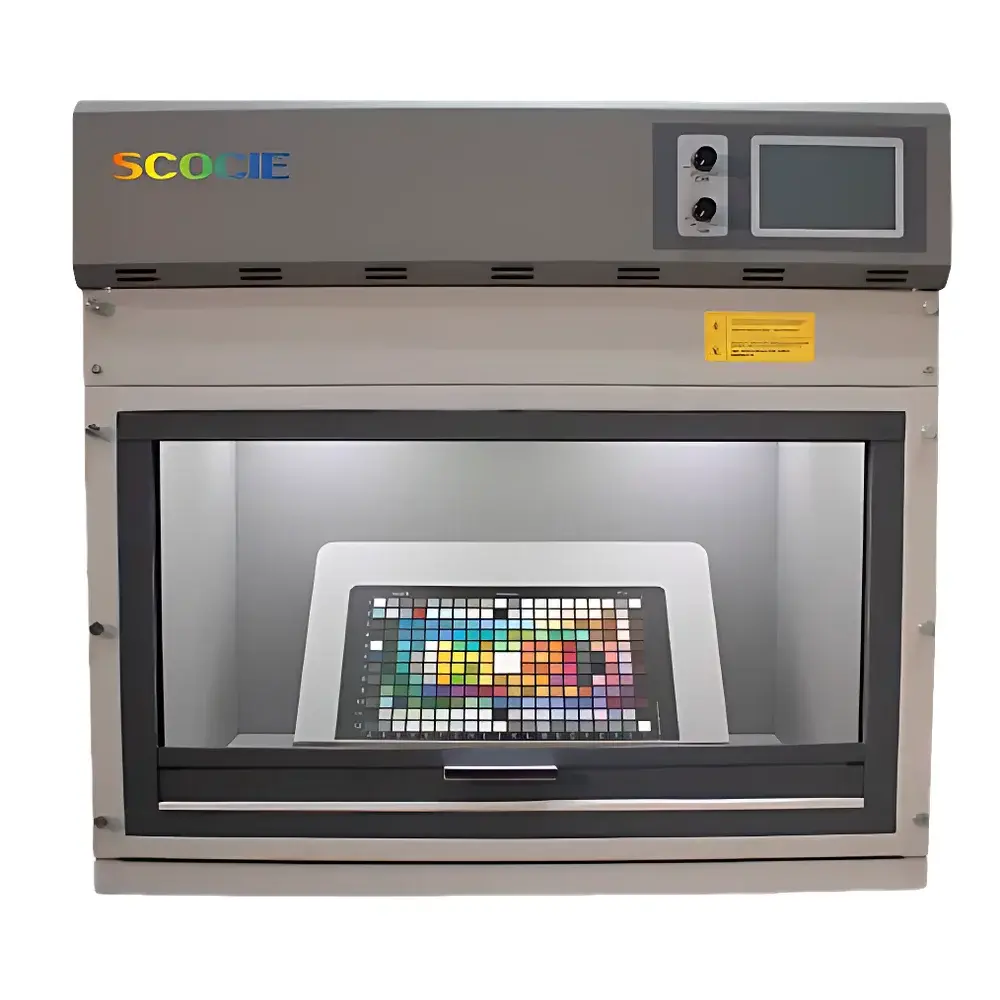
ViewTech FastnessGrade Digital Colorfastness Rating System
| Origin | Shanghai, China |
|---|---|
| Manufacturer Type | Authorized Distributor |
| Product Origin | Domestic (China) |
| Model | FastnessGrade |
| Price Range | USD 28,000 – 42,000 |
| Instrument Type | Benchtop Spectrophotometer |
| Optical Geometry | 0/45° Integrating Sphere |
| Illuminant | LED Array |
| Spectral Range | 350–700 nm |
| Repeatability (ΔE*ab) | ≤ 0.03 |
Overview
The ViewTech FastnessGrade Digital Colorfastness Rating System is a benchtop spectrophotometric imaging platform engineered for objective, repeatable assessment of textile and material colorfastness per international standards including ISO 105, AATCC TM16, AATCC TM8, AATCC TM150, and ISO 12947. Unlike conventional visual evaluation relying on human observers under standardized lighting, FastnessGrade integrates high-fidelity RGB imaging with calibrated spectral measurement (350–700 nm) to quantify chromatic shifts—both in the test specimen (change in hue, lightness, saturation) and in adjacent multifiber or white cotton substrates (staining transfer). Its 0/45° integrating sphere optical architecture ensures uniform illumination and diffuse reflectance capture, minimizing directional bias from surface texture or gloss. The system operates on a dual-evaluation paradigm: quantitative spectral analysis (ΔE*ab, ΔL*, Δa*, Δb*) complements image-based pattern recognition for multi-parameter performance grading—including pilling, abrasion resistance, and photostability—within a single acquisition cycle.
Key Features
- Integrated LED-based 0/45° spectrophotometric imaging with NIST-traceable calibration across 350–700 nm
- Dual-mode operation: automated digital rating (per ISO 105-A02, AATCC Evaluation Procedure 1) and manual reference-guided assessment
- Simultaneous multi-sample imaging: up to six specimens per frame, enabling batch processing without repositioning
- Embedded standard illuminant simulation (D65, A, F2, U30, D50) compliant with CIE S 014-2/E:2020 and ISO/CIE 11664-2
- Onboard spectral data export in CIE XYZ, L*a*b*, L*C*h*, and CMYK formats; supports ASTM E308 and CIE 15:2018 computation
- Robust mechanical design with temperature-stabilized optics and humidity-controlled sample chamber (optional)
Sample Compatibility & Compliance
FastnessGrade accommodates flat, flexible, and moderately textured substrates up to 200 × 200 mm, including woven/knitted textiles, nonwovens, leather, coated papers, and polymer films. It supports all major colorfastness test methods requiring visual or instrumental evaluation against standardized grey scales (ISO 105-A02), blue wool references (ISO 105-B02), and multifiber fabrics (ISO 105-F10). The instrument’s spectral repeatability (≤0.03 ΔE*ab) meets the precision requirements of ISO 17991:2016 for instrumental color difference measurement in quality control laboratories. Data integrity complies with GLP principles: audit trails record operator ID, timestamp, calibration status, and raw spectral files. Optional 21 CFR Part 11-compliant software modules support electronic signatures and role-based access control for regulated environments.
Software & Data Management
The FastnessGrade Control Suite (v4.x) provides a modular interface for method configuration, image acquisition, spectral analysis, and report generation. Built-in algorithms perform automatic region-of-interest (ROI) segmentation aligned with AATCC TM150 pilling charts and ISO 105-X12 crockmeter patterns. All spectral and image data are stored in vendor-neutral formats (CSV, TIFF, XML) compatible with LIMS integration. Batch reports include statistical summaries (mean ΔE, SD, CV%), pass/fail flags against user-defined tolerances, and annotated comparative images with overlay grids. Export options include PDF (ISO-compliant certificate format), Excel, and direct API endpoints for MES/ERP synchronization. Software validation documentation (IQ/OQ/PQ protocols) is available upon request for GMP-aligned deployments.
Applications
FastnessGrade serves as a unified platform across R&D, QC, and third-party testing labs. In textile manufacturing, it accelerates grading of wash, rub, light, and perspiration fastness—reducing inter-laboratory variability by eliminating subjective observer bias. Print and packaging users apply its spectral matching capability to verify ink consistency across substrate batches and assess metamerism under multiple illuminants. Food and agricultural applications include non-destructive maturity indexing of fruits (e.g., chlorophyll degradation tracking) and roast degree classification of coffee beans via L* trajectory modeling. Coating and automotive OEMs utilize its UV-enhanced mode (optional 365 nm LED) to quantify fluorescent additive concentration and monitor aging-induced chromatic drift in interior trims.
FAQ
Does FastnessGrade comply with ISO 105 and AATCC test method requirements?
Yes—it is validated for use in accordance with ISO 105-A02 (gray scale assessment), ISO 105-B02 (blue wool scale), and AATCC TM16 (lightfastness), supporting both instrumental and hybrid (instrument-assisted visual) grading workflows.
Can the system evaluate non-textile materials such as plastics or painted surfaces?
Yes—its 0/45° geometry and broad spectral range enable reliable color difference measurement on matte, semi-gloss, and textured non-fibrous substrates, provided surface curvature and reflectivity fall within defined operational limits.
Is remote operation and data sharing supported?
Yes—the system includes secure HTTPS-based web interface for real-time monitoring, image/data export via encrypted cloud sync, and collaborative annotation tools for geographically distributed QA teams.
What calibration standards are supplied and how often must they be renewed?
Each unit ships with NIST-traceable ceramic tile standards (white, black, gray) and a certified multifiber reference fabric. Annual recalibration is recommended; full traceability documentation is provided with each service event.
How does FastnessGrade handle metamerism detection?
By capturing full-spectrum reflectance data at 10 nm intervals, the software computes metameric index (MI) values per CIE 15:2018 Annex D and identifies illuminant-dependent mismatch risks across D65, A, and F2 viewing conditions.




