
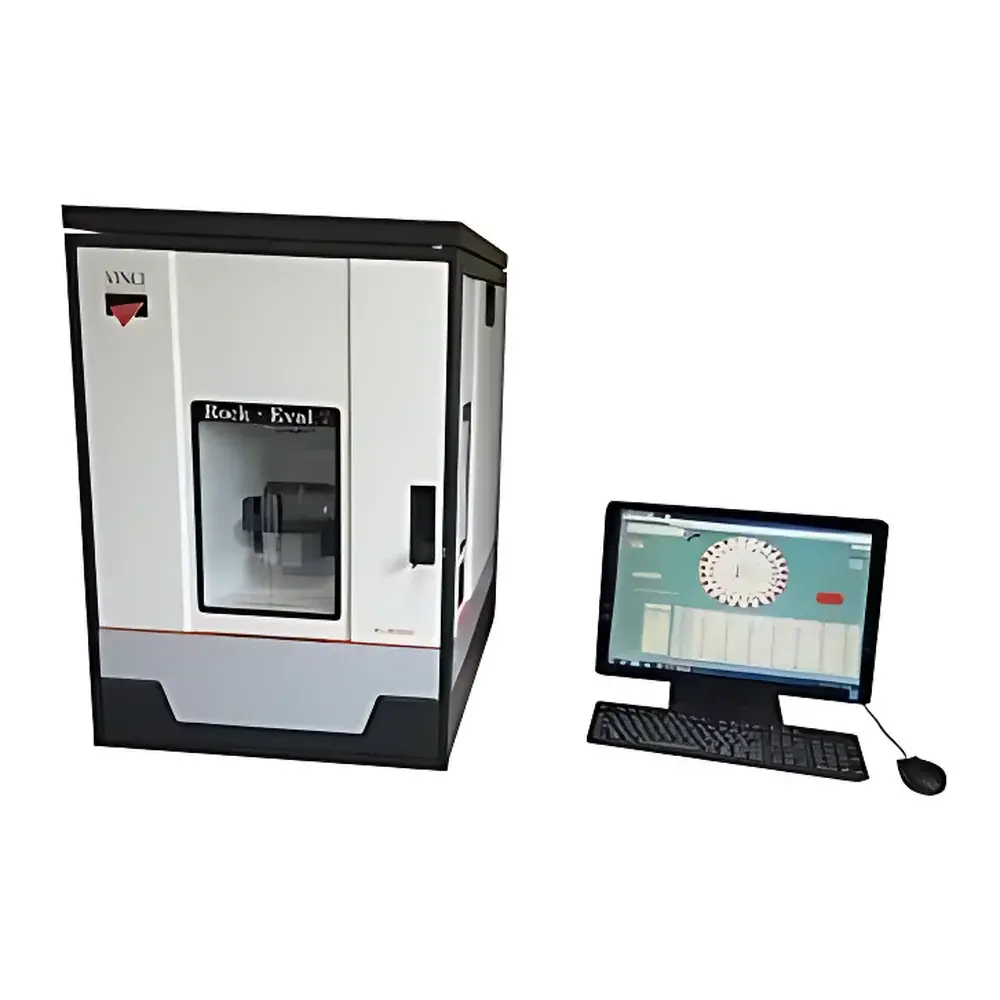
VINCI RE 7 Automated Rock Pyrolysis Analyzer
| Brand | VINCI |
|---|---|
| Origin | France |
| Model | RE 7 |
| Max Temperature | 850 °C |
| Application | Geochemical Analysis of Organic Matter in Sedimentary Rocks |
| Compliance | Designed for ASTM D7169, ISO 10375, and USP <232>/<233> trace element context |
Overview
The VINCI RE 7 Automated Rock Pyrolysis Analyzer is a dedicated geochemical instrumentation platform engineered for quantitative thermal characterization of organic matter in sedimentary rock samples. It operates on the principle of controlled-step pyrolysis followed by high-temperature oxidation within two independent, precisely regulated furnaces. The first furnace performs programmed pyrolysis under inert atmosphere (typically helium or nitrogen), volatilizing kerogen-bound hydrocarbons and releasing free hydrocarbons (S1 peak), bound hydrocarbons (S2 peak), and residual carbon (S3-derived CO₂). The second furnace—thermally isolated and independently calibrated—oxidizes the residual carbonaceous residue at up to 850 °C, quantifying the mineral-associated carbon (MINC) and enabling accurate calculation of total organic carbon (TOC = S1 + S2 + (S3 × k), where k is instrument-specific calibration factor). This dual-furnace architecture eliminates cross-contamination, ensures thermal stability across sequential runs, and delivers high reproducibility (<2% RSD for TOC in replicate shale samples per ASTM D7169 interlaboratory study protocols).
Key Features
- Dual independent high-precision furnaces with individual PID temperature control and real-time thermocouple feedback (±0.5 °C accuracy from 50–850 °C)
- Automated sample loading carousel accommodating up to 24 standard 10-mm-diameter rock powder crucibles (ASTM D5308-compliant geometry)
- Integrated mass flow controllers for carrier gas (He/N₂) and oxygen, with programmable gas switching between pyrolysis and oxidation phases
- High-sensitivity flame ionization detector (FID) for hydrocarbon quantification and non-dispersive infrared (NDIR) detector for CO/CO₂ measurement
- Onboard calibration verification using certified reference materials (CRM) such as USGS SDO-1 and NIST SRM 2710a
- Rugged stainless-steel fluidic path with heated transfer lines (maintained at 220 °C) to prevent condensation of heavy hydrocarbons
Sample Compatibility & Compliance
The RE 7 accepts powdered rock specimens (grain size ≤125 µm, dried at 60 °C for 24 h prior to analysis), including shales, carbonates, coals, and source rock cuttings. Sample mass is automatically weighed (0.05–1.0 g range) via integrated microbalance with ±10 µg resolution. The system complies with method requirements outlined in ASTM D7169 (Standard Test Method for Determination of Hydrocarbon Types in Middle Distillates by High Performance Liquid Chromatography), ISO 10375 (Petroleum products — Determination of hydrocarbon types — High-performance liquid chromatography), and aligns with data integrity expectations of FDA 21 CFR Part 11 when configured with VINCI PyroSoft™ v4.2+ and electronic signature modules. All thermal profiles, detector responses, and calibration logs are timestamped and stored with immutable audit trails.
Software & Data Management
VINCI PyroSoft™ is a Windows-based acquisition and interpretation suite supporting ICH M7 and Q5C data handling standards. It provides automated peak integration (S1, S2, S3, CO₂), kinetic modeling (Ea distribution via distributed activation energy model – DAEM), HI/OI diagram generation (van Krevelen plots), and petroleum generation potential assessment (Tmax, PI, OI, HI indices). Raw chromatograms and thermograms are saved in .cdf format compatible with third-party chemometric tools (e.g., MATLAB, Python pandas). Data export supports CSV, PDF reports (with lab logo, analyst ID, and QC flagging), and direct LIMS integration via ASTM E1467-compliant API.
Applications
- Quantitative TOC and MINC determination in exploration well cuttings and core samples
- Source rock evaluation: kerogen typing (Types I–IV), thermal maturity assessment (Tmax), and hydrocarbon generation potential mapping
- Basin modeling input parameter derivation (kinetic parameters, activation energy distributions)
- Quality control of rock-eval equivalent data in commercial geochemistry labs accredited to ISO/IEC 17025
- Method validation studies for regulatory submissions under EPA Method 8270D and APHA Standard Methods 5310B
FAQ
What sample preparation is required prior to analysis?
Rock samples must be crushed to ≤125 µm, dried at 60 °C for 24 hours, and homogenized. Carbonate correction (via acid treatment) is performed offline per ASTM D3682 if MINC interference is suspected.
Can the RE 7 differentiate between bitumen and kerogen-derived hydrocarbons?
Yes—the S1/S2 ratio, combined with Tmax and production index (PI = S1/(S1+S2)), enables semi-quantitative distinction; full speciation requires coupling with GC-MS, for which the RE 7’s effluent stream is compatible via optional transfer interface.
Is remote diagnostics supported?
VINCI Remote Assist (v2.1+) enables secure TLS 1.3–encrypted connection for firmware updates, error log retrieval, and real-time furnace performance monitoring by certified service engineers.
How often does the system require recalibration?
Daily bracketing with CRM is recommended; full multi-point calibration (temperature, FID response, NDIR linearity) is performed quarterly or after furnace maintenance, per VINCI Maintenance Protocol MP-RE7-04.
Does the RE 7 meet environmental safety standards for laboratory use?
The unit incorporates catalytic scrubbers for post-combustion NOx/SOx abatement and meets EN 61000-6-3 (EMC) and EN 61000-6-4 (emissions) for Class A laboratory equipment.




