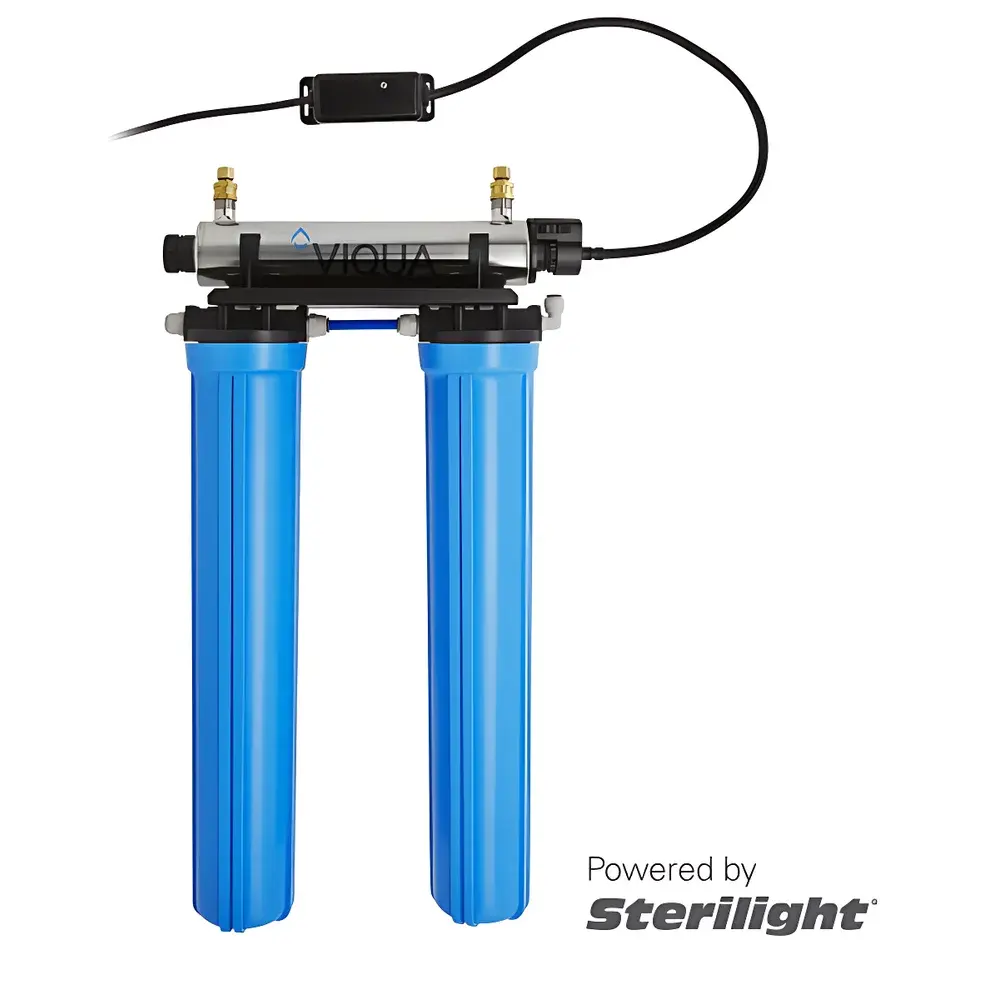
Viqua VT4-DWS Ultraviolet Water Disinfection System
| Brand | Viqua |
|---|---|
| Origin | Imported |
| Manufacturer Type | Authorized Distributor |
| Model | VT4-DWS |
| Pricing | Available Upon Request |
Overview
The Viqua VT4-DWS Ultraviolet Water Disinfection System is an NSF/ANSI 55 Class A certified point-of-entry (POE) UV disinfection unit engineered for continuous, chemical-free microbial inactivation in potable water applications. It operates on the principle of ultraviolet germicidal irradiation (UVGI), delivering a minimum validated UV dose of 40 mJ/cm² at the end of lamp life under rated flow conditions—sufficient to achieve ≥4-log (99.99%) inactivation of bacteria (e.g., E. coli, Legionella pneumophila), viruses (e.g., rotavirus, hepatitis A), and protozoan cysts (e.g., Cryptosporidium parvum, Giardia lamblia). Unlike filtration or chemical treatment, UV disinfection does not alter water chemistry, add residuals, or generate disinfection by-products (DBPs). The VT4-DWS is designed for installation downstream of primary particulate and chlorine removal stages, ensuring optimal transmittance (UVT ≥75% at 254 nm) and maximizing pathogen exposure to 254 nm UV-C photons emitted by its low-pressure, high-output amalgam lamp.
Key Features
- NSF/ANSI 55 Class A certification for microbiological reduction in municipally treated water—validated per NSF Protocol P231 for virus and protozoan inactivation.
- Integrated UV intensity sensor with real-time monitoring and automatic system shutdown if dose falls below threshold, ensuring compliance with regulatory performance requirements.
- Stainless steel 316L reactor chamber with polished internal surface (Ra ≤ 0.8 µm) to minimize biofilm adhesion and maximize UV reflectivity.
- Digital control panel with LCD display showing operational status, lamp hours, UV intensity, flow rate, and fault diagnostics—including lamp end-of-life warning and quartz sleeve fouling detection.
- Automatic wiper mechanism (optional) for quartz sleeve cleaning without system shutdown, maintaining consistent UVT transmission in hard-water or high-turbidity environments.
- Flow-rated design supporting up to 4.0 gpm (15.1 L/min) at 40 mJ/cm² minimum delivered dose—suitable for residential, commercial, and light institutional service points.
Sample Compatibility & Compliance
The VT4-DWS is intended for use with pre-treated, clarified potable water meeting the following feedwater specifications: turbidity ≤1 NTU, iron ≤0.3 ppm, manganese ≤0.05 ppm, hardness ≤7 gpg, and UVT ≥75% at 254 nm. It is not a standalone filtration device and must be paired with appropriate pretreatment (e.g., sediment filter, carbon block, softener) to prevent lamp shielding and quartz sleeve scaling. The system complies with NSF/ANSI 55 Class A, CSA B483.1, and meets the technical basis for EPA Guidance Manual for UV Disinfection of Drinking Water (2021). It supports GLP/GMP-aligned operation when integrated into documented water quality management systems, including audit-ready event logging compatible with FDA 21 CFR Part 11–enabled data acquisition platforms.
Software & Data Management
While the VT4-DWS operates as a stand-alone electromechanical system without cloud connectivity, its digital controller provides time-stamped operational logs stored locally for ≥12 months. These logs include lamp ignition cycles, cumulative UV dose delivery, intensity decay trends, and alarm events (e.g., low-intensity, flow bypass, power interruption). Optional analog 4–20 mA output enables integration with building management systems (BMS) or SCADA networks for remote status monitoring. For regulated environments, the system supports manual export of log files via USB interface for inclusion in validation reports, routine maintenance records, and annual requalification dossiers per ISO/IEC 17025 or USP water system guidelines.
Applications
The VT4-DWS serves as a final barrier in multi-stage water treatment systems across diverse non-industrial settings: residential single-family and multi-dwelling units; foodservice establishments requiring NSF/ANSI 151-compliant rinse water; healthcare facilities managing ancillary non-sterile water points (e.g., handwashing sinks, ice machines); educational campuses with distributed potable water loops; hospitality venues seeking odor- and chlorine-free drinking water; and recreational facilities where pathogen control in recirculated makeup water is critical. It is commonly deployed upstream of reverse osmosis polishing or post-carbon polishing to eliminate microbial regrowth without compromising membrane integrity or carbon adsorption capacity.
FAQ
Does the VT4-DWS remove heavy metals, lead, chlorine, or taste/odor compounds?
No. UV disinfection targets microorganisms only. Removal of dissolved contaminants requires complementary technologies: activated carbon for chlorine, chloramines, VOCs, and organoleptics; ion exchange or RO for lead and heavy metals; and mechanical filtration for particulates.
Is annual lamp replacement mandatory—even if the lamp appears functional?
Yes. UV output degrades over time. Amalgam lamps are rated for 9,000–12,000 hours; performance verification requires replacement at 12-month intervals or per manufacturer’s specified lamp life, whichever occurs first, to ensure consistent 40 mJ/cm² delivery.
Can the system operate continuously under variable flow conditions?
It is flow-compensated within its rated range (0.5–4.0 gpm). Below 0.5 gpm, dwell time exceeds design parameters and may cause overheating; above 4.0 gpm, UV dose falls below 40 mJ/cm², compromising disinfection efficacy.
Is third-party validation required before commissioning?
Yes. Initial validation must include UVT measurement, flow profiling, and biodosimetry (e.g., using MS2 coliphage challenge) per NSF/ANSI 55 Annex B or DVGW W294 protocols to confirm site-specific performance.
What maintenance tasks are required beyond lamp replacement?
Quartz sleeve inspection and cleaning every 3–6 months (more frequently in hard-water areas), O-ring replacement during lamp change, and annual verification of sensor calibration and control logic integrity.