
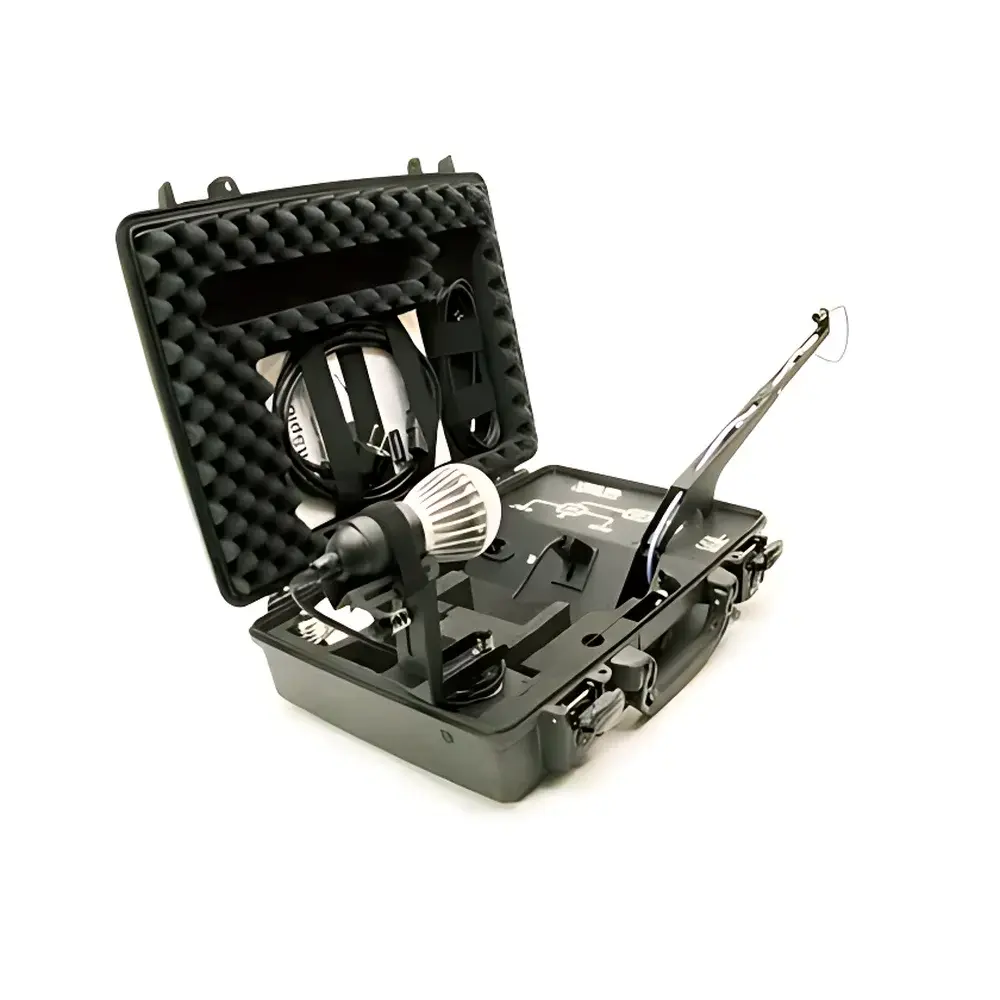
Viso LightSpion Portable Distributed Photometer
| Origin | Denmark |
|---|---|
| Manufacturer Type | Authorized Distributor |
| Origin Category | Imported |
| Model | LightSpion |
| Price | USD 42,000 (FOB Copenhagen) |
| Weight | 5 kg (operational), 6 kg (shipping) |
| Dimensions | 43 × 11.5 × 33.5 cm |
| Detector Distance | 66 cm |
| Source Diameter Range | 0–80 mm |
| Max Source Weight | 2 kg |
| Power Input | 90–260 VAC, 50/60 Hz |
| USB Current Draw | 200 mA |
| Power Analyzer Voltage Range | 90–260 VAC (±0.2 V) |
| Current Range | 0–3 A (±0.1 mA avg.) |
| Power Range | 0–300 W (±0.001 W avg.) |
| Sampling Rate | 70,000 samples/sec |
| Luminous Flux Range | 10–50,000 lm |
| Flux & Luminance Accuracy | ±4% for LEDs, ±7.82% for other sources |
| Luminous Intensity Range | 0.05–200,000 cd (±2.5%) |
| CCT Range | 1,000–10,000 K (±35 K) |
| CRI Range | 0–100 (±0.7) |
| Angular Resolution | 4°/step (Low Mode), 1°/step (High Mode) |
| Spectral Engine | STS Ocean Insight OEM spectrometer, factory-calibrated plug-and-play module |
| Recalibration Interval | Every 24 months |
| Reference Lamp | Integrated isotropic calibration lamp with traceable NIST-traceable documentation |
Overview
The Viso LightSpion Portable Distributed Photometer is an engineered solution for rapid, field-deployable photometric characterization of linear and compact light sources—designed specifically to address the longstanding metrological gap in measuring elongated emitters such as LED tubes, strip lights, and modular luminaires. Unlike conventional goniophotometers requiring darkroom installation and multi-hour measurement cycles, LightSpion implements a distributed photometric principle based on high-resolution angular scanning combined with spectral radiance integration at fixed detector distance (66 cm). Its core architecture integrates a calibrated STS-series Ocean Insight spectrometer with a synchronized power analyzer and motorized rotational stage, enabling simultaneous acquisition of spectral power distribution (SPD), luminous intensity distribution (LID), total luminous flux (lumens), correlated color temperature (CCT), and color rendering index (CRI) — all within ≤30 seconds per measurement sequence. The system operates independently of environmental ambient light due to its narrow-band optical filtering and real-time background subtraction algorithm, permitting valid measurements outdoors or in unshielded commercial environments — a capability validated per IES LM-79-19 Annex B and CIE S 025/E:2015 requirements for portable photometry.
Key Features
- True portable goniophotometric functionality: No darkroom, no fixed mounting — operational on tabletop, ladder-mounted, or handheld tripod configurations
- Dual-mode angular resolution: Selectable 1°/step (High Mode) for precision IESNA LM-63 export or 4°/step (Low Mode) for rapid QA screening
- Integrated power analyzer compliant with IEC 62301 Ed. 2.0 and EN 62301:2011 for simultaneous electrical parameter logging (V, I, P, PF, THD)
- NIST-traceable isotropic reference lamp included with full calibration certificate and spectral irradiance dataset for on-site system integrity verification
- Linear source handling: Accommodates sources up to 80 mm diameter and 2 kg mass; supports segmented measurement protocol for sources >1 m length via Viso Light Inspector software interpolation
- Factory-calibrated STS spectrometer with UV-VIS-NIR response (350–1000 nm), thermal stabilization, and automatic wavelength alignment
- Ruggedized aluminum chassis rated IP52 for dust resistance and mechanical shock absorption during transport (MIL-STD-810G compliant)
Sample Compatibility & Compliance
LightSpion is validated for photometric evaluation of LED-based linear luminaires (T5/T8/T12 equivalents), COB arrays, flexible strips, OLED panels, and compact fluorescent lamps. It meets the geometric constraints defined in CIE 127:2007 for “Type A” (far-field) photometry and supports data export in standard formats including IESNA LM-63-19, EULUMDAT (*.ldt), and CSV with SI-traceable units. All optical calibrations are performed against PTB/NIST-traceable standards under ISO/IEC 17025-accredited conditions. The integrated power analyzer satisfies EN 61000-3-2 Class C harmonic emission limits and provides RMS-accurate readings per IEEE 1459-2010 definitions. System firmware and calibration records support audit readiness for ISO 9001, ISO/IEC 17025, and FDA 21 CFR Part 11-compliant environments when paired with Viso Light Inspector’s optional electronic signature and audit trail module.
Software & Data Management
Viso Light Inspector v4.x (Windows 10/11, 64-bit) serves as the unified control, analysis, and reporting interface. It features automated measurement sequencing, real-time spectral visualization, spatially resolved chromaticity mapping, and batch processing for production line throughput. Raw datasets include timestamped metadata (temperature, humidity, operator ID, instrument serial), enabling full GLP/GMP traceability. Export options include PDF test reports with embedded digital signatures, Excel-compatible structured data, and direct upload to enterprise LIMS via REST API. Calibration history, drift compensation logs, and reference lamp validation records are stored in encrypted SQLite databases with SHA-256 hash integrity verification. Software updates follow a controlled release cycle aligned with IEC 62304 Class B medical device software guidelines.
Applications
- On-site photometric verification for lighting retrofits and energy performance contracts (EPCs)
- Manufacturing QA/QC of LED tubes and linear modules prior to shipment
- Third-party certification lab support for ENERGY STAR®, DLC, and CE marking submissions
- R&D characterization of novel phosphor-converted or hybrid white-light sources
- Field validation of lumen maintenance (LM-80/LM-84 extrapolation anchor points)
- Educational use in photometry laboratories where space and budget constrain traditional goniophotometer deployment
FAQ
What is the minimum measurable source length for linear lamps?
LightSpion requires ≥100 mm of continuous emitting surface for stable angular sampling; shorter segments may be measured but require manual correction factors applied in Viso Light Inspector.
Can LightSpion measure UV or IR-emitting sources?
The STS spectrometer covers 350–1000 nm only; UV-C (1000 nm) emissions fall outside its spectral range and require dedicated instrumentation.
Is recalibration required before each use?
No — the integrated reference lamp enables daily functional verification; full recalibration is recommended every 24 months or after physical impact exceeding 50 g-force.
Does the system comply with IES TM-30-20 metrics?
Yes — Viso Light Inspector calculates Rf (fidelity index) and Rg (gamut index) using the official CIE 026:2018 calculation engine and includes spectral sample export for third-party TM-30 analysis.
How is measurement uncertainty quantified for luminous flux?
Expanded uncertainty (k=2) is ±4.2% for LED sources at 25°C ambient, derived from Type A (repeatability) and Type B (calibration, alignment, thermal drift) components per GUM (JCGM 100:2008).
Related Products





