
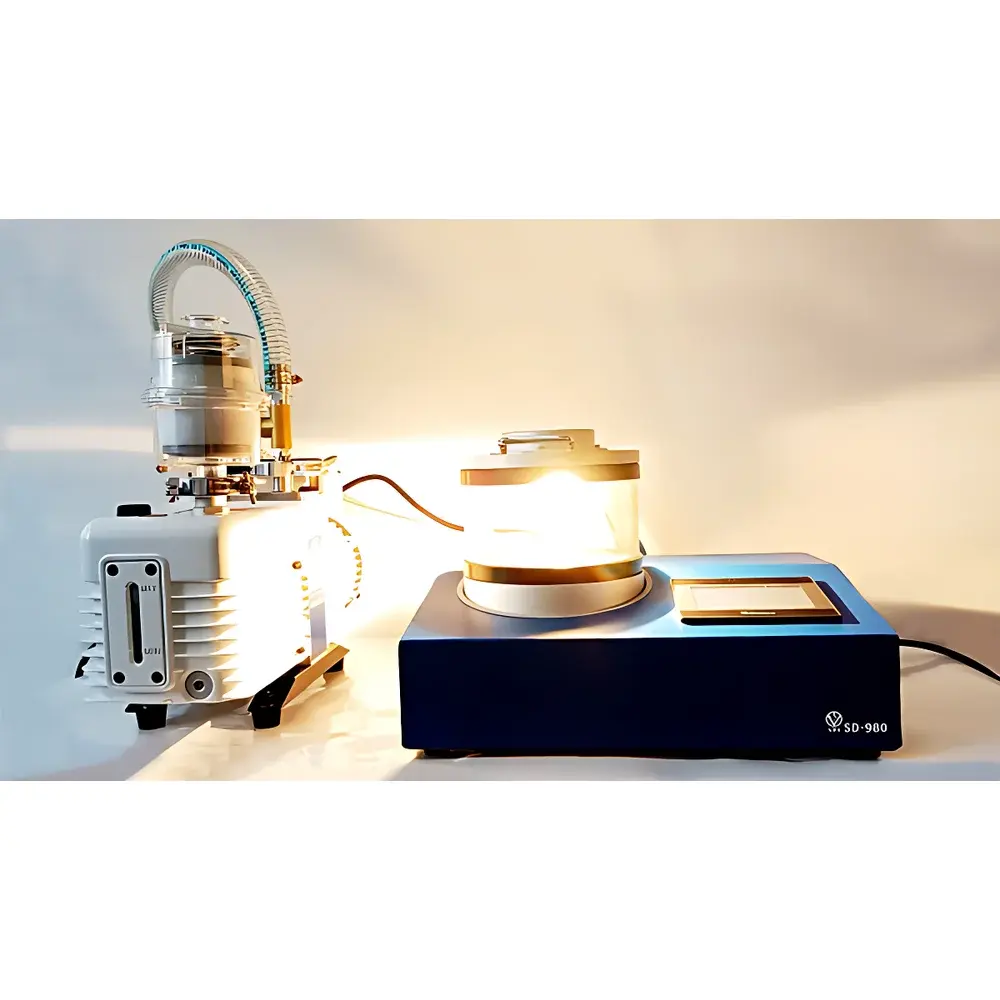
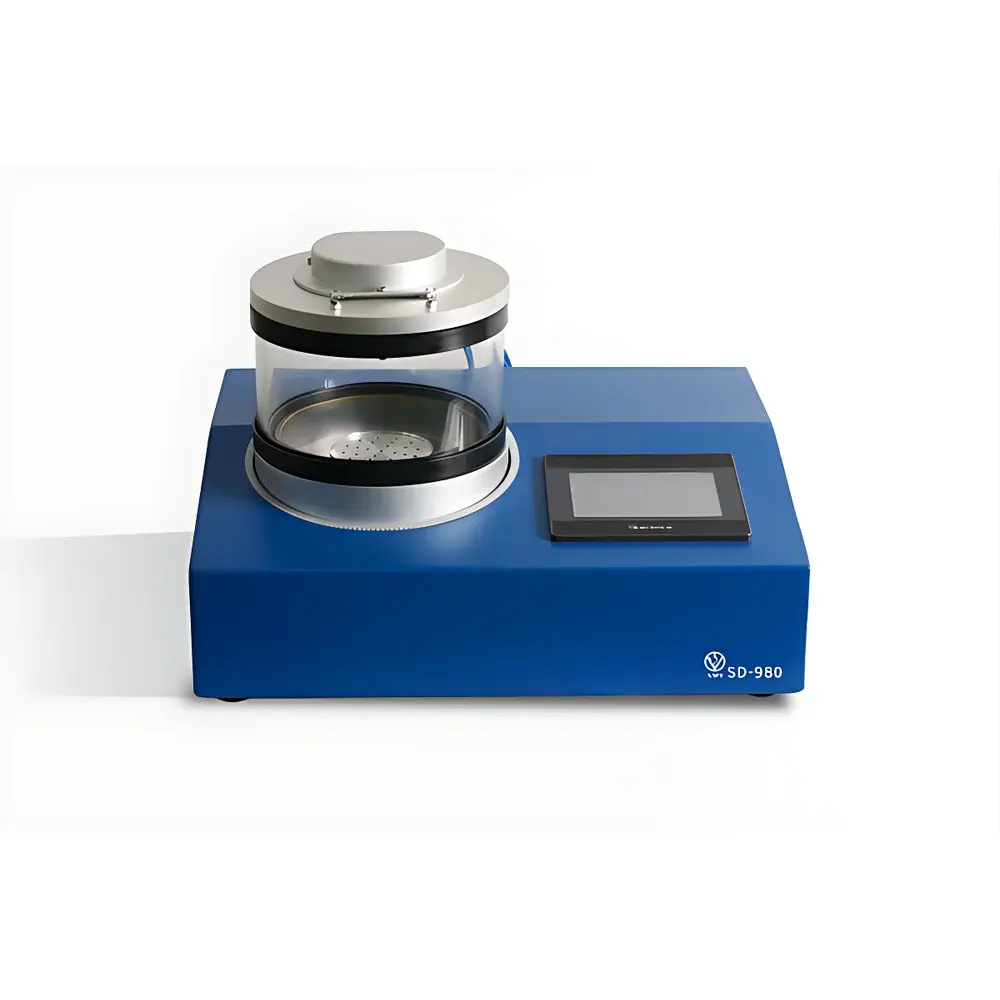
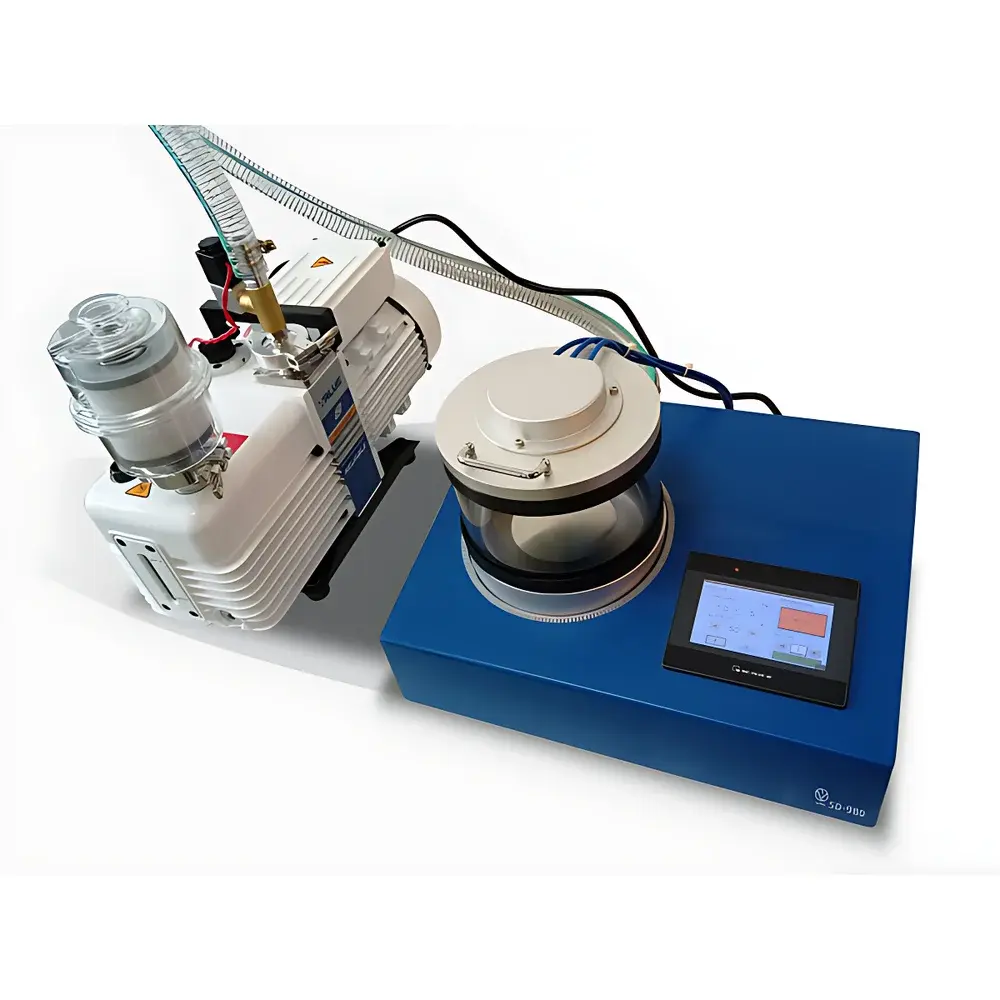
VPI SD-980 Thermal Evaporation Carbon Coater
| Brand | VPI |
|---|---|
| Model | SD-980 |
| Type | Thermal Evaporation Coater |
| Origin | Beijing, China |
| Target Material | Carbon Fiber Rope |
| Target Diameter | 30 mm |
| Chamber Dimensions (W×D×H) | 340 × 390 × 300 mm |
| Sample Stage Diameter | 70 mm |
| Vacuum Chamber (D×H) | 160 × 110 mm (Borosilicate Glass) |
| Ultimate Vacuum | 5 Pa |
| Evaporation Current Range | 50–80 A |
| Pulse Count Setting | 0–9 pulses |
| Control Interface | Touchscreen HMI |
| Power Supply | 220 V AC, 50 Hz, Grounded |
| Pump | VRD-8 Rotary Vane Pump (2 L/min) |
| Weight | ~50 kg |
| Max. Power Consumption | 1.6 kW |
| Sputtering Gas Required | None |
Overview
The VPI SD-980 Thermal Evaporation Carbon Coater is a benchtop vacuum deposition system engineered for high-reproducibility carbon coating of non-conductive specimens prior to scanning electron microscopy (SEM), transmission electron microscopy (TEM), and energy-dispersive X-ray spectroscopy (EDS) analysis. Unlike ion sputter coaters that rely on plasma-driven physical vapor deposition (PVD), the SD-980 employs resistive thermal evaporation—where high-purity carbon fiber rope is heated under vacuum to generate a directional vapor flux that condenses uniformly onto cooled or ambient-temperature substrates. This process yields ultra-thin (sub-5 nm), low-resistivity, amorphous carbon films with minimal topographic distortion and negligible charging artifacts—critical for high-resolution imaging and quantitative microanalysis. The system operates at a base pressure of ≤5 Pa, sufficient to suppress oxidative degradation of carbon vapor while maintaining stable thermal emission kinetics and avoiding arcing or filament failure.
Key Features
- Resistive thermal evaporation using high-purity carbon fiber rope (30 mm diameter), enabling rapid, uniform, and contamination-free carbon film deposition without inert gas supply.
- Adjustable evaporation current (50–80 A) for precise control over deposition rate and film thickness—optimized to prevent thermal damage to heat-sensitive samples such as polymers, biological tissues, or hydrated gels.
- Two operational modes: continuous (Flash) mode for rapid full-surface coverage; and programmable pulsed mode (0–9 discrete pulses) for nanoscale thickness control and reduced particulate generation—ideal for TEM grid coating and EDS calibration standards.
- Integrated touchscreen human-machine interface (HMI) with intuitive menu navigation, real-time parameter display, and repeatable recipe storage—supporting GLP-compliant workflow documentation when paired with external logging systems.
- Borosilicate glass vacuum chamber (160 mm × 110 mm D×H) provides optical access for visual alignment and process monitoring; combined with a large sample chamber (340 × 390 × 300 mm W×D×H) and 70 mm diameter rotating sample stage for multi-specimen throughput.
- Vacuum interlock circuitry prevents power delivery below safe operating pressure, eliminating risk of electrical short-circuiting or filament oxidation during pump-down or venting cycles.
Sample Compatibility & Compliance
The SD-980 accommodates standard SEM stubs (up to 50 mm), TEM grids (3.05 mm), silicon wafers, glass slides, and irregularly shaped bulk specimens up to 70 mm in diameter. Its low-energy thermal evaporation mechanism preserves delicate surface morphology and avoids ion-induced damage common in sputter-based methods—making it especially suitable for soft materials, nanoparticles, and beam-sensitive organic compounds. The system meets essential safety and electromagnetic compatibility requirements per IEC 61000-6-3 and IEC 61000-6-4. While not certified to ISO 13485 or FDA 21 CFR Part 11 out-of-the-box, its deterministic control architecture and audit-ready parameter logging (via optional USB export) support integration into GMP/GLP environments where traceability of coating parameters (current, pulse count, duration) is required for method validation.
Software & Data Management
The embedded touchscreen controller stores up to 20 user-defined protocols—including current setpoint, pulse number, dwell time per pulse, and cooldown delay—with timestamped execution history. All settings are retained after power cycling. For laboratory information management system (LIMS) integration, configuration files and session logs can be exported via USB flash drive in CSV format. No proprietary software installation is required on host PCs; however, third-party LabVIEW or Python-based automation scripts may interface with the device’s RS-232 port (optional adapter) for scheduled batch processing or remote monitoring in shared-core facilities.
Applications
- Routine carbon coating of insulating specimens (e.g., ceramics, oxides, polymers) for charge dissipation in high-vacuum SEM imaging.
- Preparation of conductive support films on copper or nickel TEM grids for nanoparticle dispersion and lattice-resolution imaging.
- Fabrication of standardized carbon reference layers for EDS quantification and background subtraction in micro-XRF mapping.
- Deposition of ultra-thin carbon windows for environmental SEM (ESEM) and low-voltage SEM applications requiring minimal electron scattering.
- Research-scale thin-film development in materials science labs studying carbon nanostructure nucleation kinetics under controlled thermal flux conditions.
FAQ
Does the SD-980 require argon or other sputtering gases?
No—this is a thermal evaporation system, not an ion sputter coater. It operates in medium vacuum (≤5 Pa) without any gas flow.
Can the SD-980 deposit metals like gold or platinum?
No. It is configured exclusively for carbon fiber rope evaporation. Metal evaporation requires higher temperature filaments, water-cooled hearths, and higher vacuum (<10⁻³ Pa), which are outside this model’s design scope.
What is the typical carbon film thickness achieved per pulse?
Under standard conditions (70 A, 0.5 s pulse, 50 mm working distance), each pulse deposits approximately 0.8–1.2 nm of amorphous carbon—verified by quartz crystal microbalance (QCM) calibration and cross-sectional TEM measurement.
Is the vacuum pump included with the system?
Yes—the VRD-8 rotary vane pump (2 L/min displacement) is integrated and pre-aligned. Oil mist filter and exhaust line are supplied.
How often does the carbon fiber rope need replacement?
Typical service life is 150–200 coating cycles under recommended current settings; degradation is signaled by inconsistent deposition rate or visible filament necking observed through the glass chamber.



