W10 Anemometer Sensor
| Origin | Beijing, China |
|---|---|
| Manufacturer Type | Distributor |
| Origin Category | Domestic (China-made) |
| Model | W10 |
| Price | Upon Request |
| Max Wind Speed Range | 0–60 m/s |
| Startup Wind Speed | ≥2.7 m/s |
| Calibration Range | 0–60 m/s |
| Accuracy | ±1% of reading |
| Operating Temperature | −40 °C to +85 °C |
| Power Supply | 12 V DC |
| Current Consumption | 10 mA @ 12 V DC |
| Output Signal | 10 V square-wave pulse (frequency proportional to wind speed) |
| Output Impedance | ≤100 Ω |
| Standard Cable Length | Up to 100 m (SC-X303-XXM type) |
| Weight | 3 kg |
| Housing Material | Aerospace-grade aluminum alloy |
| Mounting | Sleeve or clamp fixture for 32 mm OD sensor body |
| Bearing Type | Precision low-friction ball bearing |
| Sensing Principle | Optical chopper (photointerrupter) with rotating cup assembly |
Overview
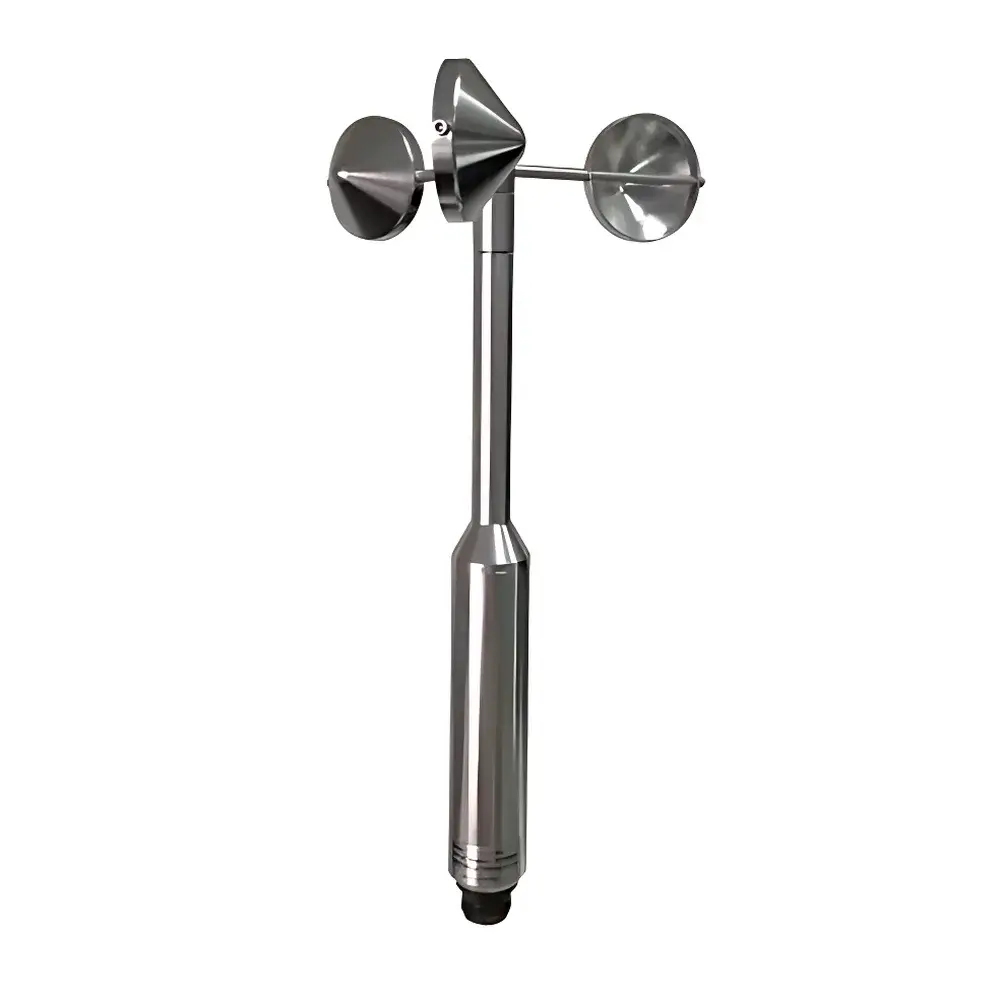
The W10 Anemometer Sensor is a high-reliability, mechanically driven cup anemometer engineered for continuous outdoor wind speed monitoring in demanding environmental and industrial applications. It operates on the well-established cup rotation principle: three symmetrical hemispherical cups mounted on an aerospace-grade aluminum alloy cross-arm rotate under wind force, driving a precision low-friction ball bearing shaft. This shaft is coupled directly to an optical chopper (photointerrupter) encoder, generating a square-wave pulse train whose frequency is linearly proportional to instantaneous wind speed. The sensor outputs a clean, TTL-compatible 10 V digital pulse signal—immune to analog drift and electromagnetic interference—enabling robust integration with data loggers, SCADA systems, and industrial PLCs compliant with IEC 61000-4 immunity standards.
Key Features
- Aerospace-grade aluminum alloy construction ensures exceptional corrosion resistance, thermal stability, and long-term dimensional integrity across −40 °C to +85 °C ambient conditions.
- Optimized three-cup geometry with aerodynamic profiling minimizes starting threshold (≤2.7 m/s) while maintaining linearity and low hysteresis up to 60 m/s.
- Integrated optical chopper eliminates mechanical wear associated with potentiometric or reed-switch transducers—delivering >5 million rotational cycles MTBF.
- 10 V square-wave output provides noise-immune digital signaling compatible with standard industrial input modules; output impedance ≤100 Ω supports stable transmission over 100 m using shielded SC-X303-XXM cable.
- Modular 32 mm outer diameter cylindrical housing enables rapid field installation via sleeve mount or universal clamp fixtures—no custom bracketing required.
- Designed and validated per IEC 61400-12-1 Annex B for wind resource assessment instrumentation and aligned with ISO/IEC 17025 traceable calibration practices.
Sample Compatibility & Compliance
The W10 is suitable for open-air deployment in agricultural microclimate networks, ecological flux towers, roadside weather stations, and airport perimeter monitoring systems. Its IP65-rated housing (per EN 60529) protects internal optics and bearings from dust ingress and water jets. The sensor meets CE marking requirements for electromagnetic compatibility (EMC Directive 2014/30/EU) and low-voltage safety (LVD Directive 2014/35/EU). While not certified for aviation-grade primary measurement, it conforms to the functional performance criteria outlined in WMO Guide to Instruments and Methods of Observation (CIMO Guide, Chapter 12) for secondary-class anemometry. Calibration certificates traceable to NIM (National Institute of Metrology, China) are available upon request.
Software & Data Management
The W10 requires no embedded firmware or proprietary software—it interfaces seamlessly with industry-standard data acquisition platforms including Campbell Scientific CR series loggers, HOBO UX120, Onset RX3000, and Siemens Desigo CC. Pulse frequency is converted to wind speed (m/s) using the factory-determined linear calibration coefficient (typically 0.75 Hz/(m/s), configurable per unit). All raw pulse timestamps and derived wind speed values can be logged with full audit trail when integrated into GLP/GMP-compliant systems supporting 21 CFR Part 11 electronic records (e.g., LabVIEW DIAdem with validation package, or Inductive Automation Ignition with Audit Module).
Applications
- Agricultural meteorology: Real-time canopy-level wind profiling for evapotranspiration modeling and frost mitigation control logic.
- Eco-hydrological research: Turbulent flux estimation in eddy covariance setups where co-location with sonic anemometers is impractical due to cost or power constraints.
- Transportation infrastructure: Roadside visibility and crosswind warning systems for bridges and mountain passes, integrated with variable message signs.
- Renewable energy pre-feasibility: Low-cost site screening for small-wind turbine potential where statistical wind distribution (Weibull parameters) is prioritized over turbulence intensity metrics.
- Industrial stack monitoring: Auxiliary wind reference for continuous emissions monitoring systems (CEMS) requiring meteorological compensation per EPA Method 9 and ISO 9096.
FAQ
What is the minimum measurable wind speed?
The W10 achieves reliable rotational initiation at ≥2.7 m/s (10 km/h); below this threshold, output pulses may be intermittent but remain physically detectable by high-sensitivity counters.
Can the W10 be used in salt-laden coastal environments?
Yes—the anodized aerospace aluminum housing and sealed bearing assembly provide proven resistance to marine aerosol exposure; annual visual inspection and optional silicone grease reapplication on the shaft seal are recommended.
Is temperature compensation applied internally?
No—the sensor’s mechanical-optical design exhibits inherently low thermal sensitivity (<0.02 % / °C), and all temperature-induced gain shifts are addressed during NIM-traceable calibration across the full −40 °C to +85 °C range.
Does the output require external pull-up or conditioning?
No—the 10 V square-wave output is actively driven and fully compatible with standard 5 V or 12 V logic inputs; no external circuitry is needed for direct connection to most industrial data loggers.
How often should recalibration be performed?
Annual recalibration is recommended for applications requiring metrological traceability; for non-regulated environmental monitoring, biennial verification against a reference anemometer (e.g., calibrated Gill WindSonic) suffices.