
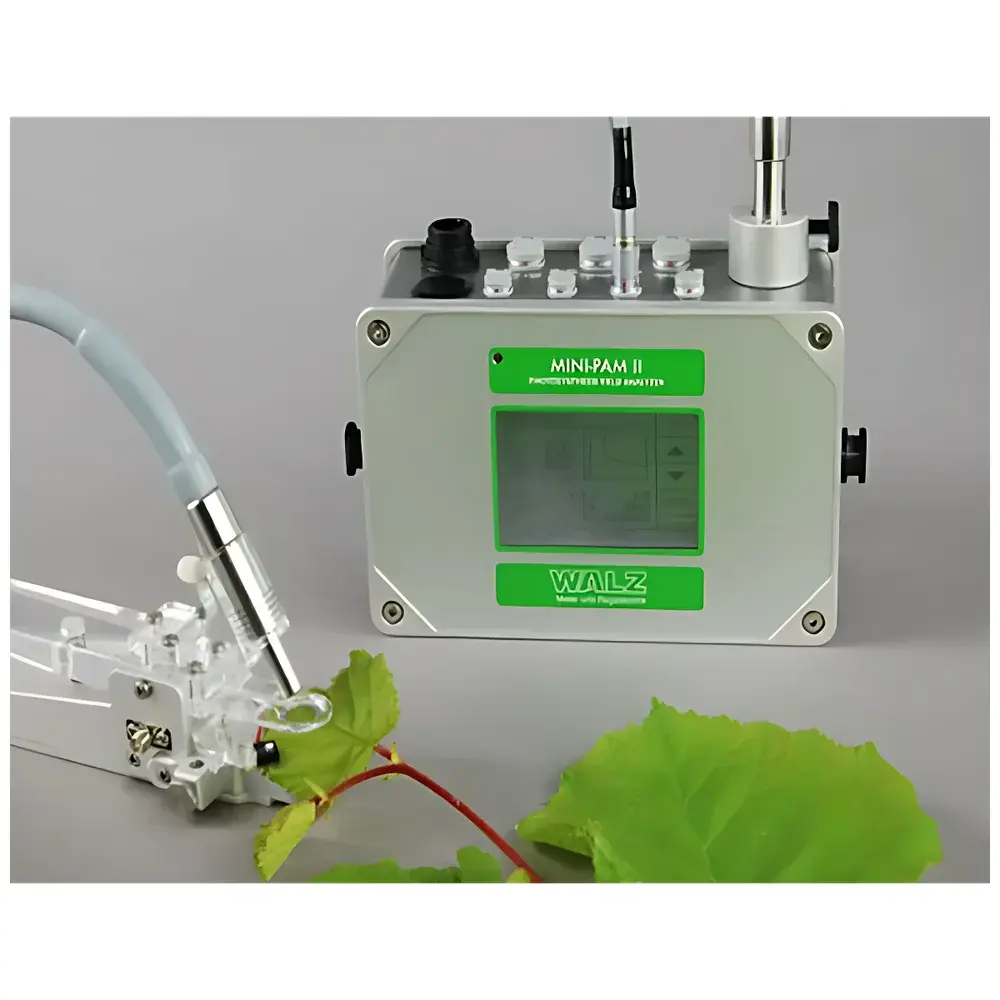
WALZ MINI-PAM-II Portable Modulated Chlorophyll Fluorometer
| Brand | WALZ |
|---|---|
| Origin | Germany |
| Model | MINI-PAM-II |
| Measurement Light | Blue LED (470 nm) or Red LED (655 nm), 0.05 µmol·m⁻²·s⁻¹ |
| Actinic Light | Blue or Red LED, up to 3000 µmol·m⁻²·s⁻¹ continuous |
| Saturation Pulse | Blue or Red LED, up to 6000 µmol·m⁻²·s⁻¹ flash |
| Far-Red Light | Peak emission at 740 nm |
| Detection | PIN photodiode with long-pass/short-pass filters and lock-in amplifier |
| Data Storage | 8 MB SD card (≈27,000 datasets) |
| PAR Range | 0–7000 µmol·m⁻²·s⁻¹ |
| Leaf Temperature Range | −20 to +60 °C |
| Relative Humidity Range | 0–100 %RH |
| Power Supply | 6 × AA rechargeable batteries (1.2 V / 2 Ah), supports ≥1000 saturation pulses per charge |
| Measured Parameters | Fo, Fm, F, Fm′, Fo′, Fv/Fm, Y(II) [ΔF/Fm′], qP, qL, qN, NPQ, Y(NPQ), Y(NO), rETR, PAR, leaf temperature, relative humidity |
| Sample Interface | 2035-B leaf clip (1 cm² measurement area, 60° fiber angle, 8 mm working distance) with integrated temperature and humidity sensors |
Overview
The WALZ MINI-PAM-II is a field-deployable, battery-powered modulated chlorophyll fluorometer engineered for high-fidelity, non-invasive assessment of photosynthetic efficiency in vivo. It operates on the principle of pulse-amplitude modulation (PAM) fluorometry, enabling quantitative dissection of Photosystem II (PSII) photochemistry through kinetic analysis of chlorophyll a fluorescence transients. By applying precisely timed measuring light, actinic illumination, saturating pulses, and far-red light—each delivered via wavelength-specific LEDs—the instrument resolves key biophysical parameters including quantum yield of PSII (Y(II)), non-photochemical quenching (NPQ), photochemical quenching (qP), and electron transport rate (rETR). Its compact architecture, low power consumption, and integrated environmental sensing make it uniquely suited for longitudinal field studies where portability, operational autonomy, and measurement reproducibility are critical. Designed and manufactured in Germany, the MINI-PAM-II complies with international standards for optical biosensing instrumentation used in ecological monitoring, stress physiology, and climate change research.
Key Features
- Modulated fluorescence detection using a temperature-stabilized PIN photodiode with dual-band optical filtering and lock-in amplifier circuitry for high signal-to-noise ratio under variable ambient light conditions.
- Integrated environmental sensors: calibrated thermistor for leaf temperature (−20 to +60 °C) and capacitive RH sensor (0–100 %RH), both spatially referenced to the 1 cm² measurement zone.
- Multi-wavelength LED excitation system: selectable blue (470 nm) or red (655 nm) measuring, actinic, and saturation pulses; plus dedicated far-red (740 nm) source for full dark-adapted state induction.
- Touchscreen interface with intuitive menu navigation supporting real-time trace visualization, slow induction kinetics (OJIP), rapid light curves (RLCs), and user-defined protocol sequencing.
- Modular optical coupling: compatible with standard MINI-PAM/F microfibers (2 mm core, 1.5 m length) and multiple clip configurations—including 2035-B (general leaf), 2060-B (Arabidopsis-sized), and 2060-A (large surface mounting).
- Onboard data logging with 8 MB SD card capacity (≥27,000 complete datasets); timestamps synchronized to internal RTC with optional GPS tagging via external module.
Sample Compatibility & Compliance
The MINI-PAM-II accommodates diverse sample types across terrestrial and aquatic systems. Standard operation employs the 2035-B leaf clip for intact, attached leaves of angiosperms, gymnosperms, and ferns. For suspended cultures (e.g., phytoplankton, microalgae), the instrument integrates with the 2030-B cuvette holder and magnetic stirrer assembly. Optional accessories—including the 2054-L multi-color external actinic source (red/green/blue/white LEDs) and 2065-M mini quantum/temperature probe—extend applicability to heterogeneous surfaces, lichens, mosses, and bryophytes. All optical components meet IEC 61000-4 electromagnetic compatibility requirements. Firmware and data export protocols support GLP-compliant workflows, including audit-trail-enabled software (PAMWin Pro v4.x) compliant with FDA 21 CFR Part 11 for electronic records and signatures when deployed in regulated agricultural or phytotoxicity testing environments.
Software & Data Management
Data acquisition and post-processing are performed using WALZ’s PAMWin Pro software suite, which provides real-time remote control via Bluetooth or USB, batch analysis of kinetic traces, automated parameter extraction (e.g., Fv/Fm, Y(NO), qL), and export to CSV, Excel, or MATLAB-compatible formats. The software implements standardized algorithms aligned with the QA/QC guidelines of the International Society of Photosynthesis Research (ISPR) and supports custom curve fitting for OJIP transient modeling. Raw fluorescence signals are stored with metadata tags (time, battery level, sensor readings, operator ID), ensuring traceability for peer-reviewed publication and regulatory submissions. Firmware updates preserve backward compatibility with legacy MINI-PAM datasets, facilitating longitudinal meta-analyses across multi-year field campaigns.
Applications
The MINI-PAM-II serves as a primary tool in plant ecophysiology, stress biology, and ecosystem monitoring. It enables quantification of dynamic photoinhibition under fluctuating irradiance, assessment of drought-induced stomatal and non-stomatal limitations, and discrimination between protective (NPQ-mediated) and damaging (Y(NO)-driven) energy dissipation pathways. Field deployments include alpine treeline studies, coastal salt marsh surveys, urban tree health assessments, and controlled-environment phenotyping platforms. In agronomy, it supports early detection of pathogen infection (e.g., fungal rusts), herbicide mode-of-action validation, and varietal screening for abiotic stress tolerance. Its compatibility with GFS-3000 gas exchange systems allows simultaneous measurement of CO₂ assimilation and PSII quantum yield—critical for modeling canopy-level carbon flux under climate scenarios.
FAQ
Can the MINI-PAM-II be used for submerged aquatic plants or phytoplankton?
Yes—when coupled with the 2030-B suspension chamber and magnetic stirrer, the system enables stable fluorescence measurements in liquid-phase samples with minimal motion artifact.
Is calibration required before each measurement session?
No—factory-calibrated sensors retain coefficients in onboard EEPROM; however, periodic verification using certified neutral density filters and reference leaf standards is recommended annually.
What is the maximum sampling frequency during rapid light curve (RLC) acquisition?
The instrument supports RLC protocols with up to 12 actinic steps per minute, each including saturation pulse application and full relaxation interval, conforming to standard RLC methodology (Ralph & Gademann, 2005).
Does the device support remote triggering of saturation pulses in autonomous setups?
Yes—via the built-in IR receiver or optional wired trigger input, enabling synchronization with external environmental loggers or imaging systems.
How does the far-red light source contribute to measurement accuracy?
The 740 nm far-red LED fully oxidizes the PSII acceptor side (QA⁻ → QA), ensuring complete relaxation of non-photochemical quenching and accurate determination of Fo′ and Fm′ under light-adapted conditions.
Related Products



