
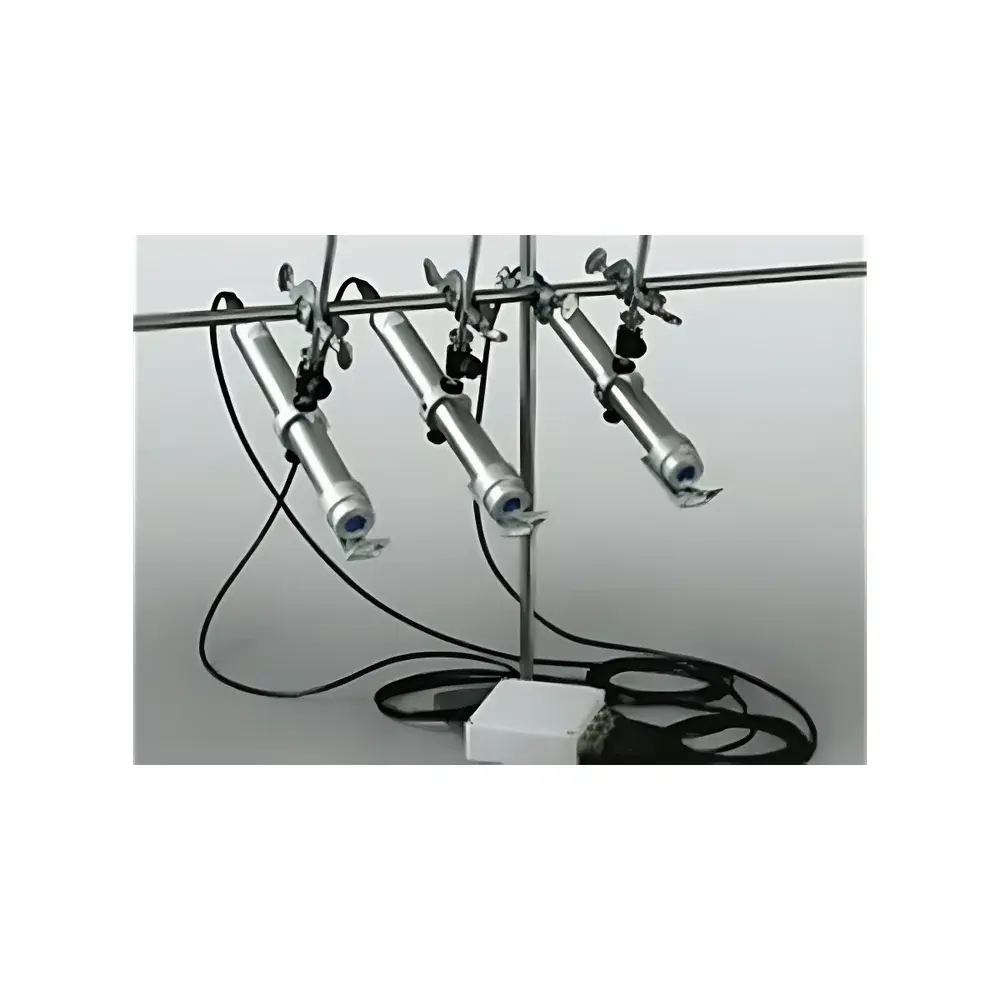
WALZ MONITORING-PAM Multi-Channel Continuous Chlorophyll Fluorescence Monitoring System
| Brand | WALZ |
|---|---|
| Origin | Germany |
| Model | MONITORING-PAM |
| Power Supply | Solar panel or internal rechargeable battery (field unit) |
| Data Storage | microSD card (terrestrial version) / internal flash memory (submersible version) |
| Channel Capacity | 1–7 measurement heads per MONI-DA data logger (recommended: 3 or 4) |
| Environmental Rating | IP68-rated field components (submersible version) |
| Measured Parameters | Fo, Fm, F, Fo′, Fm′, Fv/Fm, Y(II), qP, qL, qN, NPQ, Y(NPQ), Y(NO), ETR, PAR, and temperature |
| Operating Modes | Standalone long-term field monitoring OR real-time PC-connected operation |
| Compliance | Designed for GLP-aligned ecological monitoring |
Overview
The WALZ MONITORING-PAM is a modular, multi-channel chlorophyll a fluorescence monitoring system engineered for unattended, long-term assessment of photosynthetic performance in terrestrial and aquatic plant systems. Based on pulse-amplitude modulation (PAM) fluorometry principles, the system quantifies photochemical efficiency through non-invasive optical excitation and detection of modulated red-light-induced fluorescence emissions (650–690 nm). Unlike conventional single-point fluorometers, the MONITORING-PAM architecture enables simultaneous, time-synchronized measurements across up to seven independent measurement heads—each equipped with calibrated actinic light sources, saturating pulses, and dual-wavelength (650 nm/850 nm) detection optics. This capability supports high-temporal-resolution tracking of diurnal and seasonal dynamics in PSII quantum yield, energy dissipation pathways, and photoinhibitory responses under natural environmental gradients.
Key Features
- Modular field deployment: Terrestrial (MONI-DA) and submersible (MONI-DA/S) data loggers rated IP65 and IP68 respectively, enabling operation in rainforest understories, alpine meadows, paddy fields, or freshwater/marine benthic habitats.
- Flexible channel scalability: Each MONI-DA unit supports 1–7 measurement heads via daisy-chained RS-485 communication; recommended configurations use 3 or 4 heads to balance spatial resolution with power budget and data throughput.
- Dual operational modes: Fully autonomous field logging (with microSD or internal flash storage) or real-time PC-based acquisition using the MONI-SET3/MONI-SET4 interface kits.
- Comprehensive parameter suite: Calculates primary and derived fluorescence parameters including Fo, Fm, Fv/Fm, Y(II), qP, qL, qN, NPQ, Y(NPQ), Y(NO), linear electron transport rate (ETR), incident PAR (via integrated quantum sensor), and probe-tip temperature.
- Robust power management: Field units operate on rechargeable Li-ion batteries (72 h typical runtime) or optional solar charging kits—enabling deployments exceeding 6 months without maintenance in temperate zones.
Sample Compatibility & Compliance
The MONITORING-PAM accommodates diverse photosynthetic samples without physical contact: intact leaves (broadleaf, needle, succulent), lichens, mosses, phytoplankton suspensions, macroalgae, and coral symbionts. Measurement heads feature adjustable clamping mechanisms and collimated optical paths optimized for variable leaf thickness and surface reflectance. All hardware complies with IEC 60529 ingress protection standards (IP65/IP68), and firmware implements timestamped, CRC-verified data logging aligned with ISO 17025 documentation requirements for environmental monitoring networks. Raw fluorescence traces and processed parameters are exportable in CSV and HDF5 formats, supporting traceability in GLP- and GMP-regulated research contexts—including long-term ecological research (LTER) sites and agricultural decision-support systems.
Software & Data Management
Acquisition and analysis are performed using WALZ’s proprietary PAMWin Pro software (Windows 10/11 compatible), which provides real-time visualization of fluorescence induction kinetics, rapid light curves (RLCs), and dark relaxation kinetics—with built-in nonlinear regression fitting (e.g., exponential decay models for qP/qN, hyperbolic tangent for RLCs). The software enforces metadata tagging (location, operator, sample ID, calibration date) and generates audit trails compliant with FDA 21 CFR Part 11 when configured with electronic signatures. Field-collected datasets include automatic daylight-synchronization, GPS-embedded headers (when paired with external modules), and configurable sampling intervals (1 min to 24 h). Data integrity is preserved via write-once microSD cards (terrestrial) or encrypted internal flash (submersible), with automated rollover and error logging.
Applications
- Long-term ecological monitoring: Tracking seasonal acclimation, drought stress thresholds, and recovery trajectories across forest canopies, grassland plots, or wetland vegetation.
- Agricultural water-use optimization: Integrating real-time Y(II) and NPQ trends into irrigation scheduling algorithms for precision viticulture, orchard management, and greenhouse crop steering.
- Aquatic ecosystem health assessment: Quantifying phytoplankton photophysiology in reservoirs, estuaries, and coral reef monitoring programs—especially under nutrient enrichment or thermal stress scenarios.
- Climate change impact studies: Deploying distributed MONITORING-PAM arrays along altitudinal or latitudinal transects to resolve genotype-by-environment interactions in photosynthetic resilience.
- Controlled environment phenotyping: Coupling with environmental chambers or growth rooms for high-throughput screening of photosynthetic mutants or breeding lines under defined light, CO2, and temperature regimes.
FAQ
What is the maximum cable length between the MONI-DA logger and a measurement head?
Standard configurations support up to 10 m per head using shielded twisted-pair cables; custom lengths up to 30 m are feasible with signal repeaters and impedance-matched cabling.
Can the system measure underwater macrophytes at depth?
Yes—the MONI-DA/S submersible variant operates continuously at depths up to 10 m (IP68 rating), with pressure-compensated optical windows and corrosion-resistant titanium housings.
How is calibration maintained across multiple heads?
Each measurement head undergoes factory calibration against NIST-traceable reference standards; field recalibration is performed using the integrated dark-adaptation protocol and standardized actinic light intensity verification routines.
Is remote data retrieval supported?
While the base system relies on physical SD card extraction or USB download, optional GSM/GPRS telemetry modules enable scheduled FTP uploads to cloud repositories—subject to local network availability and power provisioning.
Does the software support batch processing of multi-site datasets?
Yes—PAMWin Pro includes scripting capabilities (via Python API) for automated parameter extraction, outlier filtering, and cross-site statistical comparison across hundreds of concurrent time series.




