
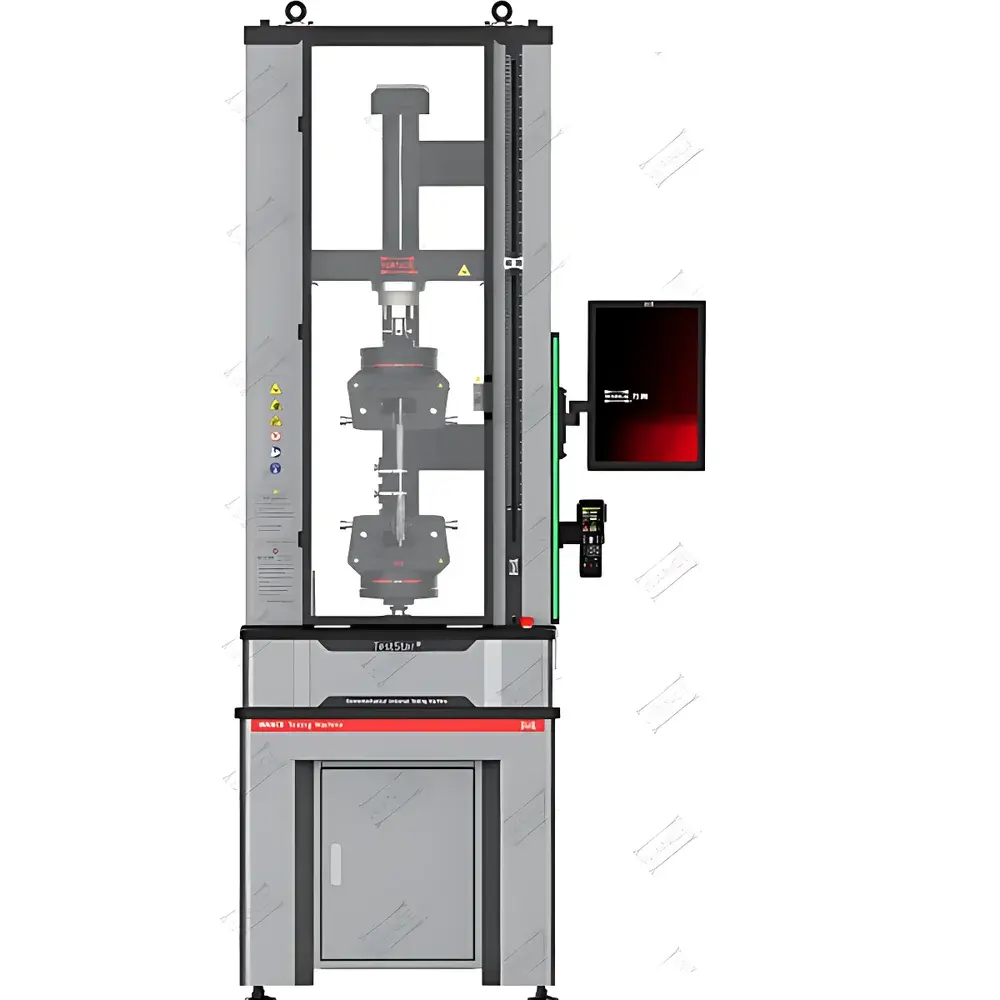
WANCE ETM-B Series Desktop Electronic Universal Testing Machine
| Brand | WANCE |
|---|---|
| Origin | Guangdong, China |
| Manufacturer Type | Authorized Distributor |
| Country of Origin | China |
| Model | ETM-B |
| Instrument Type | Electronic Universal Testing Machine |
| Load Capacity Range | 0.1 kN to 10 kN |
| Load Accuracy Class | 0.5 (per GB/T 16491-2022 and ISO 7500-1:2018) |
| Frame Type | Single-Column Desktop |
| Maximum Test Speed | 2000 mm/min |
| Minimum Test Speed | 0.00005 mm/min |
| Crosshead Return Speed | 2400 mm/min |
| Crosshead Travel | 1090 mm |
| Position Resolution | 0.011 µm |
| Axial Frame Stiffness | 50 kN/mm (measured with spoke-type load cell configuration) |
| Vertical Test Space | 1250 mm |
| Horizontal Test Space | 420 mm |
| Dimensions (H×W×D) | 1700 × 770 × 640 mm |
| Weight | 270 kg |
| Power Supply | AC 220 V ±10%, 50 Hz, 1 kW |
Overview
The WANCE ETM-B Series Desktop Electronic Universal Testing Machine is a precision-engineered electromechanical system designed for static mechanical property characterization of solid materials under tension, compression, bending, shear, peel, tear, and puncture loading conditions. Operating on a closed-loop servo-controlled DC motor drive with high-resolution encoder feedback, the ETM-B implements displacement-, load-, and strain-controlled test modes in accordance with internationally recognized metrological frameworks—including ISO 7500-1:2018 (static calibration of force-proving instruments), ASTM E4 (load verification of testing machines), and GB/T 16491-2022 (Chinese national standard for electronic universal testers). Its rigid single-column steel frame—engineered to deliver 50 kN/mm axial stiffness when equipped with spoke-type load cells—ensures minimal deflection during high-force testing, thereby maintaining measurement integrity across the full 0.1–10 kN load range. The system’s ultra-low minimum speed (50 nm/s) enables quasi-static creep and stress-relaxation protocols, while its 2000 mm/min maximum speed supports dynamic modulus evaluation and high-throughput quality control screening.
Key Features
- Class 0.5 load accuracy certified per GB/T 16491-2022 and traceable to national metrological standards, ensuring compliance with ISO/IEC 17025-accredited laboratory requirements.
- Sub-micron crosshead position resolution (0.011 µm) achieved via high-fidelity optical encoder and optimized gear reduction transmission.
- Single-space desktop architecture with 1250 mm vertical and 420 mm horizontal test envelopes—optimized for integration with environmental chambers, video extensometers, and automated specimen handling modules.
- Wide dynamic speed range (50 nm/s to 2000 mm/min) supporting both slow-strain-rate ASTM D638/D790 tests and rapid failure analysis per ISO 6892-1 Annex C.
- Modular hardware interface enabling seamless integration of optional accessories: cryogenic or thermal chambers (−70°C to +300°C), non-contact video extensometry systems (with sub-pixel strain resolution), and pneumatic wedge grips for high-repeatability clamping.
- Robust mechanical design compliant with GB/T 2611-2022 (general technical requirements for testing machines) and JJG 139-2014 (verification regulation for tensile/compression testers).
Sample Compatibility & Compliance
The ETM-B accommodates standardized specimens per ASTM, ISO, GB, and DIN specifications—including dog-bone tensile bars (ASTM D638 Type I–V), three-point bend beams (ASTM D790), peel substrates (ASTM D903, GB/T 2790), trouser-tear coupons (GB/T 529), and puncture fixtures for flexible packaging (ASTM F1306). It supports testing of metallic alloys, fiber-reinforced polymers, thermoplastics, elastomers, adhesives, textiles, biomedical scaffolds, and food-grade laminates. All firmware and calibration routines adhere to GLP/GMP principles; audit trails, electronic signatures, and user-access controls are configurable to meet FDA 21 CFR Part 11 requirements when paired with validated software packages. Mechanical verification reports include uncertainty budgets aligned with ISO/IEC Guide 98-3 (GUM).
Software & Data Management
The system operates with WANCE’s proprietary TestMaster™ v5.x software—a Windows-based platform supporting real-time data acquisition at up to 10 kHz sampling rate. Software modules include automated test sequence scripting (per ISO 527-1:2019 Annex B), multi-curve overlay with statistical comparison (mean ± SD, coefficient of variation), and export to CSV, XML, and PDF formats compatible with LIMS environments. Calibration certificates are digitally signed and embedded with QR-coded traceability metadata. Raw data files retain native timestamping, sensor ID tagging, and environmental parameter logging (when interfaced with climate chambers). Optional IQ/OQ documentation packages support regulated industry validation per ASTM E2500 and EU Annex 11.
Applications
- Mechanical qualification of automotive composites (e.g., carbon-fiber epoxy laminates per SAE J2334)
- Quality assurance of medical device packaging (ASTM F88 seal strength, ASTM F1140 burst pressure)
- Research-grade tensile mapping of hydrogels and electrospun nanofibers
- Creep compliance testing of bituminous binders (AASHTO T322)
- Peel strength assessment of pressure-sensitive adhesives (ISO 8510-2)
- Compression yield analysis of foamed polymers (ASTM D1621)
- Interlaminar shear strength (ILSS) evaluation of prepreg systems (ASTM D2344)
FAQ
What international standards does the ETM-B comply with for load calibration?
The system meets Class 0.5 accuracy per GB/T 16491-2022 and ISO 7500-1:2018; calibration is traceable to NIM (National Institute of Metrology, China) or equivalent national metrology institutes.
Can the ETM-B be integrated into an existing LIMS or MES infrastructure?
Yes—TestMaster™ supports OPC UA and RESTful API interfaces for bidirectional data exchange with laboratory information management systems and manufacturing execution systems.
Is the machine suitable for testing biological tissues under physiological conditions?
When coupled with a temperature- and humidity-controlled chamber and non-contact extensometry, the ETM-B supports biomechanical testing per ISO 19207 (soft tissue tensile testing) and ASTM F2193 (tendon/ligament mechanical testing).
What is the recommended maintenance interval for the load cell and drive system?
Annual verification is advised per JJG 475-2008; preventive maintenance—including lubrication of lead screws and encoder alignment checks—is recommended every 1,000 operational hours or semiannually, whichever occurs first.



