
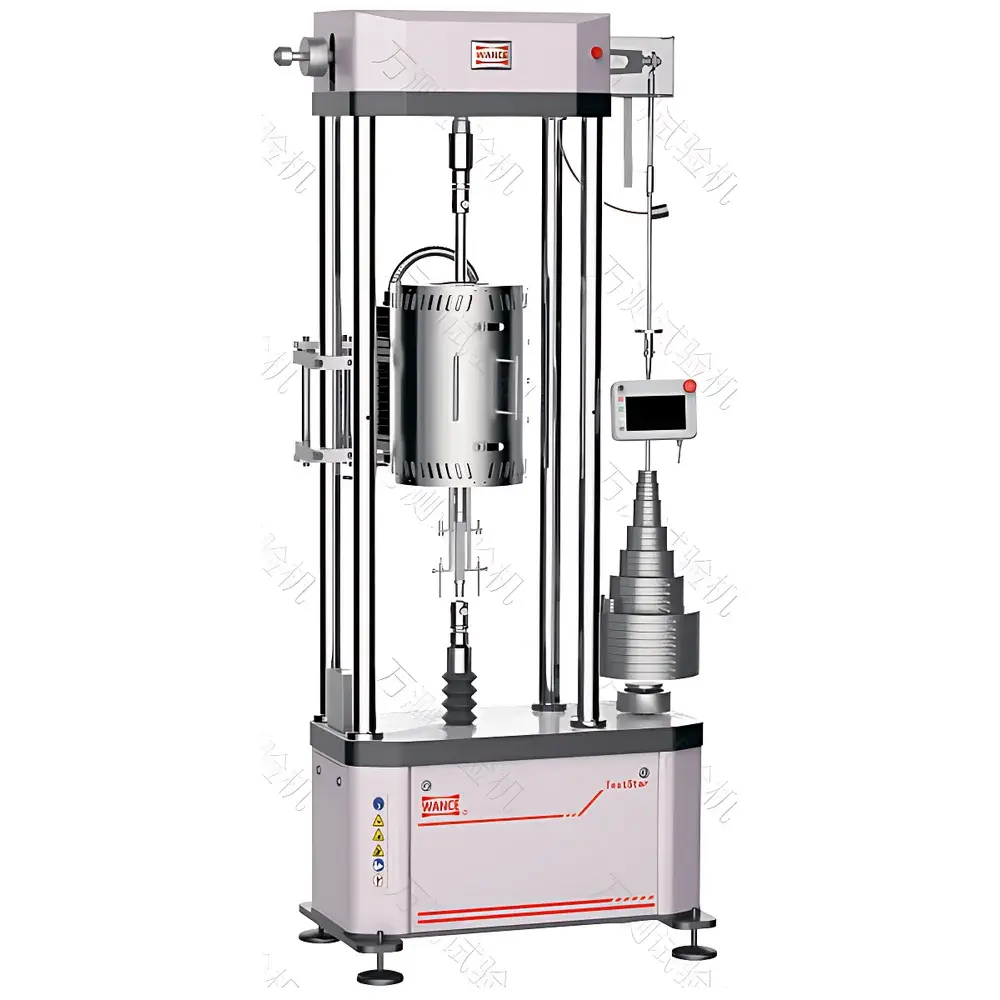
WANCE HTC Series A Mechanical High-Temperature Creep and Stress Rupture Testing System
| Brand | WANCE |
|---|---|
| Origin | Guangdong, China |
| Instrument Type | Mechanical Lever-Based Creep Testing System |
| Models | HTC304A / HTC504A / HTC804A / HTC105A |
| Max Test Load | 30 kN / 50 kN / 80 kN / 100 kN |
| Load Accuracy | ±0.5% of reading (≥5% FS), ±1% (2–5% FS) |
| Load Resolution | 1 N |
| Lever Ratios | 1:40, 1:50, 1:100 |
| Alignment Tolerance | ≤10% |
| Furnace Temp Range | 200–1100 °C |
| Temp Stability | ±2 °C (300–600 °C), ±3 °C (600–900 °C), ±4 °C (900–1100 °C) |
| Temp Gradient | ≤2–4 °C over ≥150 mm isothermal zone |
| Creep Deformation Range | 0–10 mm |
| Deformation Accuracy | ≤±0.5% FS |
| Resolution | 0.001 mm |
| Downrod Stroke | 200 mm |
| Downrod Speed | 2.5 mm/min (fine alignment), 50 mm/min (rapid positioning) |
| Power Supply | 380 V ±10%, 3-phase |
Overview
The WANCE HTC Series A is a mechanically actuated, lever-amplified high-temperature creep and stress rupture testing system engineered for long-term mechanical property evaluation of metallic materials under sustained uniaxial tensile loading at elevated temperatures. Unlike conventional electromechanical testers, this system employs a precision-machined mechanical lever train with calibrated mass loading—ensuring intrinsic stability, zero drift over extended durations (up to 10,000+ hours), and full compliance with static force metrology principles defined in JJG 276–1988. The system operates on the fundamental principle of constant-load creep: a fixed tensile force is applied via deadweight amplification through high-ratio levers (1:40 to 1:100), while thermal exposure is maintained in a three-zone split-type atmospheric furnace. Specimens are subjected to controlled isothermal conditions within a ≥150 mm uniform temperature zone, enabling measurement of time-dependent strain accumulation (creep strain), time-to-rupture (stress rupture life), and minimum creep rate—all critical parameters for structural integrity assessment in aerospace turbine discs, nuclear reactor components, and high-temperature piping systems.
Key Features
- Mechanically amplified load application using calibrated lever arms and stainless steel deadweights—eliminates servo drift, ensures traceable force metrology per ISO 7500-1 Class 0.5/1 requirements.
- Three-zone split-type high-efficiency vacuum-formed ceramic fiber furnace with integrated PID + AI control; achieves ±2 °C stability at 600 °C and maintains ≤4 °C axial gradient across 150 mm isothermal zone.
- High-precision external creep deformation measurement via Heidenhain linear glass scale (resolution: 0.001 mm; linearity error ≤±0.01%), mounted outside furnace to avoid thermal drift and electromagnetic interference.
- Self-aligning lower grip assembly driven by synchronous timing belt and preloaded ball screw—ensures ≤10% specimen misalignment and minimizes bending moment during prolonged loading.
- Dual-speed downrod actuation: 2.5 mm/min for fine coaxial adjustment and 50 mm/min for rapid specimen insertion—reducing operator intervention during multi-unit batch testing.
- RS-485 industrial fieldbus architecture connecting up to 32 test stations to a central controller; supports noise-immune communication over distances up to 1200 m without repeaters.
- Integrated hardware/software overload protection: automatic shutdown triggered when measured load exceeds 110% of selected full-scale range, with dual-channel verification (load cell + lever displacement).
- High-temperature alloy pull rods and extensometer guide rods (Inconel 718/X750 grade) rated for continuous operation at 1000 °C; all furnace-accessory interfaces designed for thermal expansion compensation.
Sample Compatibility & Compliance
The HTC Series A accommodates standard cylindrical specimens (M12/M16 threaded ends, φ5–φ10 mm) and flat sheet specimens (1–3 mm thickness) per ASTM E139, ISO 204, and GB/T 2039–2012. Fixture configurations support both uniaxial tension and constrained thermal expansion setups. All furnace and mechanical subsystems conform to GB 5226.1 (electrical safety), IEC 61000-4-3 (EMC immunity), and JJG 276–1988 calibration protocol for high-temperature creep machines. Temperature uniformity validation is performed per HB 5151–1996 Annex B, with documented mapping reports available upon request. System-level traceability supports GLP/GMP audit requirements—including electronic signature, audit trail, and data immutability features in accordance with FDA 21 CFR Part 11 when deployed with validated software configuration.
Software & Data Management
The proprietary WANCE CreepTest Suite v4.2 is a Windows-based, multi-station supervisory platform supporting concurrent control of up to 32 HTC units. It implements real-time closed-loop temperature ramping with programmable soak dwell steps, automated load application sequencing, and synchronized data acquisition at user-defined intervals (1 s to 1 h). Raw sensor streams (load, displacement, thermocouple voltage) are timestamped with microsecond precision and stored in encrypted binary archives compliant with ASTM E1434 metadata standards. Curve-fitting modules calculate Larson-Miller parameters, Norton-Bailey exponents, and minimum creep rate derivatives directly from primary data. Export formats include CSV, XML (ASTM E1447), and PDF-certified test reports with digital signatures, revision history, and calibration certificate cross-references. Audit logs record all operator actions, parameter changes, and alarm events with IP address and Windows login ID attribution.
Applications
This system serves as a reference-grade platform for high-temperature mechanical property certification across regulated industries. In aerospace, it validates creep resistance of Ni-base superalloys (e.g., Inconel 718, Waspaloy) used in combustor liners and turbine blades per AMS 2269 and Rolls-Royce RRP 7002. In nuclear energy, it supports ASME Section III Case N-795 qualification of pressure vessel steels (e.g., SA-508 Gr.4N) under simulated PWR operating conditions. Metallurgical R&D labs utilize its long-term stability to develop constitutive models for thermo-mechanical fatigue prediction. Universities employ the system for graduate-level instruction in time-dependent plasticity, diffusion-controlled deformation mechanisms, and high-temperature fracture kinetics. Additional use cases include qualification of brazed joints in heat exchangers, creep-fatigue interaction studies under cyclic thermal loading, and intergranular embrittlement assessment in austenitic stainless steels exposed to aggressive environments.
FAQ
What standards does the HTC Series A comply with for calibration and testing?
It meets JJG 276–1988 (China national verification regulation), GB/T 2039–2012 (metal creep testing), HB 5150/5151–1996 (aerospace creep/rupture methods), and aligns with ASTM E139 and ISO 204 for international comparability.
Can the system operate unattended for 10,000-hour tests?
Yes—mechanical load train eliminates electronic drift; furnace thermal stability and sealed optical encoder design ensure uninterrupted operation with scheduled maintenance every 3000 hours.
Is remote monitoring supported for multi-site laboratories?
RS-485 network enables centralized supervision; optional OPC UA gateway allows integration into enterprise MES/SCADA systems with TLS 1.2 encryption.
How is specimen alignment verified before test initiation?
Built-in local display interface provides real-time lever deflection feedback during manual coarse alignment, followed by automated fine-tuning using motorized downrod position correction within ±0.1 mm tolerance.
Are high-temperature extensometers included in base configuration?
No—the system uses external Heidenhain encoders coupled to furnace-mounted guide rods; high-temperature clip-on extensometers (e.g., Kaman KD-2306) are available as optional accessories for direct gauge-length strain measurement.



