
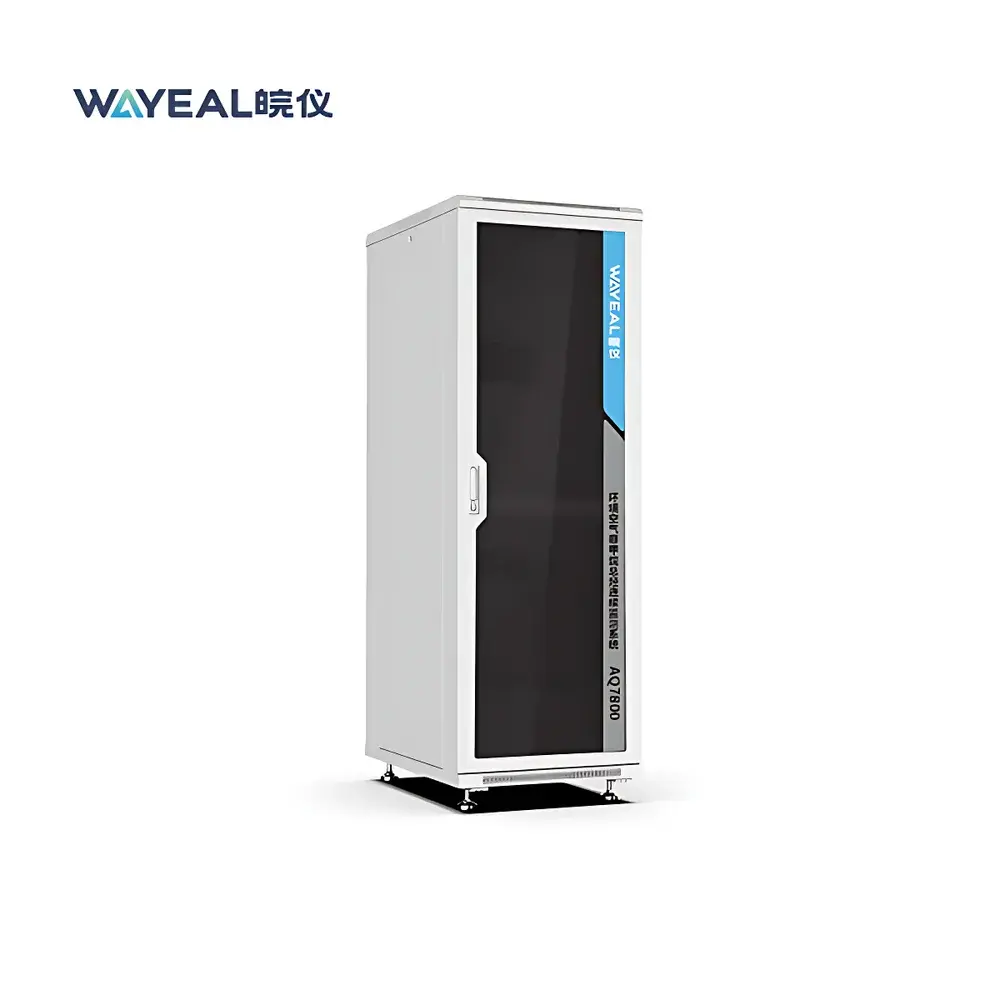
WAYEAL AQ7800 Ambient Air Methane and Total Non-Methane Hydrocarbons (NMHC) Continuous Monitoring System
| Brand | WAYEAL |
|---|---|
| Origin | Anhui, China |
| Manufacturer Type | Direct Manufacturer |
| Product Origin | Domestic (China) |
| Model | AQ7800 |
| Instrument Type | Online Fixed-Station Analyzer |
| Detection Principle | Gas Chromatography with Flame Ionization Detection (GC-FID) |
| Measurement Method | Direct Analysis (Non-Preconcentration Bypass Mode with Cold Trap Preconcentration Option) |
| Detection Limit | ≤1 ppbC (as Carbon) |
| Compliance | HJC-ZY84-2020 |
Overview
The WAYEAL AQ7800 Ambient Air Methane and Total Non-Methane Hydrocarbons (NMHC) Continuous Monitoring System is an online, laboratory-grade analytical platform engineered for unattended, real-time quantification of methane (CH₄) and total non-methane hydrocarbons in ambient air. It implements a dual-path gas chromatographic separation architecture coupled with flame ionization detection (GC-FID), operating under strict thermal management protocols to ensure molecular integrity across the full C₁–C₁₀ hydrocarbon range. Unlike catalytic oxidation-based NMHC analyzers, the AQ7800 applies direct chromatographic speciation—retaining methane as a discrete peak while resolving the summed carbon response of all non-methane volatile organic compounds (NMVOCs) eluting after methane. This methodology aligns with the fundamental definition of NMHC in Chinese regulatory practice: total hydrocarbons minus methane, measured without chemical conversion artifacts. The system incorporates a programmable cryogenic trap (−30 °C to −40 °C) for selective preconcentration and matrix removal, followed by rapid thermal desorption and GC column transfer. All critical transport lines—from inlet to detector—are maintained at ≥180 °C via integrated trace heating, eliminating condensation points and minimizing adsorptive losses of semi-volatile compounds such as n-decane, styrene, or terpenes.
Key Features
- True direct measurement architecture compliant with HJC-ZY84-2020, eliminating reliance on catalytic converters or empirical correction factors
- Cryogenic preconcentration module with dual-bed composite sorbent (Tenax TA + Carbopack B) for selective NMHC trapping and water/CO₂ rejection
- Mass flow controller (MFC)-based volumetric sampling with real-time flow calibration and cumulative volume logging
- Fully heated sample pathway (≥180 °C) from inlet valve through transfer lines, GC column oven, and FID jet—zero cold spots
- Ultra-low surface activity: all wetted surfaces undergo electropolished stainless steel passivation and silco-treated coating
- Automated sequence control including trap conditioning, sample loading, back-flush, desorption, separation, and detector purge
- Onboard diagnostics with leak detection, temperature deviation alerts, FID flame stability monitoring, and baseline noise trending
Sample Compatibility & Compliance
The AQ7800 is validated for continuous operation in ambient air matrices with particulate loadings ≤100 µg/m³ (TSP), relative humidity up to 95% RH (non-condensing), and ambient temperature ranges from −20 °C to +50 °C. It meets the performance verification criteria specified in HJC-ZY84-2020, including precision (RSD ≤5% at 50 ppbC), accuracy (±15% recovery across 20–500 ppbC range), and linearity (R² ≥0.999 over 1–1000 ppbC). While not certified to EU EN 13528 or US EPA TO-15/TO-17 protocols, its GC-FID core engine is intrinsically compatible with ISO 8573-1 (compressed air purity) and ASTM D6420-18 (hydrocarbon analysis by GC-FID) methodologies. Data acquisition supports audit-ready timestamping, instrument parameter logging, and raw chromatogram storage—enabling GLP-compliant record retention per internal QA policies.
Software & Data Management
The embedded Linux-based control software provides fully automated daily calibration (zero/span with certified CH₄/NMHC standard gases), multi-point linear regression, and retention time locking. Chromatograms are stored in vendor-neutral .cdf format (NetCDF-compatible) with embedded metadata (inlet pressure, column head pressure, detector gain, MFC setpoint). Remote access is enabled via TLS-secured HTTP/HTTPS interface supporting Modbus TCP and OPC UA for integration into SCADA or EMS platforms. All configuration changes, calibration events, and alarm logs are recorded with immutable timestamps and operator ID tagging—supporting basic 21 CFR Part 11 readiness when deployed with external identity management. Export options include CSV (hourly averaged NMHC/CH₄ concentrations), PDF reports (daily QC summary), and XML (for national environmental data portals).
Applications
- Urban background air quality stations requiring long-term NMHC trend analysis under China’s “Blue Sky Defense War” framework
- Roadside, airport apron, and seaport terminal monitoring where transient NMHC spikes from fuel handling, aircraft APU emissions, or ship auxiliary engines must be resolved
- Fenceline monitoring at petrochemical, pharmaceutical, and coating manufacturing facilities for LDAR (Leak Detection and Repair) program support
- Industrial park ambient air surveillance networks integrating with photochemical modeling inputs (e.g., ozone formation potential estimation)
- Research-grade field campaigns investigating biogenic NMHC contributions (isoprene, monoterpenes) in forested or agricultural zones
FAQ
Does the AQ7800 require external calibration gas cylinders for daily operation?
Yes—routine zero/span calibration uses certified CH₄-in-air (e.g., 100 ppbC) and NMHC-in-air (e.g., propane-equivalent 200 ppbC) standards traceable to NIM (National Institute of Metrology, China). Optional auto-calibration modules with dual-cylinder manifolds are available.
Can the system differentiate individual NMHC species, or does it report only total NMHC?
The standard AQ7800 reports total NMHC as a summed carbon signal post-methane. Optional configuration with extended GC temperature programming and high-resolution capillary columns enables semi-quantitative C₂–C₆ speciation; however, this mode reduces cycle time and is not compliant with HJC-ZY84-2020 NMHC reporting requirements.
What maintenance intervals are recommended for the cryogenic trap and GC column?
Trap cartridges require replacement every 6 months under typical urban ambient conditions (≤50 ppbC average); GC columns are rated for ≥12 months of continuous operation when operated within specified temperature limits and protected by the integrated guard column and back-flush logic.
Is remote firmware update supported over cellular or Ethernet connection?
Yes—secure OTA (over-the-air) updates are supported via authenticated HTTPS push from WAYEAL’s technical support portal, with rollback capability and pre-update compatibility validation.
How is moisture managed during high-humidity sampling?
The system employs a Nafion™ membrane dryer upstream of the trap, coupled with real-time dew point monitoring and automatic trap cooldown adjustment to prevent ice formation without compromising NMHC adsorption efficiency.







