
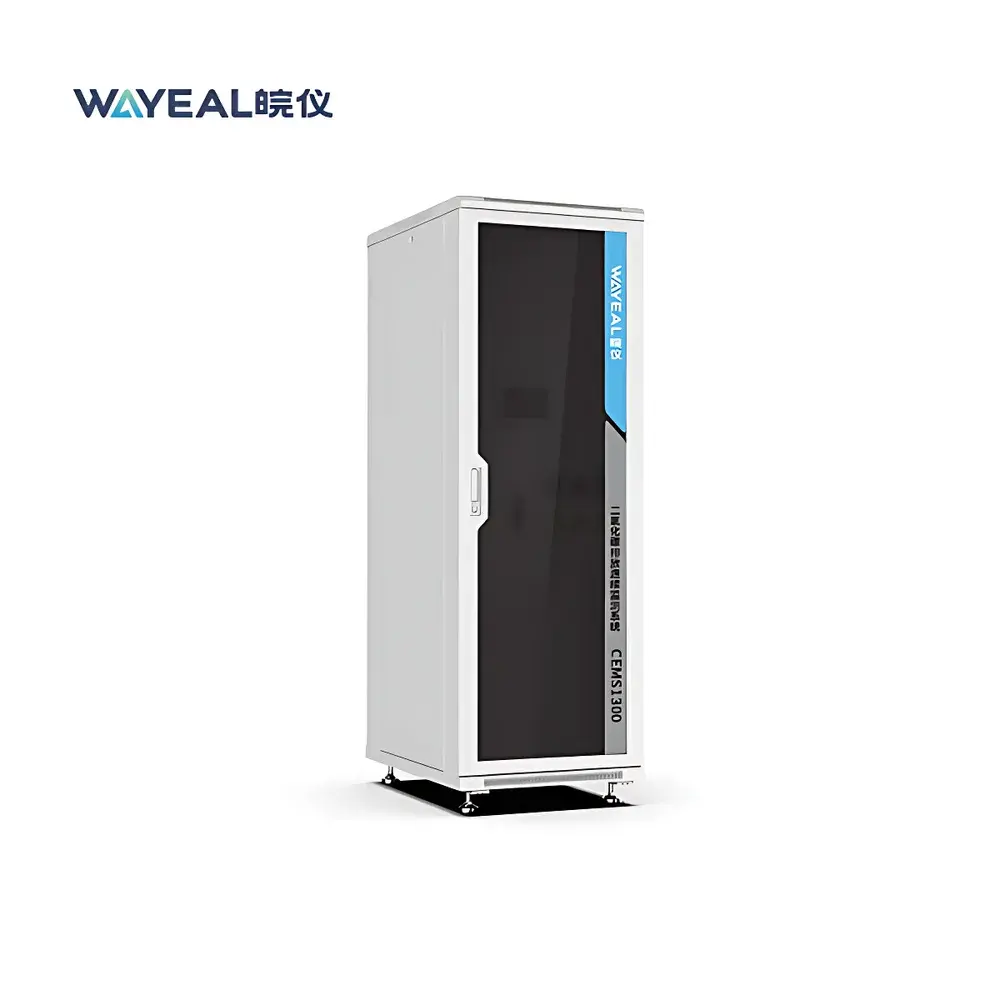
WAYEAL CEMS1300 Fixed Source Continuous Emissions Monitoring System (CEMS) for CO₂, SO₂, NO, and NO₂
| Brand | WAYEAL |
|---|---|
| Origin | Anhui, China |
| Manufacturer Type | Original Equipment Manufacturer (OEM) |
| Product Category | Domestic |
| Model | CEMS1300 |
| Instrument Type | Continuous Emissions Monitoring System (CEMS) |
| Measured Gases | CO₂, SO₂, NO, NO₂ |
| Detection Principle | Non-Dispersive Infrared (NDIR) Spectroscopy |
| Compliance | Certified by China National Environmental Monitoring Centre (CNEMC) for Applicability Testing |
| Data Output | Wet-base, dry-base, and normalized (e.g., 6% O₂) concentration values |
| Calibration | Automated zero/span calibration with diagnostic and alarm functions |
| Connectivity | LAN-based distributed architecture with remote data access capability |
| Regulatory Alignment | Designed to support compliance with China’s HJ 75–2017 and HJ 76–2017 standards |
Overview
The WAYEAL CEMS1300 is a certified, turnkey Continuous Emissions Monitoring System (CEMS) engineered for regulatory-grade, long-term measurement of carbon dioxide (CO₂), sulfur dioxide (SO₂), nitrogen monoxide (NO), and nitrogen dioxide (NO₂) from stationary combustion sources—including coal-fired boilers, cement kilns, waste incinerators, and industrial furnaces. Its core measurement technology is based on Non-Dispersive Infrared (NDIR) spectroscopy, operating on the Lambert–Beer law: gaseous molecules absorb infrared radiation at characteristic wavelengths, and the degree of absorption is directly proportional to their concentration in the sampled flue gas stream. The system employs thermally stabilized, electro-optically modulated IR sources, narrowband interference filters matched to target analyte absorption bands (e.g., 4.26 µm for CO₂, 7.35 µm for SO₂), and high-sensitivity pyroelectric or photonic detectors. All optical components are housed within a temperature-controlled, corrosion-resistant sample cell designed for hot/wet extractive sampling—eliminating condensation-related drift and preserving the integrity of moisture-sensitive measurements.
Key Features
- Regulatory-compliant architecture validated per CNEMC Applicability Testing Protocol (HJ 75–2017 / HJ 76–2017), ensuring data admissibility in China’s national emissions reporting framework.
- Multi-gas NDIR detection module with independently configurable ranges—CO₂ (0–100%, 0–25%, or 0–5% v/v), SO₂ (0–500 ppm to 0–5000 ppm), NO/NO₂ (0–200 ppm to 0–2000 ppm)—enabling application-specific optimization without hardware modification.
- Integrated O₂ measurement via paramagnetic or zirconia sensor, enabling real-time conversion between wet-base, dry-base, and oxygen-normalized (e.g., 6% O₂) concentration outputs per statutory requirements.
- Automated calibration sequence with dual-point (zero/span) verification using certified reference gases; scheduled calibration intervals configurable from 6 to 24 hours.
- Self-diagnostic firmware continuously monitors optical path integrity, detector signal-to-noise ratio, flow stability, and temperature gradients—triggering event logs and configurable alarms upon deviation thresholds.
- Robust extractive sampling train with heated probe (180 °C), PTFE-lined sample line, and chiller-based moisture removal (dew point ≤4 °C), minimizing particulate interference and water vapor quenching effects.
Sample Compatibility & Compliance
The CEMS1300 is designed for extractive sampling of flue gases at temperatures up to 200 °C and dust loadings ≤10 g/Nm³. It accommodates acidic, humid, and particulate-laden streams typical of coal, biomass, and municipal solid waste combustion. All wetted materials—including probe, filter housing, and sample cell—are constructed from 316L stainless steel and fluoropolymer-coated components to resist SO₃-induced corrosion and condensate attack. The system meets electromagnetic compatibility (EMC) Class A per GB/T 17626 series and operates reliably under ambient conditions of −20 °C to +50 °C. While primarily deployed under China’s Ministry of Ecology and Environment (MEE) regulatory regime, its modular design and traceable measurement chain align with ISO 14064-3 verification principles and provide foundational data integrity for future alignment with international GHG accounting frameworks (e.g., GHG Protocol, ISO 14067).
Software & Data Management
The embedded CEMS Data Acquisition and Handling System (DAHS) complies with HJ 212–2017 communication protocol for seamless integration into provincial and national environmental monitoring platforms. It records second-level raw analog signals, performs real-time spectral compensation for cross-interference (e.g., H₂O and CO impact on CO₂ quantification), applies linearization algorithms, and stores minute-averaged, hour-averaged, and daily summary data with full audit trail. All data modifications—manual overrides, calibration events, maintenance logs—are timestamped, user-ID authenticated, and non-erasable per GLP-aligned data governance. Remote access is enabled via encrypted HTTPS or VPN tunneling; historical datasets export in CSV/Excel format with metadata tags (instrument ID, calibration certificate numbers, QA/QC flags). Optional OPC UA server module supports integration into plant-wide DCS or MES systems.
Applications
- Continuous regulatory reporting of CO₂ emissions under China’s national carbon market (CCER and pilot trading schemes).
- Performance evaluation of flue gas desulfurization (FGD) and selective catalytic reduction (SCR) systems via simultaneous SO₂/NOₓ/CO₂ trend analysis.
- Combustion efficiency optimization through correlation of CO₂/O₂ ratios with fuel feed rate and excess air control.
- Source apportionment studies where multi-point CEMS1300 deployments enable spatial mapping of emission intensity across complex industrial clusters.
- Baseline establishment and MRV (Monitoring, Reporting, Verification) for corporate Scope 1 GHG inventories aligned with CDP and TCFD disclosure standards.
FAQ
Does the CEMS1300 meet international CEMS standards such as EN 15267 or US EPA PS-11?
The CEMS1300 is certified per China’s HJ 75–2017/HJ 76–2017 and has not undergone third-party type approval under EN 15267 or EPA Performance Specification 11. However, its NDIR methodology, calibration traceability to NIM-certified standards, and DAHS audit functionality provide a technically comparable foundation for adaptation to other regulatory regimes.
Can the system operate in hot/wet sampling mode without gas conditioning?
Yes—the optical module and sample cell are rated for direct hot/wet operation up to 180 °C. However, for optimal long-term stability in high-moisture (>15% v/v) or high-dust applications, integrated heated sampling and chilled mirror dew point control are recommended.
How is measurement uncertainty quantified and documented?
Uncertainty budgets are derived per GUM (JCGM 100:2008) principles and include contributions from calibration gas accuracy (±1% of value), detector linearity (±0.5% FS), temperature drift (<±0.02% FS/°C), and flow variation (±0.3% FS). Full uncertainty statements accompany factory acceptance test reports.
Is remote firmware update supported?
Firmware updates require authenticated local USB interface connection and digital signature verification; over-the-air updates are disabled by default to ensure cybersecurity compliance with MEE’s CEMS network security guidelines.
What is the expected service life of the NDIR optical module?
Under continuous operation with scheduled maintenance (filter replacement every 6 months, annual optical alignment check), the NDIR module maintains metrological performance for ≥8 years—validated by accelerated life testing per IEC 60068-2-64.







