
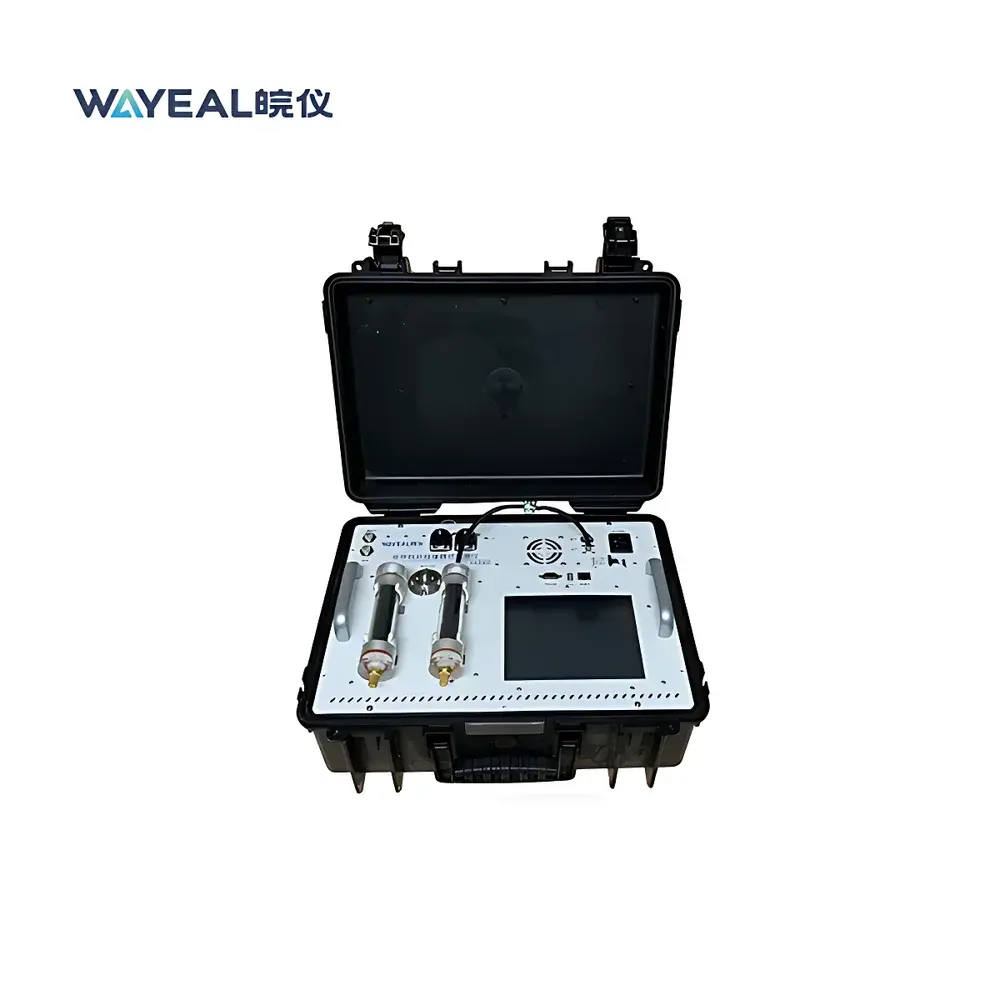
WAYEAL PA2000 Portable Total Hydrocarbons and Non-Methane Hydrocarbons (NMHC) Analyzer
| Brand | WAYEAL |
|---|---|
| Origin | Anhui, China |
| Manufacturer Type | Direct Manufacturer |
| Regional Classification | Domestic (China) |
| Model | PA2000 |
| Instrument Type | Portable |
| Detection Principle | Catalytic Oxidation + Flame Ionization Detection (FID) |
| Regulatory Compliance | HJ 1012–2018 |
| Detection Limit | Sub-ppb (NMHC) |
| Analysis Cycle | As low as 5 seconds |
| Operating Temperature | Full-path high-temperature heating (≥180 °C) |
| Methane Separation Method | High-efficiency catalytic oxidation (≥98% conversion efficiency) |
| Catalyst Lifetime | ≥3 years |
| Oxygen Measurement | Integrated paramagnetic/O₂ sensor |
| Weight | ~13 kg |
| Carrier Gas | Not required |
| Combustion Air | Built-in compressor — no external air supply needed |
Overview
The WAYEAL PA2000 is a field-deployable, fully integrated analyzer engineered for real-time quantification of total hydrocarbons (THC), methane (CH₄), and non-methane hydrocarbons (NMHC) in ambient air and industrial exhaust streams. It operates on the principle of selective catalytic oxidation coupled with flame ionization detection (FID), eliminating the need for gas chromatographic separation while maintaining regulatory-grade accuracy. Unlike conventional GC-FID systems, the PA2000 employs a high-temperature (≥180 °C), heated sample pathway from probe tip to detector—ensuring quantitative transfer of semi-volatile and high-boiling-point VOCs without condensation or adsorption losses. The catalytic converter achieves >98% oxidation efficiency for non-methane species, enabling precise differentiation between CH₄ and NMHC via differential FID response before and after catalysis. Designed and validated per HJ 1012–2018, the instrument meets the technical specifications required for enforcement-level monitoring, third-party verification, and continuous compliance assessment in China’s environmental regulatory framework.
Key Features
- True portable architecture: Weighing only ~13 kg, the PA2000 integrates all critical subsystems—including heated sampling train, catalytic converter, FID detector, O₂ sensor, internal air compressor, and rechargeable Li-ion power pack—into a single, ruggedized chassis.
- Zero external gas dependency: No bottled carrier gas (e.g., N₂ or He) or compressed zero air is required; onboard air generation ensures operational autonomy during extended field campaigns.
- Sub-second analytical cycle: Achieves full THC/CH₄/NMHC quantification in as little as 5 seconds, enabling dynamic process monitoring and rapid source identification during mobile surveys.
- Catalyst-based methane discrimination: Replaces fragile, temperature-sensitive GC valves and columns with a robust, long-life (>3 years) catalytic module operating at stable thermal conditions—reducing maintenance frequency and lifecycle cost.
- Integrated oxygen measurement: Paramagnetic or electrochemical O₂ sensor co-located with the main gas stream enables concurrent O₂ correction per HJ 1012–2018, supporting dry-basis concentration reporting and combustion efficiency estimation.
- High-temperature path integrity: Entire flow path—from inlet filter to FID jet—is maintained above 180 °C, minimizing wall losses for C₆–C₁₂ aliphatics, aromatics, and oxygenated VOCs commonly encountered in refinery, chemical, and coating facility emissions.
Sample Compatibility & Compliance
The PA2000 is validated for direct analysis of undiluted stack gases (with optional dilution module), fugitive emissions, ambient boundary air, and indoor workplace atmospheres. It accommodates sample matrices containing particulate loadings up to 5 mg/m³ (with heated inline filtration) and moisture content ≤30% v/v (handled via thermally stabilized condensate management). All hardware and firmware comply with HJ 1012–2018 requirements for linearity (R² ≥ 0.999), repeatability (<2% RSD), zero drift (<±0.5% FS/24 h), and span drift (<±1.0% FS/24 h). Data output formats support CSV export and Modbus TCP for integration into EPA-compliant CEMS architectures or enterprise environmental data management platforms.
Software & Data Management
The embedded Linux-based firmware provides a touchscreen GUI with multilingual support (English/Chinese), real-time chromatogram-free signal visualization, and configurable alarm thresholds (ppb-level NMHC excursion, O₂ depletion, catalyst temperature deviation). Raw analog outputs (4–20 mA) and digital interfaces (RS485, USB-C, Wi-Fi 802.11n) enable seamless connection to SCADA, DCS, or cloud-based IoT dashboards. Audit-trail functionality logs all calibration events, parameter changes, and system diagnostics with timestamped user ID attribution—supporting GLP-aligned documentation practices. Firmware updates are performed via signed OTA packages to ensure traceability and cybersecurity compliance.
Applications
- Regulatory enforcement: On-site inspection of point sources (stacks, vents) and area sources (fugitive leaks, loading docks) by MEE-affiliated agencies and certified third-party testing laboratories.
- Compliance verification: NMHC emission rate validation against permit limits (e.g., GB 31570–2015, GB 31571–2015) during performance testing and periodic monitoring.
- VOCs abatement evaluation: Quantitative assessment of destruction/removal efficiency (DRE) for RTOs, RCUs, and carbon adsorption units using paired upstream/downstream measurements.
- Source apportionment: Mobile mapping of NMHC gradients across industrial perimeters to prioritize leak detection and repair (LDAR) efforts.
- Process optimization: Real-time feedback on combustion stoichiometry and unburnt hydrocarbon slip in thermal oxidizers and flare stacks.
FAQ
Does the PA2000 require calibration gas cylinders for routine operation?
No. Zero air is generated internally; span calibration uses certified NMHC standard gases (e.g., propane in air), but cylinder refills are only needed every 3–6 months depending on usage frequency.
Can the instrument measure methane independently without NMHC calculation?
Yes. The dual-FID configuration (pre- and post-catalyst) allows direct CH₄ quantification, with NMHC derived by subtraction—fully traceable to NIST-traceable standards.
Is the PA2000 suitable for use in explosive atmospheres (ATEX Zone 1)?
Not intrinsically safe by default; however, an optional ATEX-certified explosion-proof enclosure (II 2G Ex db IIB T4 Gb) is available upon request for hazardous area deployment.
What is the recommended maintenance interval for the catalytic converter?
Under typical industrial exhaust conditions, catalyst replacement is advised after ≥3 years or upon observed conversion efficiency drop below 95%, verified via built-in diagnostic test sequence.
How is data integrity ensured during field use?
All measurements include embedded GPS coordinates, ambient pressure/temperature/humidity metadata, and cryptographic hash signatures—enabling forensic auditability per ISO/IEC 17025 and CNAS requirements.
Related Products







