
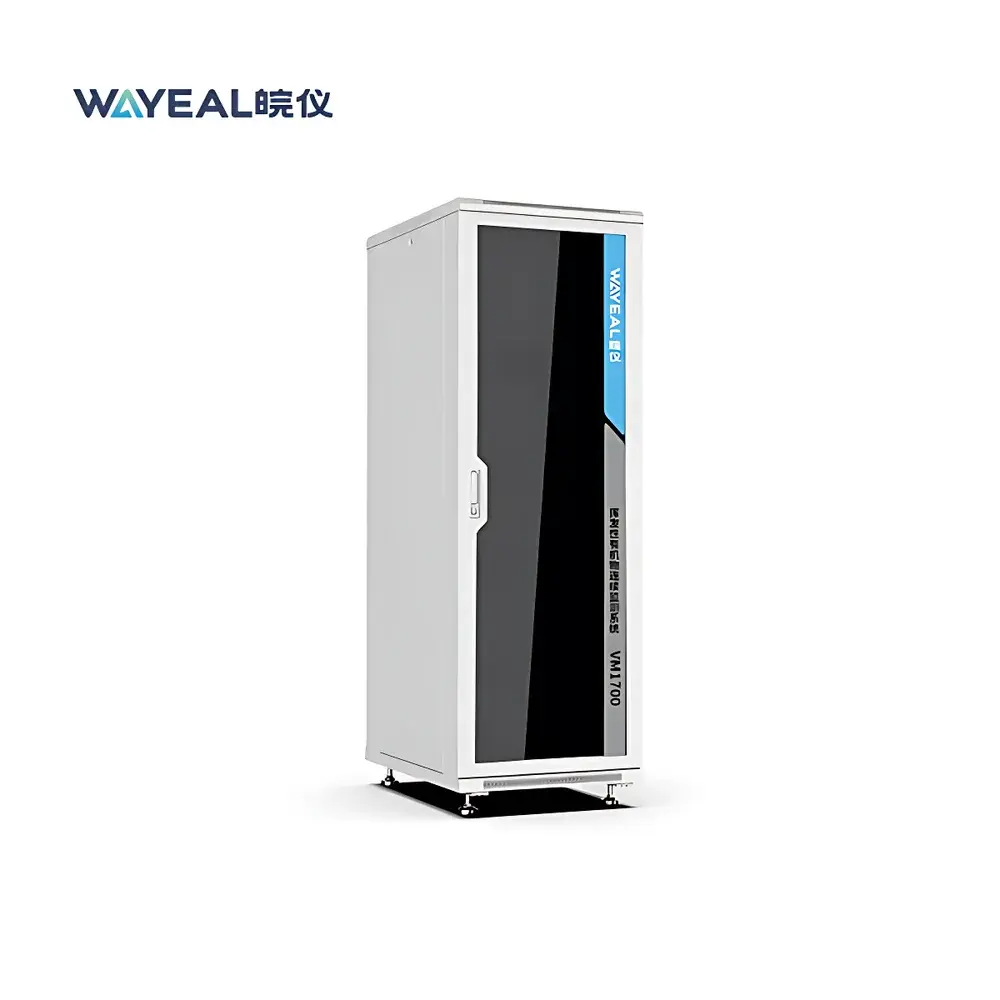
WAYEAL VM1700 VOCs Online Monitoring System (Gas Chromatography with Flame Ionization Detection)
| Brand | WAYEAL |
|---|---|
| Origin | Anhui, China |
| Manufacturer Type | Direct Manufacturer |
| Country of Origin | China |
| Model | VM1700 |
| Instrument Type | Online Continuous Emission Monitoring System (CEMS) |
| Detection Principle | Gas Chromatography–Flame Ionization Detection (GC-FID) |
| Target Analytes | Methane (CH₄), Total Hydrocarbons (THC), Non-Methane Hydrocarbons (NMHC), and selected BTEX compounds |
| Sample Path Temperature | 175 °C (fully heated from probe to detector) |
| Compliance | Certified by China National Environmental Monitoring Centre (CNEMC) for CEMS applicability testing |
Overview
The WAYEAL VM1700 VOCs Online Monitoring System is an industrial-grade, continuous emission monitoring system engineered for regulatory-compliant, real-time quantification of volatile organic compounds (VOCs) in fixed-source exhaust streams. It operates on the validated principle of gas chromatography coupled with flame ionization detection (GC-FID), a reference method recognized under multiple national and international standards—including EPA Method 25A, ISO 11890-2, and HJ 1012–2018 (China’s Technical Specification for VOCs CEMS). Designed specifically for high-moisture, high-concentration, and thermally labile industrial effluents, the VM1700 integrates full-path 175 °C high-temperature heating—from sampling probe through transfer line, pre-concentrator (if configured), column oven, and FID detector—to prevent condensation, adsorption, or catalytic loss of heavy-end hydrocarbons (e.g., C₈–C₁₂ aliphatics and aromatics). Its modular architecture separates sample conditioning, separation, detection, and data handling into functionally isolated subsystems housed within a climate-controlled rack-mounted cabinet, enabling long-term unattended operation in harsh plant environments.
Key Features
- Full-path 175 °C heated sampling train: Eliminates cold spots and minimizes analyte loss for high-boiling-point VOCs including xylenes, ethylbenzene, naphthalene, and heavier aromatic species.
- Dual-stream sampling design: Main stack gas is drawn via vacuum pump; a precisely metered sidestream is delivered to the GC-FID analyzer—ensuring rapid system response time (< 300 s T90 for NMHC) without compromising representativeness.
- Triple-stage particulate and moisture filtration: Comprising stainless-steel sintered filter (5 µm), heated coalescing filter, and chemical scrubber (optional), protecting GC columns and FID jet integrity over extended service intervals.
- Robust GC-FID configuration: Equipped with dual capillary columns (e.g., DB-1/DB-624 or equivalent) for parallel THC/NMHC and speciated BTEX analysis; FID optimized for linear dynamic range > 10⁶ and low detection limits (sub-ppb for methane, < 5 ppb for benzene).
- Integrated calibration management: Automated multi-point calibration using certified standard gases (CH₄, propane, benzene); supports bracketing, span-check, and zero-drift verification per HJ 75–2017 and EU EN 15267 requirements.
Sample Compatibility & Compliance
The VM1700 is validated for use across diverse industrial emission sources characterized by elevated humidity (> 80% RH), particulate loading (< 10 mg/m³), and VOC concentration ranges from 0.1 to 10,000 ppmv (as propane or carbon equivalent). It complies with China’s HJ 1012–2018 technical specification for VOCs CEMS and has successfully passed applicability testing conducted by the China National Environmental Monitoring Centre (CNEMC). While not pre-certified for U.S. EPA or EU MCERTS schemes, its GC-FID core methodology aligns with the analytical foundation of EPA Method 25A and EN 12619, supporting adaptation to local regulatory validation protocols. The system meets electromagnetic compatibility (EMC) Class A requirements per GB/T 17626 series and is rated IP54 for cabinet ingress protection.
Software & Data Management
The embedded Linux-based data acquisition and processing unit runs WAYEAL’s proprietary CEMS software, compliant with HJ 212–2017 communication protocol for environmental data transmission. It provides real-time chromatogram visualization, peak integration with retention time locking, auto-baseline correction, and configurable reporting intervals (1-min, 15-min, hourly, daily). Audit trails record all user actions, calibration events, maintenance logs, and instrument faults—supporting GLP-aligned data integrity. Raw chromatographic data (including detector voltage vs. time) are stored locally for ≥180 days and exportable in CSV or ASTM E1709-compliant formats. Remote diagnostics and firmware updates are supported via secure TLS-encrypted Ethernet or 4G LTE connection.
Applications
The VM1700 is deployed in regulated emission monitoring at point sources where organic compound control is mandated: petrochemical fluidized catalytic cracking (FCC) units, pharmaceutical solvent recovery systems, semiconductor cleanroom abatement stacks, leather tanning exhaust ducts, flexographic printing dryers, and automotive paint booth afterburners. It serves both compliance-driven applications (e.g., permit reporting under China’s “Three-Year Action Plan for VOCs Control”) and process optimization roles—such as verifying destruction efficiency of RTO/RCO thermal oxidizers or quantifying breakthrough in activated carbon adsorbers. Its speciation capability enables source apportionment studies when paired with laboratory GC-MS confirmation.
FAQ
Does the VM1700 support speciated VOC analysis beyond NMHC?
Yes—it can be configured with dual-column switching and retention time indexing to quantify individual compounds including benzene, toluene, ethylbenzene, xylenes (BTEX), and styrene, subject to column selection and calibration standard availability.
What maintenance intervals are recommended for routine operation?
Filter replacement every 3 months; FID nozzle cleaning and detector optimization every 6 months; GC column reconditioning or replacement annually—depending on sample matrix severity.
Is the system compatible with third-party SCADA or DCS platforms?
Yes—via Modbus TCP, OPC UA, or HJ 212–2017-compliant serial/ethernet protocols; custom API integration available upon request.
Can the VM1700 operate in explosive atmospheres?
The base system is rated for non-hazardous area installation (Zone 2/Class I Div 2); explosion-proof variants with ATEX/IECEx certification are available as OEM-engineered options.
How is data integrity ensured during power interruption or network outage?
Onboard non-volatile memory retains ≥72 hours of raw chromatographic data and event logs; automatic resynchronization occurs upon network recovery without data loss.







