
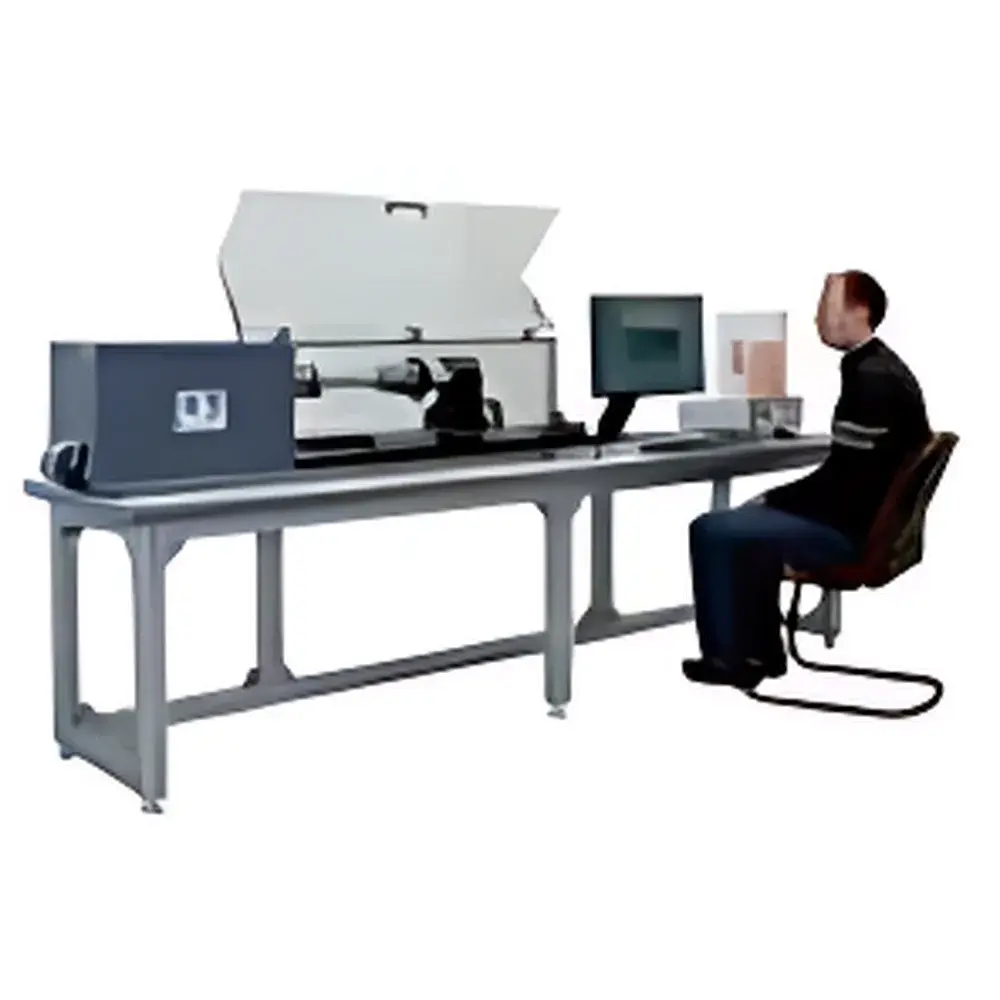
W+B LFM-T Series High-Capacity Electronic Torsion Testing Machine
| Brand | W+B |
|---|---|
| Origin | Switzerland |
| Model | LFM-T |
| Torque Range | 20–500 N·m |
| Application | High-force torsional characterization of structural components and fasteners |
Overview
The W+B LFM-T Series is a high-precision, servo-controlled electronic torsion testing machine engineered for static and quasi-static torsional mechanical characterization of industrial-scale components. It operates on the principle of controlled angular displacement or torque application under closed-loop feedback, enabling accurate determination of torsional stiffness, shear modulus (G), yield torque, ultimate torsional strength, plastic deformation behavior, and fracture toughness under pure torsion. Designed for laboratory and quality control environments requiring traceable, repeatable, and ISO 14577-compliant mechanical data, the LFM-T series meets the metrological demands of R&D labs, automotive OEMs, aerospace component suppliers, and fastener manufacturers conducting full-size part validation per ASTM F568M, ISO 898-1, and DIN 267-12.
Key Features
- High-capacity torsion frame with rigid cast-iron base and precision-machined torque transmission path, minimizing parasitic bending moments and ensuring axial alignment stability during testing.
- Dual-mode control architecture: supports both torque-controlled (constant rate or step loading) and angle-controlled (displacement-driven) test profiles with real-time switching capability.
- Integrated high-resolution rotary encoder (≤0.001° resolution) and calibrated torque transducer (class 0.5 per ISO 376), traceable to national metrology institutes (e.g., METAS, PTB).
- Motorized crosshead with programmable speed range (0.001–360°/min), enabling low-strain-rate creep-torsion studies and high-speed failure analysis.
- Modular gripping system accommodating solid shafts, hollow tubes, threaded fasteners (M6–M48), drill bits, drive axles, and custom fixtures—designed for minimal slippage and stress concentration.
- Compliance with electromagnetic compatibility (EMC) standards IEC 61326-1 and safety requirements per IEC 61000-6-2/6-4.
Sample Compatibility & Compliance
The LFM-T accommodates specimens up to 1,200 mm in length and 150 mm in diameter, supporting standardized test geometries defined in ISO 7800 (torsion testing of metallic materials) and ASTM E143 (shear modulus determination). It is routinely deployed for qualification testing of torque-to-yield (TTY) bolts, drivetrain couplings, orthopedic implant stems, and composite drive shafts. All measurement functions are compliant with ISO/IEC 17025 requirements for testing laboratories, and raw data acquisition satisfies FDA 21 CFR Part 11 audit trail and electronic signature prerequisites when paired with validated software modules.
Software & Data Management
The system is operated via W+B’s proprietary TorsionControl Suite v4.x—a Windows-based platform supporting multi-channel synchronized acquisition (torque, angle, temperature optional), real-time curve overlay, and automated report generation in PDF/XLSX formats. The software implements GLP/GMP-aligned user access levels (operator, supervisor, administrator), configurable test method templates, and built-in statistical process control (SPC) tools for batch consistency evaluation. Raw binary data files (.wbd) retain full metadata (calibration IDs, environmental timestamps, operator credentials), enabling full reprocessing and third-party verification. Optional integration with LIMS platforms via OPC UA or RESTful API ensures seamless data flow into enterprise QA systems.
Applications
- Quantification of torsional yield point and plastic hinge formation in high-strength steel fasteners per ISO 898-2.
- Evaluation of torsional fatigue life and crack propagation resistance in nickel-based superalloy turbine shafts.
- Validation of adhesive bond integrity in hybrid aluminum-composite drive axles under combined torsion-bending loads.
- Shear modulus derivation from linear elastic region slope in polymer matrix composites (ASTM D5229/D5379).
- Calibration and verification of torque wrenches and digital torque sensors against primary standards.
- Research-grade torsional hysteresis and energy dissipation analysis in shape memory alloys and viscoelastic elastomers.
FAQ
What is the maximum allowable specimen length and diameter for the LFM-T series?
Standard configuration supports specimens up to 1,200 mm in length and 150 mm in diameter; extended-length variants are available upon request.
Does the system support automatic torque calibration verification?
Yes—integrated self-check routines verify transducer linearity and zero drift before each test sequence, with results logged and exportable.
Can the LFM-T perform torsional creep tests?
Yes—via constant-torque hold profiles with sub-microradian angular resolution and time-stamped strain monitoring over durations exceeding 1,000 hours.
Is the software compliant with FDA 21 CFR Part 11?
When deployed with electronic signature modules and audit-trail logging enabled, the TorsionControl Suite meets all technical and procedural requirements of 21 CFR Part 11.
What international standards does the LFM-T reference for test execution?
Primary references include ISO 7800, ASTM E143, ASTM F568M, ISO 898-1/2, DIN 267-12, and EN 10204 Type 3.1 material certification workflows.



