
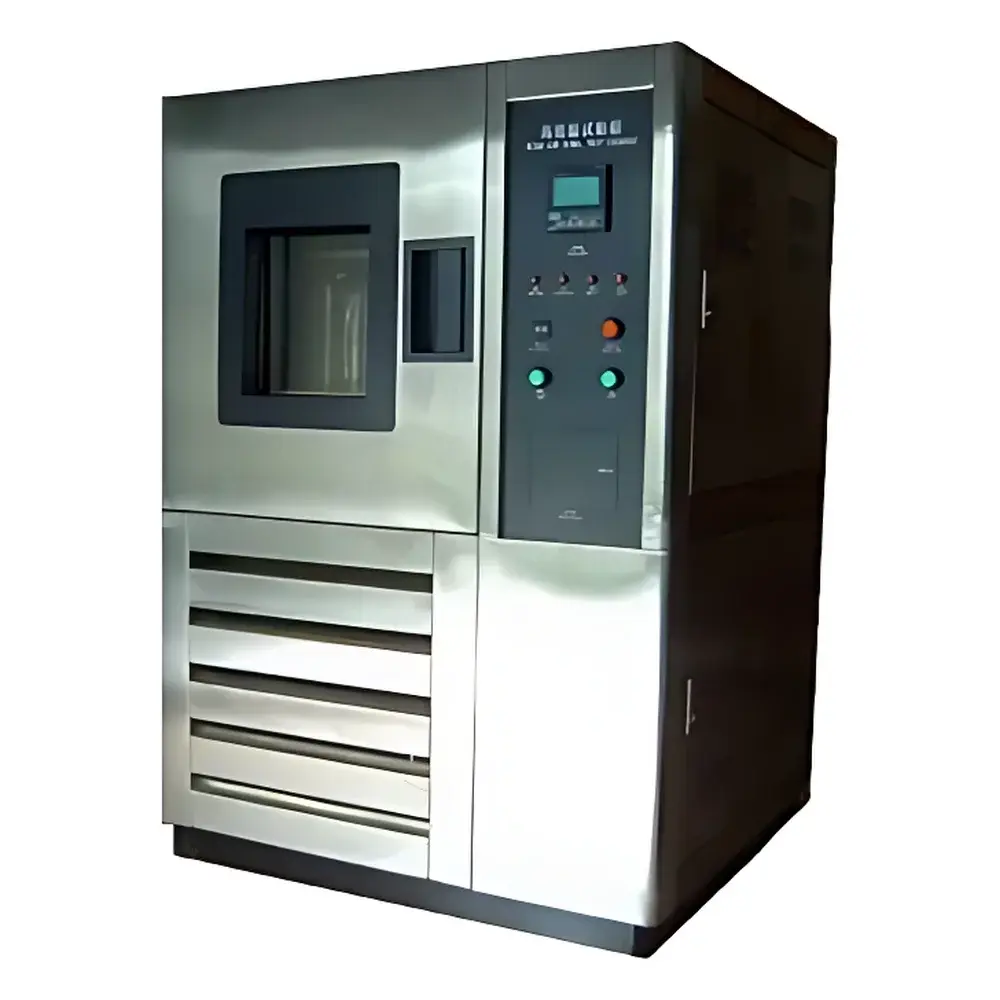
WGD40 Fiber Optic & Crystal Precision Thermal Cycling Chamber with Programmable Temperature Control
| Origin | Guangdong, China |
|---|---|
| Manufacturer Type | Authorized Distributor |
| Origin Category | Domestic (China) |
| Model | WGD40 |
| Pricing | Available Upon Request |
| Temperature Range | −40 °C to +100 °C (optional up to +150 °C) |
| Temperature Uniformity | ±1.5 °C |
| Temperature Stability | ±0.5 °C |
| Heating Rate | −40 °C → +100 °C in ≈55 min |
| Cooling Rate | +20 °C → −40 °C in ≈60 min |
| Internal Volume | 408 L |
| Inner Dimensions (W×D×H) | 600 × 800 × 850 mm |
| Construction | SUS304 Stainless Steel Interior, Powder-Coated Cold-Rolled Steel Exterior |
| Insulation | High-Density Polyurethane Foam + Glass Wool |
| Refrigeration System | Single-Stage Mechanical Compression (R507) or Dual-Stage Cascade (R404A/R23) |
| Controller | LED-Based Programmable PID Controller, 4 Programs × 10 Segments, 9999 Cycles |
| Compliance | GB/T 10589, GB/T 11158, GB/T 10592, GB/T 2423.1–2423.22, IEC 60068-2-1/2/14, GJB 150.3/150.4 |
Overview
The WGD40 Fiber Optic & Crystal Precision Thermal Cycling Chamber is an engineered environmental test system designed for high-fidelity thermal stress evaluation of optoelectronic components, crystalline materials, and micro-scale precision devices. Operating on a balanced temperature control (BTC) principle, the chamber maintains precise thermal profiles through active feedback regulation between heating and refrigeration subsystems—ensuring minimal overshoot and stable setpoint adherence under dynamic load conditions. Unlike generic thermal chambers, the WGD40 integrates low-thermal-mass internal architecture and optimized airflow dynamics specifically to minimize thermal gradients across sensitive sample zones—critical for testing fiber Bragg gratings (FBGs), lithium niobate (LiNbO₃) waveguides, quartz crystal resonators, and thin-film piezoelectric substrates where localized thermal strain directly impacts optical phase stability or resonant frequency drift. Its dual-range capability (−40 °C to +100 °C standard; optional −70 °C to +150 °C) supports both accelerated aging per MIL-STD-810H Method 502.6 and qualification-level thermal shock per IEC 60068-2-14 Test N.
Key Features
- Engineered BTC (Balanced Temperature Control) system with expert PID tuning—eliminates thermal overshoot during rapid ramp transitions, essential for maintaining integrity of fragile optical coatings and bonded crystal interfaces.
- Forced-air circulation via multi-wing centrifugal blower and aerodynamically optimized ducting—achieves ±1.5 °C uniformity across full working volume without dead zones, verified per IEC 60068-3-5.
- Dual refrigeration architecture: single-stage R507 system for standard operation or cascade configuration (R404A/R23) for extended low-temperature reach—both compliant with EPA SNAP and EU F-Gas Regulation (No. 517/2014).
- SUS304 stainless steel interior chamber with seamless welded corners and electropolished finish—prevents particulate shedding and corrosion-induced outgassing, meeting cleanroom-compatible handling requirements for photonic device testing.
- Programmable controller supporting up to 4 independent thermal profiles, each with 10 programmable segments and 9999-cycle repetition—enabling complex duty cycles such as thermal cycling with dwell, ramp-hold-ramp sequences, and stepwise stress profiling.
- Integrated safety architecture: independent overtemperature cut-off (separate from main controller), compressor high-pressure/overheat protection, phase failure detection, and earth leakage circuit interruption—all documented in accordance with IEC 61000-6-2 EMC immunity standards.
Sample Compatibility & Compliance
The WGD40 is explicitly validated for thermally sensitive passive and active optoelectronic components—including single-mode and polarization-maintaining optical fibers, bulk and waveguide-based nonlinear crystals (e.g., BBO, KTP), MEMS oscillators, SAW/BAW filters, and multilayer ceramic capacitors (MLCCs) used in RF front-end modules. Its internal dimensions (600 × 800 × 850 mm) accommodate standard 19″ rack-mount optical test fixtures and custom fixture plates with integrated thermal interface monitoring. All performance specifications comply with national and international test standards referenced in the design basis: GB/T 2423.1 (cold), GB/T 2423.2 (dry heat), GB/T 2423.22 (temperature change), IEC 60068-2-14 (thermal shock), and GJB 150.3/150.4 (military environmental testing). Calibration traceability follows ISO/IEC 17025 requirements, with optional factory calibration certificate available upon request.
Software & Data Management
While the base unit features a standalone LED-based controller with real-time LCD display and manual keypads, optional RS485/Modbus RTU or Ethernet TCP/IP interfaces enable integration into centralized laboratory data acquisition networks. Third-party SCADA systems (e.g., LabVIEW, Ignition, or Siemens Desigo CC) can log temperature setpoints, actual chamber readings, cycle counters, and alarm events with timestamped audit trails. For regulated environments—including ISO 13485-certified medical device manufacturing or IATF 16949 automotive component validation—the optional data logging module provides 21 CFR Part 11-compliant electronic records, including user authentication, immutable event logs, and signature-enabled report generation. Raw temperature data is exportable in CSV format for statistical process control (SPC) analysis using Minitab or JMP.
Applications
- Thermal cycling reliability assessment of fiber optic gyroscopes (FOGs) and interferometric sensors under repeated expansion/contraction stress.
- Qualification testing of laser diode packages and pump combiners subjected to thermal mismatch between silica fiber and ceramic submounts.
- Stability evaluation of high-Q crystalline resonators (e.g., SC-cut quartz) across operational temperature bands—supporting IEEE Std 1139 frequency stability characterization.
- Pre-conditioning of PCB assemblies containing embedded optical transceivers prior to burn-in or HALT protocols.
- Material coefficient of thermal expansion (CTE) correlation studies for hybrid photonic integrated circuits (PICs) integrating III-V semiconductors with silicon photonics platforms.
- Environmental screening of optical isolators, circulators, and wavelength-selective switches used in DWDM infrastructure.
FAQ
Does the WGD40 support thermal shock testing per IEC 60068-2-14?
Yes—the chamber’s rapid ramp rates (≤60 min for −40 °C ↔ +100 °C transitions) and dual-zone thermal inertia management meet the minimum transition time requirements for Test N, provided external sample mounting fixtures do not impede airflow.
Can the internal chamber be modified to accommodate custom cable feedthroughs or vacuum ports?
Standard configurations include one Φ50 mm cable port with silicone gasket seal; additional ports or flanged vacuum interfaces (KF25/KF40) are available as factory-installed options—subject to structural integrity verification and thermal leakage assessment.
Is the temperature controller compliant with GLP/GMP documentation requirements?
The base controller does not include electronic signature or audit trail functionality; however, the optional Ethernet-enabled data logger module delivers full 21 CFR Part 11 compliance—including role-based access control, operation history, and tamper-evident record archiving.
What maintenance intervals are recommended for the refrigeration system?
Compressor oil and filter-drier replacement every 24 months under continuous operation; annual inspection of condenser coil cleanliness, refrigerant charge verification, and PT100 sensor calibration traceability—documented per ISO/IEC 17025.
Are calibration certificates included with shipment?
A factory-as-tested performance report is supplied standard; NIST-traceable calibration certificates (including uncertainty budgets per ISO/IEC 17025) are available as an add-on service with lead time scheduling.



