
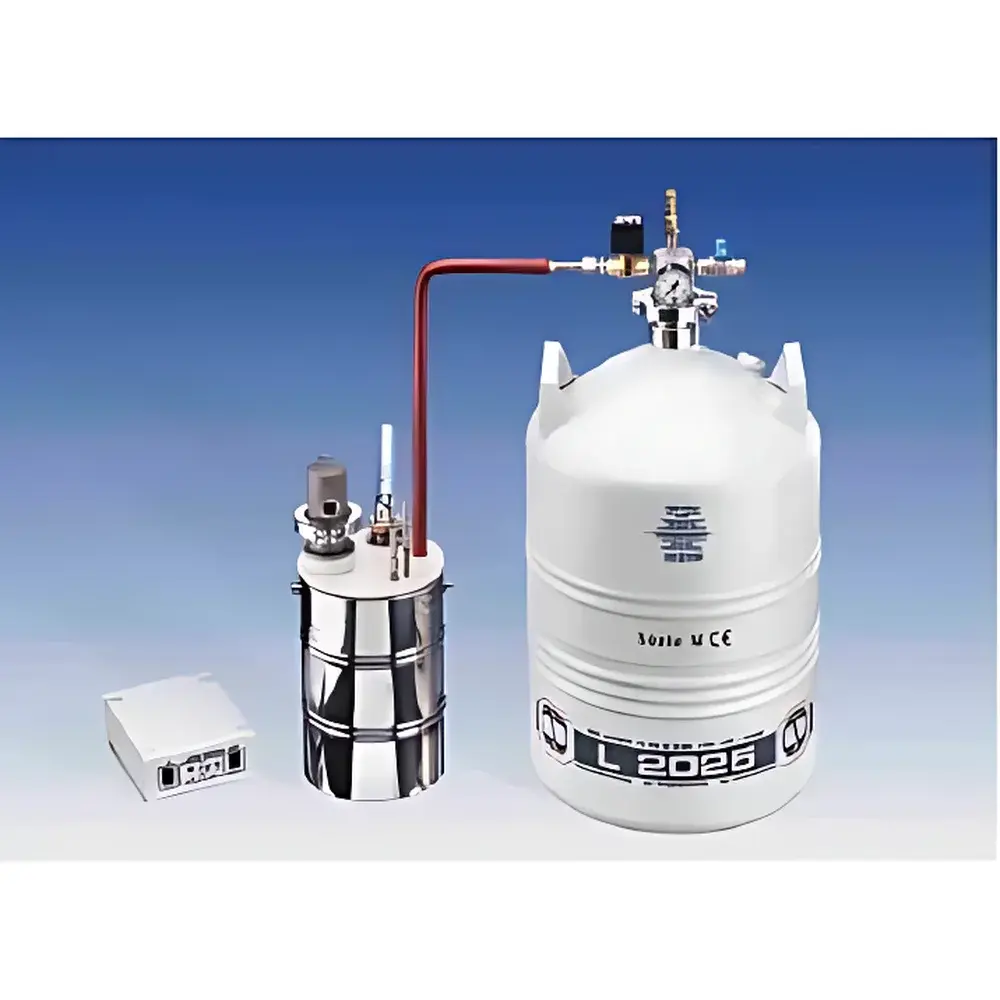
WIGGENS 2760-35 Automated Liquid Nitrogen Level Control System
| Brand | WIGGENS |
|---|---|
| Origin | Germany |
| Model | 2760-35 |
| Storage Tank Capacity | 35 L |
| Control Principle | Dual-Temperature-Sensor Feedback with 24 V Solenoid Valve Actuation |
| Power Supply | 24 V DC |
| Sensor Type | Immersion Thermistors (High/Low Level) |
| Compliance | Designed for GLP-compliant low-temperature process control in laboratory and industrial settings |
Overview
The WIGGENS 2760-35 Automated Liquid Nitrogen Level Control System is an engineered solution for maintaining precise, repeatable liquid nitrogen (LN₂) levels within Dewar vessels during critical low-temperature applications. It operates on a closed-loop thermistor-based feedback principle: two calibrated immersion temperature sensors—strategically positioned at predetermined high and low level thresholds—detect phase-change-induced temperature shifts as the LN₂ meniscus rises or falls. When the liquid level drops below the lower sensor, the control unit energizes a 24 V DC solenoid valve integrated into a pressurized siphon transfer line, enabling passive nitrogen transfer from a dedicated 35 L storage tank into the Dewar via inherent vapor pressure differential. Flow ceases automatically upon detection of LN₂ contact at the upper sensor, ensuring stable level maintenance between the two setpoints without manual intervention or external pumps. This architecture eliminates reliance on float switches or ultrasonic transducers—devices prone to icing, condensation interference, or calibration drift in cryogenic environments—and delivers robust, long-term stability essential for thermal contraction fitting, cold trap operation, sensor calibration, and cryopreservation workflows.
Key Features
- Self-contained 35 L LN₂ reservoir with integrated siphon assembly and 24 V solenoid valve for passive, pressure-driven replenishment
- Dual thermistor-based level sensing system optimized for cryogenic thermal transition detection (−196 °C), minimizing false triggers from ambient condensation or vapor turbulence
- Modular design compatible with standard WIGGENS stainless steel and glass Dewar vessels, cold traps (e.g., SL29GL-A, S54V-K16-Z), and custom cryogenic fixtures
- Fail-safe operation: valve de-energizes on power loss; system defaults to closed state, preventing uncontrolled LN₂ transfer
- Thermally insulated transfer lines reduce boil-off and maintain consistent delivery kinetics across extended operational cycles
- Front-panel status indicators for sensor activation, valve state, and system readiness—designed for integration into ISO 17025-accredited lab environments
Sample Compatibility & Compliance
The 2760-35 system supports a broad range of cryogenic sample handling configurations—including axial thermal shrink-fit assemblies, cryogenic cold traps for vacuum systems, and calibration baths for platinum resistance thermometers (PRTs) and thermocouples per ASTM E220 and IEC 60751. Its sensor placement and control hysteresis are validated for use with biological cryovials, metal components undergoing controlled thermal contraction (e.g., bearing housings, shaft couplings), and analytical cold traps in GC-MS and FTIR applications. The system adheres to fundamental safety requirements outlined in EN 13445-3 (Unfired Pressure Vessels – Part 3: Design) for auxiliary cryogenic equipment and incorporates traceable sensor calibration documentation suitable for GLP and GMP audit trails. While not a medical device, its architecture aligns with FDA 21 CFR Part 11 data integrity expectations when paired with compliant logging software.
Software & Data Management
The 2760-35 operates as a standalone hardware controller with no embedded firmware or network interface. All operational logic resides in analog-digital hybrid circuitry to ensure deterministic response time (< 1.2 s valve actuation latency) and immunity to electromagnetic interference common near cryocoolers or vacuum pumps. For laboratories requiring electronic recordkeeping, the unit provides isolated 0–5 V analog outputs corresponding to high/low sensor states and valve position—compatible with third-party DAQ systems (e.g., National Instruments CompactDAQ, Keysight 34972A) configured for continuous timestamped logging. Optional RS-485 expansion modules (sold separately) enable integration into LabVIEW or Python-controlled environments supporting Modbus RTU protocol, facilitating automated reporting for ISO/IEC 17025 clause 7.7 (result reporting) and internal SOP compliance.
Applications
- Controlled thermal shrink-fitting of precision mechanical components (e.g., aerospace bearings, turbine shafts) where dimensional repeatability depends on sustained −196 °C exposure
- Maintaining optimal liquid height in cold traps used with rotary evaporators, freeze dryers, and high-vacuum systems to maximize condensation surface area and minimize backstreaming
- Stabilizing bath temperature uniformity during calibration of Class A PRTs and Type T thermocouples per ISO/IEC 17025 Clause 6.4.10 (reference material traceability)
- Enabling reproducible cryo-fixation protocols for electron microscopy specimen preparation, where inconsistent LN₂ levels cause ice crystal artifact formation
- Supporting long-duration cryostatic testing of superconducting materials and quantum devices requiring sub-200 K thermal stability over 72+ hour cycles
FAQ
Does the 2760-35 require external power beyond the supplied 24 V DC input?
No. The system draws ≤ 1.2 A at 24 V DC solely for sensor biasing and solenoid actuation. No auxiliary cooling, computing, or communication modules are integrated.
Can the high/low sensor positions be adjusted for non-standard Dewar geometries?
Yes. Sensor mounting brackets are configurable along the included support rod; final placement must be verified using LN₂ fill-and-measure validation per user-defined level tolerances.
Is the 35 L storage tank certified for transport or long-term static storage?
The tank complies with PED 2014/68/EU for stationary use only. Transport requires separate UN-certified LN₂ dewars meeting ADR/RID regulations.
How frequently do the thermistor sensors require recalibration?
Under normal laboratory conditions, annual verification against a NIST-traceable cryogenic reference thermometer is recommended; drift exceeds ±0.3 °C/year only under repeated thermal cycling beyond 500 cycles.
What failure modes are monitored by the control unit?
The unit continuously checks sensor continuity, open-circuit faults, and solenoid coil resistance. An audible alarm activates upon detection of sustained valve-open state exceeding 120 seconds—indicative of sensor misalignment or tank depletion.



