
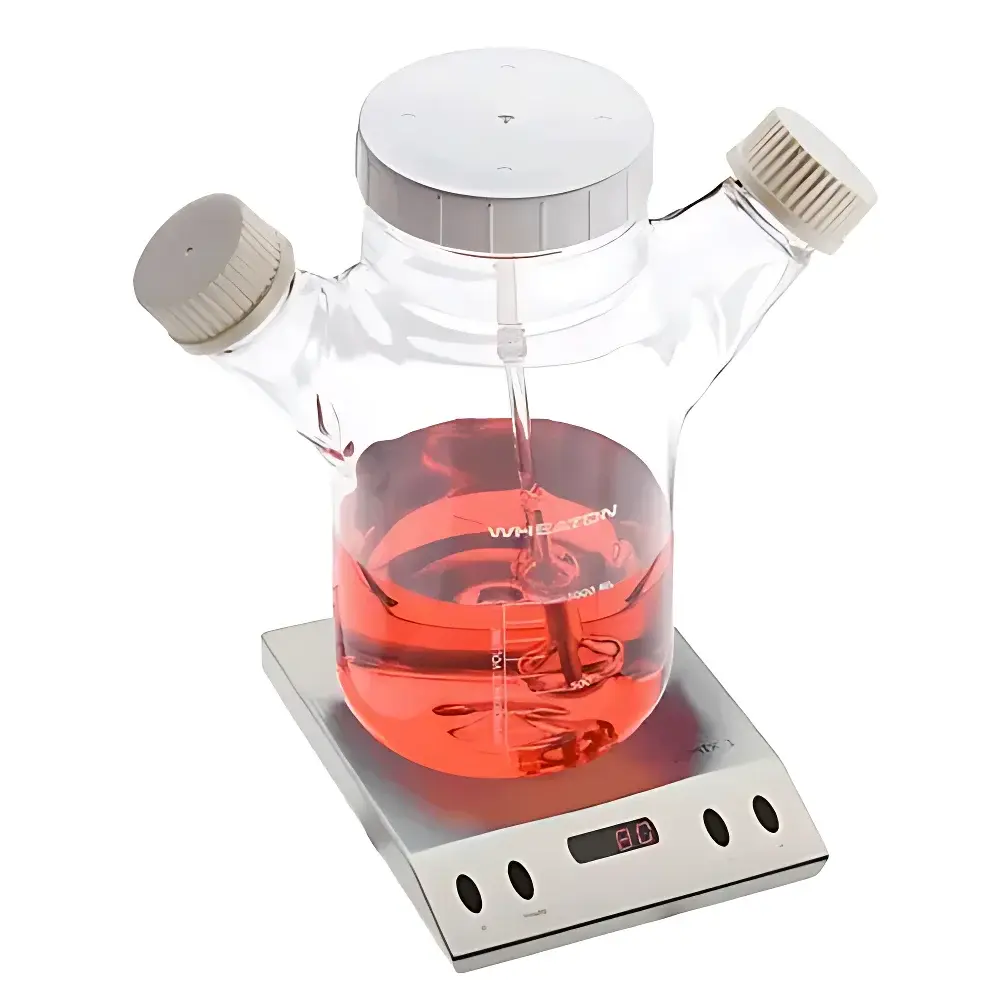
WIGGENS BioMIX1 Integrated Magnetic Drive Stirrer for Cell Culture
| Brand | WIGGENS |
|---|---|
| Origin | Germany |
| Model | BioMIX1 |
| Stirrer Type | Magnetic Drive Stirrer |
| Max. Stirring Volume | 5 L |
| Speed Range | 2–250 rpm |
| IP Rating | IP64 |
| Operating Temperature | −10 to 50 °C (at ≤80% RH) |
| Power Supply | 100–240 V, 50–60 Hz, 1.5 A |
| Housing Material | Stainless Steel (304) |
| Dimensions (W×D×H) | 180 × 230 × 38 mm |
| Weight | 1.4 kg |
| Motor Type | Maintenance-Free MAG Stepper Motor |
| Display & Control | Integrated LED Interface |
| Certifications | CE, RoHS, IEC 61000-6-3/6-4 |
Overview
The WIGGENS BioMIX1 Integrated Magnetic Drive Stirrer is an engineered solution specifically designed for sensitive biological applications requiring gentle, contamination-controlled mixing. Unlike conventional electromagnetic or gear-driven stirrers, the BioMIX1 employs a brushless MAG stepper motor coupled with contactless magnetic drive technology—eliminating mechanical wear, electrical arcing, and localized heat generation at the drive interface. This architecture ensures zero thermal contribution to the sample environment, making it suitable for extended-duration operation inside CO₂ incubators, hypoxia chambers, or cold rooms where temperature stability and sterility are critical. Its sealed stainless-steel housing (AISI 304) and IP64 ingress protection provide full resistance against dust, condensation, and incidental splashes—enabling direct placement within humidified incubator environments without risk of corrosion or microbial ingress. The unit operates across a precisely regulated speed range of 2–250 rpm, delivering high-torque, low-vibration rotation even at sub-10 rpm speeds—essential for maintaining cell viability during suspension culture, microcarrier-based expansion, or media equilibration.
Key Features
- Integrated design: Co-located control electronics, display, and magnetic drive unit minimize footprint (180 × 230 × 38 mm) and simplify benchtop or incubator integration.
- MAG stepper motor: Maintenance-free, brushless actuation delivers consistent torque from 2 rpm upward, with no speed drop under load and negligible electromagnetic interference (EMI).
- IP64-rated enclosure: Fully sealed stainless-steel housing resists corrosion, supports autoclave-compatible surface cleaning (e.g., 70% ethanol, hydrogen peroxide vapor), and complies with ISO 14644-1 Class 8 cleanroom handling protocols.
- Thermally neutral operation: No heat dissipation from motor or electronics into the working area; validated for continuous 72+ hour use at 37 °C/5% CO₂ without affecting chamber humidity or temperature uniformity.
- Flat, seamless top plate: Precision-machined 130 mm diameter platform enables stable positioning of flasks (up to 5 L), spinner vessels, and multi-well plates; surface roughness Ra < 0.8 µm facilitates rapid decontamination.
Sample Compatibility & Compliance
The BioMIX1 accommodates standard magnetic stir bars (lengths 20–80 mm, diameters 6–12 mm) as well as specialized bioreactor stir elements—including PTFE-coated, glass-encapsulated, and low-shear elliptical stir bars optimized for shear-sensitive mammalian or stem cell lines. It supports common culture formats: T-flasks, roller bottles, spinner flasks (e.g., Corning® HYPERFlask®), and custom bioreactor vessels with external magnetic coupling. The device conforms to IEC 61010-1 (Safety Requirements for Electrical Equipment for Measurement, Control, and Laboratory Use) and meets EMC standards IEC 61000-6-3 (emissions) and IEC 61000-6-4 (immunity). While not certified for GMP manufacturing environments, its construction, traceable calibration history (via optional factory report), and audit-ready operational logs support GLP-compliant workflows in preclinical R&D labs.
Software & Data Management
The BioMIX1 features a local LED display with tactile push-button interface—no external PC or software required for routine operation. Speed setpoints are stored in non-volatile memory and retained after power cycling. For laboratories requiring electronic records, optional RS-485 Modbus RTU output (accessory module) enables integration with LabVantage, STARLIMS, or custom SCADA systems. When paired with compliant data acquisition firmware, the unit supports 21 CFR Part 11–aligned audit trails—including timestamped speed changes, runtime duration, and fault event logging—with user authentication via external controller. All firmware updates are delivered via secure USB interface with cryptographic signature verification.
Applications
- Suspension culture of CHO, HEK293, and hybridoma cells in serum-free or chemically defined media.
- Homogenization of hydrogel-based 3D culture scaffolds prior to seeding.
- Equilibration of buffered saline solutions, enzyme cocktails, and transfection reagents without foaming or denaturation.
- Long-term agitation of primary neuronal cultures or organoid differentiation media under controlled gas atmospheres.
- Quality control mixing of diagnostic reagents where batch-to-batch viscosity consistency must be preserved.
FAQ
Can the BioMIX1 be operated inside a CO₂ incubator at 37 °C and 95% relative humidity?
Yes—the IP64 rating, stainless-steel housing, and thermally isolated electronics allow uninterrupted operation under these conditions. Validation data confirms no measurable impact on incubator humidity setpoint stability over 168-hour cycles.
Is speed calibration traceable to national standards?
Factory calibration uses NIST-traceable tachometric reference equipment; optional Certificate of Calibration (ISO/IEC 17025 accredited lab) is available upon order.
Does the unit support programmable ramp profiles or multi-step sequences?
No—speed is manually set and held constant. For time-varying protocols, external PLC or timer relay integration via the RS-485 interface is required.
What stir bar geometries are recommended for viscous media (>20 cP)?
Elliptical or cross-shaped stir bars (e.g., WIGGENS W-MAG-EL60) provide superior torque transfer and laminar flow patterns in methylcellulose or alginate-containing media.
How often does preventive maintenance need to be performed?
None—the MAG stepper motor has no brushes, bearings, or lubricants; only periodic visual inspection of housing integrity and cleaning per institutional biosafety guidelines is advised.



