
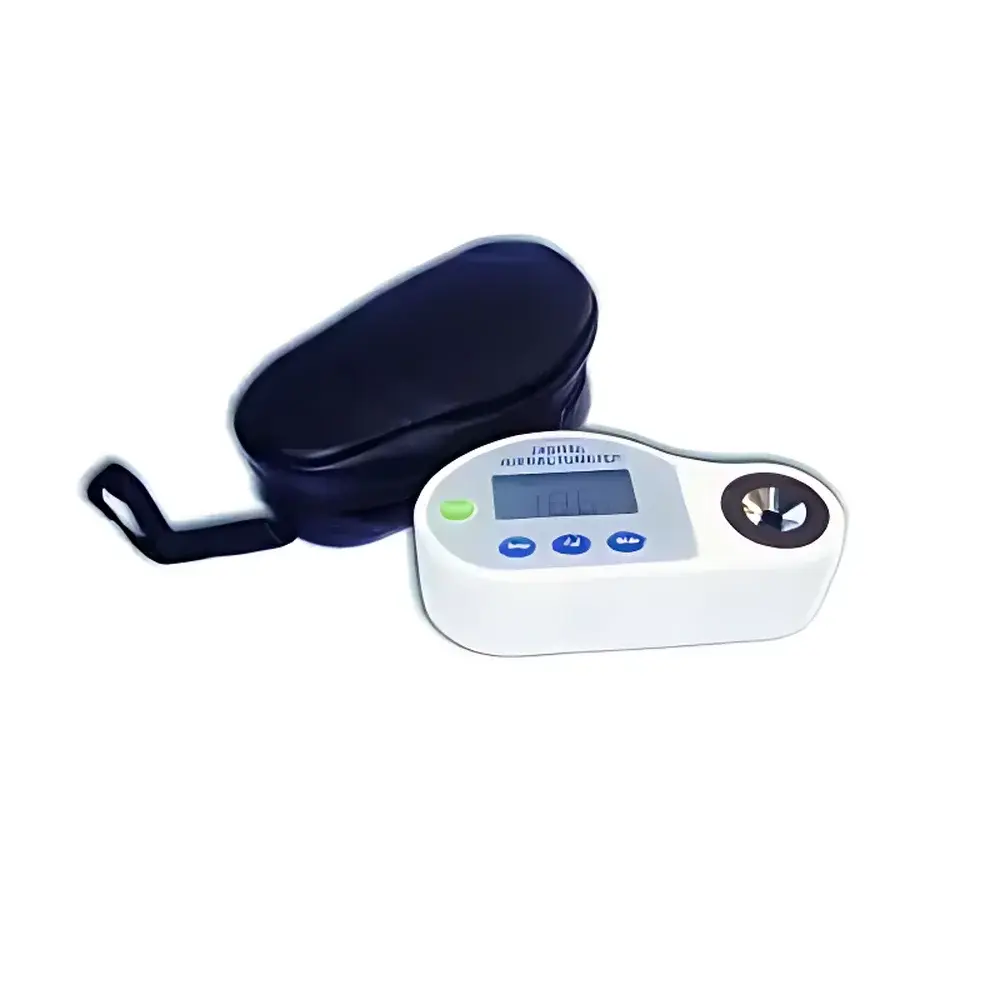
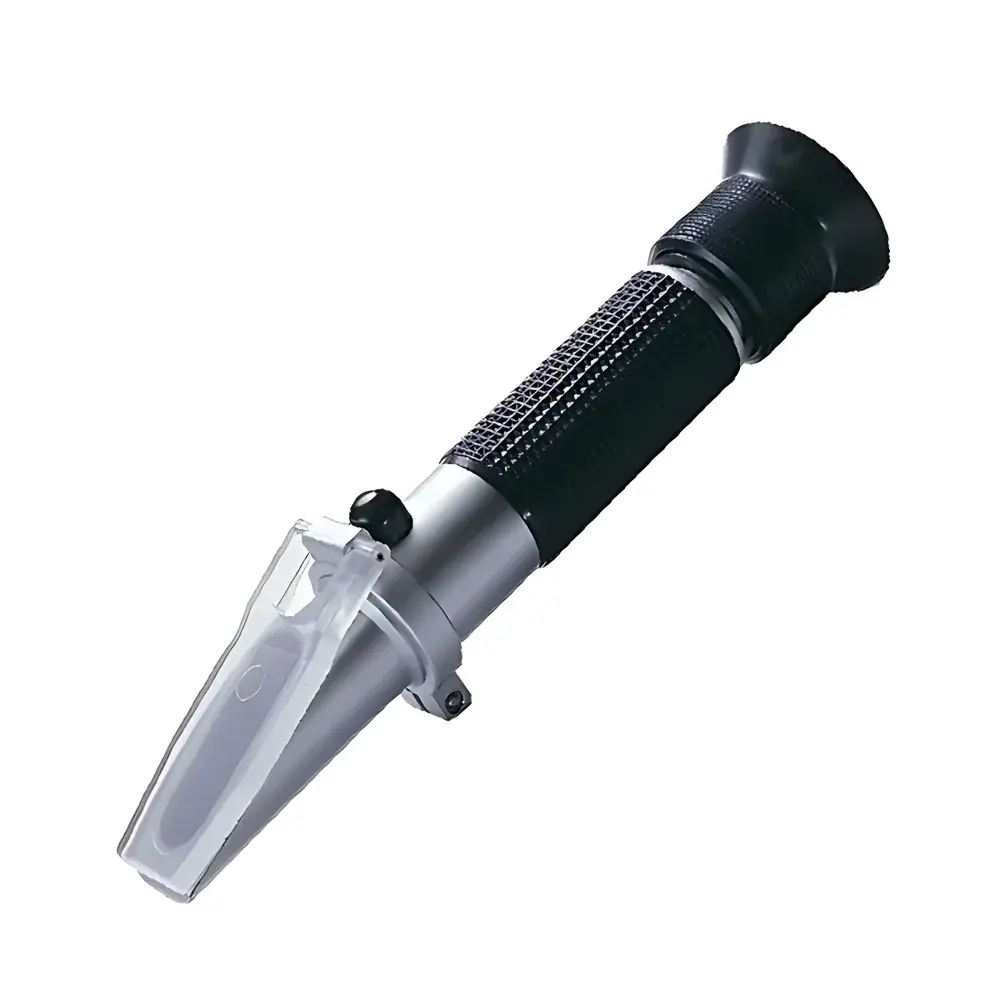
WIGGENS BR0035 Digital & Analog Handheld Refractometer
| Brand | WIGGENS |
|---|---|
| Origin | Singapore |
| Product Type | Handheld Refractometer |
| Temperature Compensation | Yes |
| Digital Display | Yes |
| Measurement Range (Brix) | 0–35% |
| Accuracy (Brix) | ±0.1% |
| Refractive Index Range | 1.3330–1.3900 |
| Resolution (RI) | 0.0003 |
| Dimensions | 27 × 40 × 210 mm |
| Weight | 215 g |
Overview
The WIGGENS BR0035 is a dual-mode handheld refractometer engineered for precision measurement of soluble solids concentration—expressed as Brix (% w/w)—and refractive index (RI) in liquid samples. It operates on the fundamental optical principle of total internal reflection: light passing from a high-refractive-index prism into a sample undergoes critical angle shift proportional to the sample’s solute concentration. This shift is optically translated into a calibrated scale (analog) and simultaneously converted via integrated photodiode array and microprocessor into a digital readout. Designed for field-deployable and benchtop use in regulated environments, the BR0035 complies with core metrological requirements for routine quality control in food, beverage, chemical, and environmental laboratories. Its temperature-compensated design ensures stable readings across ambient conditions (10–40 °C), minimizing manual correction and enhancing inter-laboratory reproducibility.
Key Features
- Dual-readout capability: Simultaneous analog scale viewing and backlit digital LCD display for rapid verification and documentation.
- Automatic temperature compensation (ATC) using a built-in thermistor sensor, referenced to 20 °C per ISO 2173 and AOAC 932.12 standards.
- High-precision Abbe-type prism assembly fabricated from optical-grade BK7 glass with anti-scratch coating for long-term calibration stability.
- Robust, ergonomic housing constructed from impact-resistant ABS polymer with IP65-rated sealing against dust and incidental water exposure.
- No external power required for analog operation; digital mode powered by two AAA batteries (included), supporting >10,000 measurements per set.
- Factory-calibrated with NIST-traceable sucrose solutions; user recalibration possible using distilled water (0% Brix) and standard 30% sucrose reference.
Sample Compatibility & Compliance
The BR0035 is validated for aqueous solutions containing sugars (e.g., glucose, fructose, sucrose), salts, alcohols, glycols, and organic acids at concentrations within its specified range. It is routinely employed in applications governed by ASTM D115, ISO 2173 (fruit juices), ISO 5725 (accuracy validation), and USP for clarity assessment of pharmaceutical excipients. The instrument meets CE marking requirements under Directive 2014/30/EU (EMC) and 2014/35/EU (LVD). For GLP/GMP environments, its ATC functionality and digital logging readiness support audit-ready workflows when paired with optional data transfer accessories. Note: Viscous, turbid, or highly volatile samples require pre-filtration or equilibration to avoid prism fouling or evaporation artifacts.
Software & Data Management
While the BR0035 operates as a standalone instrument, its digital output supports RS-232 serial interface (via optional adapter cable) for integration into LIMS or laboratory informatics platforms. When connected, it transmits timestamped Brix, RI, and temperature values in ASCII format compliant with ASTM E1382. Firmware supports configurable data output protocols—including auto-send on stabilization—and enables traceability via operator ID tagging (when used with compatible host software). All digital measurements are stored locally in non-volatile memory (up to 500 records), with automatic overwrite protection and export via USB-C (adapter required). The device adheres to FDA 21 CFR Part 11 principles through optional password-protected user roles and electronic audit trail generation in integrated systems.
Applications
- Food & Beverage: Brix quantification in fruit juices, soft drinks, jams, honey, and dairy products per Codex Alimentarius standards.
- Viticulture & Brewing: Must sugar monitoring during fermentation, wort gravity estimation, and post-fermentation alcohol screening (in conjunction with hydrometry).
- Agriculture & Horticulture: Rapid assessment of crop maturity (e.g., tomato, grape, mango) and fertilizer solution concentration.
- Chemical & Industrial: Glycol concentration in antifreeze/coolants, salt content in brines, and ethanol/water mixture verification.
- Environmental & Aquaculture: Salinity (0–28% NaCl equivalent) and specific gravity (1.000–1.050) measurement in seawater, pond water, and recirculating aquaculture systems.
FAQ
What calibration standards are recommended for routine verification?
Distilled water (0.0% Brix, RI = 1.3330 at 20 °C) and a certified 30.00 ± 0.05% sucrose standard (RI = 1.3822) are recommended per ISO 2173 Annex A.
Can the BR0035 measure non-sugar solutes accurately?
It provides reliable relative concentration estimates for linear RI contributors (e.g., NaCl, ethylene glycol); however, Brix scale readings for non-sucrose solutes require application-specific conversion factors.
Is the instrument suitable for ISO/IEC 17025-accredited testing?
Yes—when operated within its specified environmental range, maintained per manufacturer’s schedule, and verified with traceable standards, it fulfills metrological requirements for accredited routine testing.
How often should the prism surface be cleaned?
After each sample measurement using lint-free lens tissue and reagent-grade isopropanol; avoid abrasive cleaners or excessive pressure to preserve prism coating integrity.
Does the BR0035 support multiple unit outputs (e.g., %w/w, °Bx, RI) simultaneously?
Digital display defaults to Brix; RI and temperature are accessible via menu toggle; analog scale is fixed to Brix or salinity depending on model variant.




