
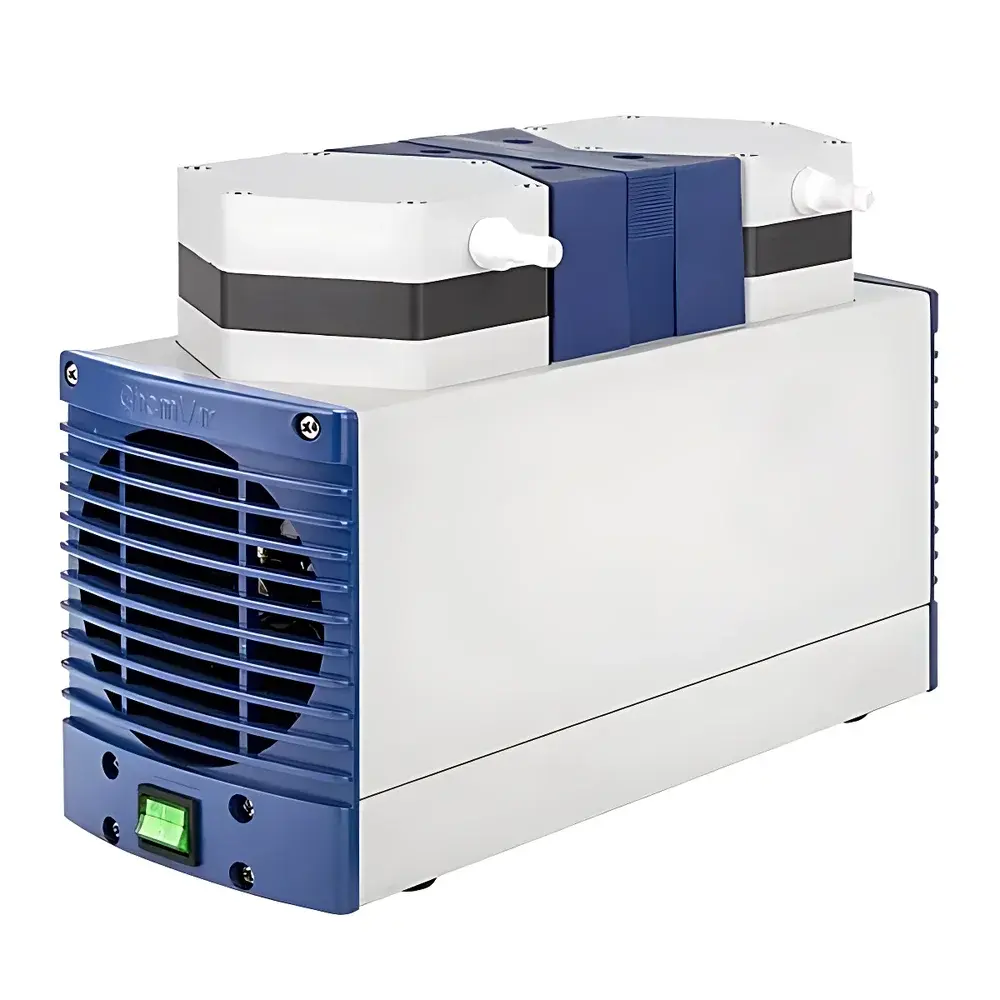
WIGGENS C602 Corrosion-Resistant Diaphragm Vacuum Pump
| Brand | WIGGENS |
|---|---|
| Origin | Germany |
| Model | C602 |
| Pump Type | Diaphragm Pump |
| Oil-Free Design | Yes |
| Ultimate Vacuum | ≤80 mbar |
| Pumping Speed | 70 L/min |
| Motor Power | 270 W |
| Dimensions (W×D×H) | 380 × 156 × 226 mm |
| Weight | 14.5 kg |
| Noise Level | ≤55 dB(A) |
| Motor Speed | 1450 rpm |
| Electrical Supply | 220–240 V / 50 Hz |
| Inlet/Outlet Port | 10 mm |
| Protection Features | Thermal Overload Cut-off, Fuse Protection |
| Chemical Resistance | Full PTFE-wetted Parts |
| Sealed Drive Chamber | Yes |
Overview
The WIGGENS C602 Corrosion-Resistant Diaphragm Vacuum Pump is an engineered solution for laboratories and pilot-scale facilities handling aggressive chemical vapors, acidic or alkaline gases, and condensable solvents. Operating on positive displacement principle via a PTFE-coated elastomeric diaphragm, the C602 delivers consistent vacuum performance without oil lubrication—eliminating risk of hydrocarbon contamination, oil backstreaming, or disposal liabilities associated with rotary vane pumps. Its hermetically sealed drive mechanism physically isolates the motor and mechanical transmission components from the gas path, ensuring long-term reliability in corrosive environments where conventional vacuum systems degrade rapidly. Designed to meet ISO 8573-1 Class 0 air purity requirements for oil-free operation, the C602 serves as a robust alternative to water aspirators and oil-sealed pumps in applications demanding chemical inertness, low maintenance, and regulatory compliance.
Key Features
- Full PTFE wetted surfaces—including diaphragm, valves, and internal gas pathways—providing broad resistance to halogenated solvents, strong acids (e.g., HCl, HNO₃), bases (e.g., NaOH), and organic vapors.
- Hermetically separated pumping chamber and drive assembly prevents corrosion-induced bearing failure and extends service life beyond 10,000 operating hours under typical lab duty cycles.
- Integrated thermal cut-off switch automatically de-energizes the motor if internal temperature exceeds safe operational limits; auto-restart occurs only after passive cooling restores nominal thermal state.
- Low-noise operation at ≤55 dB(A) enables installation in shared laboratory spaces without acoustic shielding or dedicated pump rooms.
- Oil-free, dry-running architecture eliminates need for oil changes, vapor traps, or wastewater treatment—reducing total cost of ownership and aligning with ISO 14001 environmental management objectives.
- Standard 10 mm barbed inlet/outlet ports accommodate common vacuum tubing (e.g., Tygon® E-3603, Viton®); optional corrosion-resistant vacuum regulators and sintered PTFE inlet filters available for particulate and moisture mitigation.
Sample Compatibility & Compliance
The C602 is validated for continuous duty with chemically aggressive media including but not limited to: chlorinated hydrocarbons (e.g., CH₂Cl₂, CCl₄), sulfur-containing compounds (e.g., H₂S, SO₂), nitrogen oxides, hydrogen fluoride (HF) vapor (at low concentrations and controlled humidity), and condensable solvents such as acetone, methanol, and ethyl acetate. It complies with IEC 61000-6-3 (EMC emission standards) and IEC 61000-6-2 (immunity). While not certified for ATEX or IECEx hazardous area use, its non-sparking motor design and absence of ignition sources make it suitable for general-purpose chemical labs operating under OSHA 1910.120 and EU CLP/GHS labeling frameworks. The pump supports GLP-compliant workflows when paired with traceable vacuum sensors and audit-ready data loggers.
Software & Data Management
The C602 operates as a standalone analog device with no embedded firmware or digital interface. However, it integrates seamlessly into automated vacuum control systems via external pressure transducers (e.g., capacitance manometers calibrated to 0.1–1000 mbar range) and programmable logic controllers (PLCs) or LabVIEW-based acquisition platforms. Optional vacuum regulators with analog 0–10 V or 4–20 mA output enable closed-loop setpoint control compatible with ISO/IEC 17025-accredited calibration protocols. All accessories—including PTFE filter housings and vacuum gauges—carry CE marking and are supplied with manufacturer’s Declaration of Conformity per EU Machinery Directive 2006/42/EC.
Applications
- Vacuum-assisted filtration of corrosive filtrates in analytical chemistry and pharmaceutical QC labs.
- Rotary evaporation of acid-labile or base-sensitive compounds under controlled sub-atmospheric conditions.
- Reduced-pressure distillation of halogenated solvents in process development settings.
- Gel drying and lyophilization pre-vacuum stages where oil-free conditions prevent sample adulteration.
- SPME and solid-phase extraction (SPE) manifold evacuation with aggressive eluents (e.g., trifluoroacetic acid).
- Replacement of water-jet aspirators in teaching labs—reducing municipal water consumption by >95% and eliminating drain-back risks.
FAQ
Is the C602 suitable for continuous operation with hot solvent vapors?
Yes—its PTFE diaphragm and valve assemblies withstand intermittent exposure to saturated vapors up to 60 °C; however, prolonged operation above 45 °C ambient requires active ventilation per WIGGENS Technical Bulletin TB-C602-Rev.3.
Can it achieve vacuum levels below 20 mbar?
No—the C602 is rated for ultimate vacuum ≤80 mbar; for deeper vacuums (e.g., <5 mbar), a two-stage diaphragm pump or secondary backing pump is required.
Does it comply with FDA 21 CFR Part 11 for electronic records?
As a non-digital, manually operated device, the C602 itself does not generate electronic records; however, when integrated with compliant data acquisition hardware and software, it supports Part 11-aligned validation protocols.
What maintenance intervals are recommended?
Diaphragm replacement every 6,000–8,000 hours; valve kit inspection annually or after 500 h of aggressive gas exposure; no lubrication or oil changes required.
Is the pump compatible with vacuum ovens requiring stable 50–100 mbar setpoints?
Yes—when used with an external analog vacuum regulator and feedback controller, it maintains ±2 mbar stability over 8-hour cycles under constant load.



