
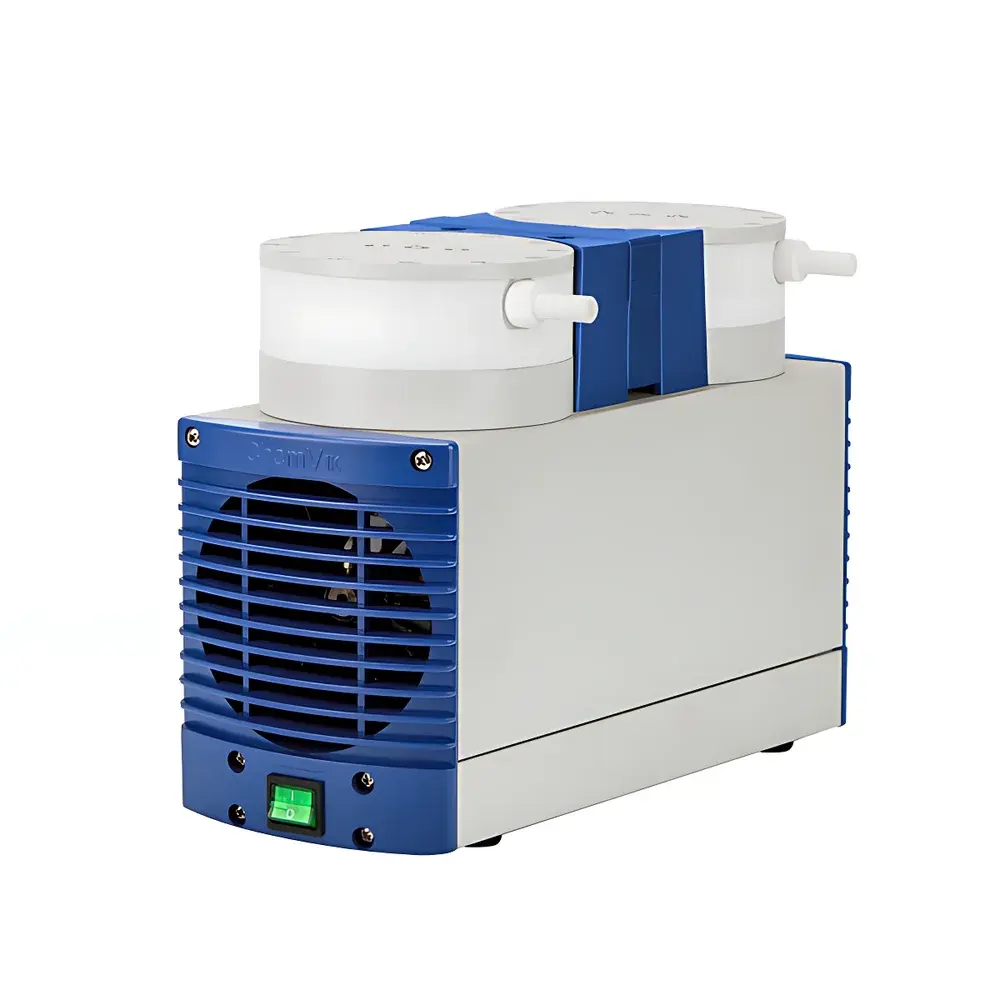
WIGGENS C610 Chemical-Resistant Diaphragm Vacuum Pump
| Brand | WIGGENS |
|---|---|
| Origin | Germany |
| Model | C610 |
| Pump Type | Diaphragm Vacuum Pump |
| Ultimate Vacuum | 2–4 mbar |
| Pumping Speed | 37 L/min |
| Motor Power | 245 W |
| Dimensions (W×D×H) | 380 × 171 × 226 mm |
| Weight | 13.8 kg |
| Noise Level | ≤60 dB(A) |
| Protection Class | IP40 |
| Motor Speed | 1450 rpm |
| Inlet/Outlet Port | 10 mm |
| Voltage/Frequency | 220–240 V / 50 Hz |
| Thermal Overload Protection | Yes |
| Gas-Contact Materials | PTFE-coated diaphragm, PTFE valves, PTFE seals, stainless steel housing components |
Overview
The WIGGENS C610 Chemical-Resistant Diaphragm Vacuum Pump is an engineered solution for laboratories and pilot-scale process environments requiring reliable, oil-free vacuum generation in the presence of aggressive vapors and corrosive gases. Based on positive displacement principle, the pump operates via oscillating PTFE-coated elastomeric diaphragms driven by an eccentric cam mechanism—eliminating internal lubrication and preventing cross-contamination. Its dual-stage configuration enables stable ultimate vacuum levels between 2 and 4 mbar while maintaining consistent pumping speed of 37 L/min across a wide operational range. Designed specifically for chemical compatibility, all gas-path components—including diaphragms, check valves, inlet/outlet manifolds, and sealing elements—are constructed from or fully lined with polytetrafluoroethylene (PTFE), ensuring resistance to halogenated solvents, strong acids (e.g., HCl, HNO₃), alkalis, and organic vapors commonly encountered in pharmaceutical synthesis, analytical sample preparation, and fine chemical processing.
Key Features
- Chemical-resistant wetted path: Full PTFE contact surfaces (diaphragms, valves, gaskets) and corrosion-inhibited stainless steel housing components
- Oil-free, dry operation: Eliminates risk of oil backstreaming, reduces maintenance intervals, and avoids hazardous waste disposal associated with rotary vane pumps
- Dual-stage diaphragm architecture: Enhances vacuum depth and improves response time during dynamic load changes (e.g., solvent evaporation or filtration ramp-up)
- Integrated thermal protection circuitry: Automatically de-energizes motor when internal temperature exceeds safe threshold; resumes operation after passive cooling without manual reset
- Low-noise mechanical design: Acoustic emission ≤60 dB(A) at 1 m distance, suitable for shared laboratory environments and ISO Class 5–7 cleanroom-adjacent installations
- IP40-rated enclosure: Provides protection against solid ingress (≥1 mm particles) and limited dust exposure—aligned with IEC 60529 for general-purpose lab use
- Modular accessory interface: Standard 10 mm hose barb ports compatible with optional chemically resistant vacuum regulators, particulate filters (e.g., sintered PTFE), and condensate traps
Sample Compatibility & Compliance
The C610 is validated for continuous duty with vapors generated during common laboratory operations including acid digestion, solvent-based extraction (e.g., SPE, LLE), reduced-pressure distillation, and lyophilization pre-chamber evacuation. Its PTFE-wetted construction complies with ASTM D471 (rubber property testing in liquids) and meets material compatibility benchmarks referenced in USP Analytical Instrument Qualification for non-classified instruments. While not certified for explosive atmospheres (ATEX/IECEx), its spark-free motor and absence of flammable lubricants make it appropriate for use in Zone 2 classified areas when installed per local electrical codes. The pump supports GLP-compliant workflows through stable performance under variable load conditions and traceable operating parameters (voltage, current, thermal status).
Software & Data Management
The C610 operates as a standalone analog device with no embedded firmware or digital interface. However, its electrical characteristics (220–240 V / 50 Hz input, 1.1 A nominal current draw, 245 W power consumption) are compatible with external power monitoring systems and programmable logic controllers (PLCs) used in automated vacuum manifold setups. For regulated environments, users may integrate the pump into instrument qualification protocols (IQ/OQ/PQ) using calibrated pressure transducers and data loggers compliant with FDA 21 CFR Part 11 requirements for electronic records. Optional accessories—including vacuum gauges with 4–20 mA output and analog vacuum regulators—enable closed-loop control integration in GMP-aligned evaporation or drying systems.
Applications
- Vacuum-assisted filtration (e.g., Büchner, Hirsch, and membrane filtration with aggressive filtrates)
- Rotary evaporation of chlorinated, acidic, or amine-containing solvents
- Reduced-pressure concentration of peptide hydrolysates, nucleic acid extracts, and API intermediates
- Gel drying and blot transfer under inert or mildly acidic vacuum conditions
- Solid-phase extraction (SPE) cartridge conditioning and elution steps involving TFA, formic acid, or trifluoroethanol
- Replacement of water aspirators in eco-conscious labs seeking zero liquid discharge and reduced utility load
- Pre-vacuum priming for high-vacuum systems (e.g., freeze dryers, mass spectrometers) where oil contamination must be avoided
FAQ
Is the C610 suitable for pumping hydrogen chloride (HCl) gas?
Yes—the entire gas path is PTFE-lined, and the pump has demonstrated stable operation under continuous HCl vapor exposure at concentrations up to 10% v/v at ambient temperature.
Can it handle condensed solvent vapors without damage?
Yes—its diaphragm assembly and valve geometry accommodate transient liquid carryover; however, prolonged exposure to free liquid ingress should be mitigated using an inline PTFE condensate trap.
Does it meet ISO 8573-1 purity class requirements for compressed air?
Not applicable—the C610 is a vacuum generator, not a compressor; however, its oil-free design ensures Class 0 (zero oil content) vacuum quality per ISO 8573-1 Annex B definitions.
What is the expected service life under continuous 8-hour daily operation?
With proper installation (level mounting, adequate ventilation, and use of recommended filters), mean time between failures (MTBF) exceeds 12,000 hours based on field data from pharmaceutical QC labs.
Is remote on/off control supported?
No native digital interface exists, but the unit can be integrated into external control circuits via its hardwired terminal block (L/N/PE) and auxiliary thermal cut-off signal pins (optional wiring kit required).



