
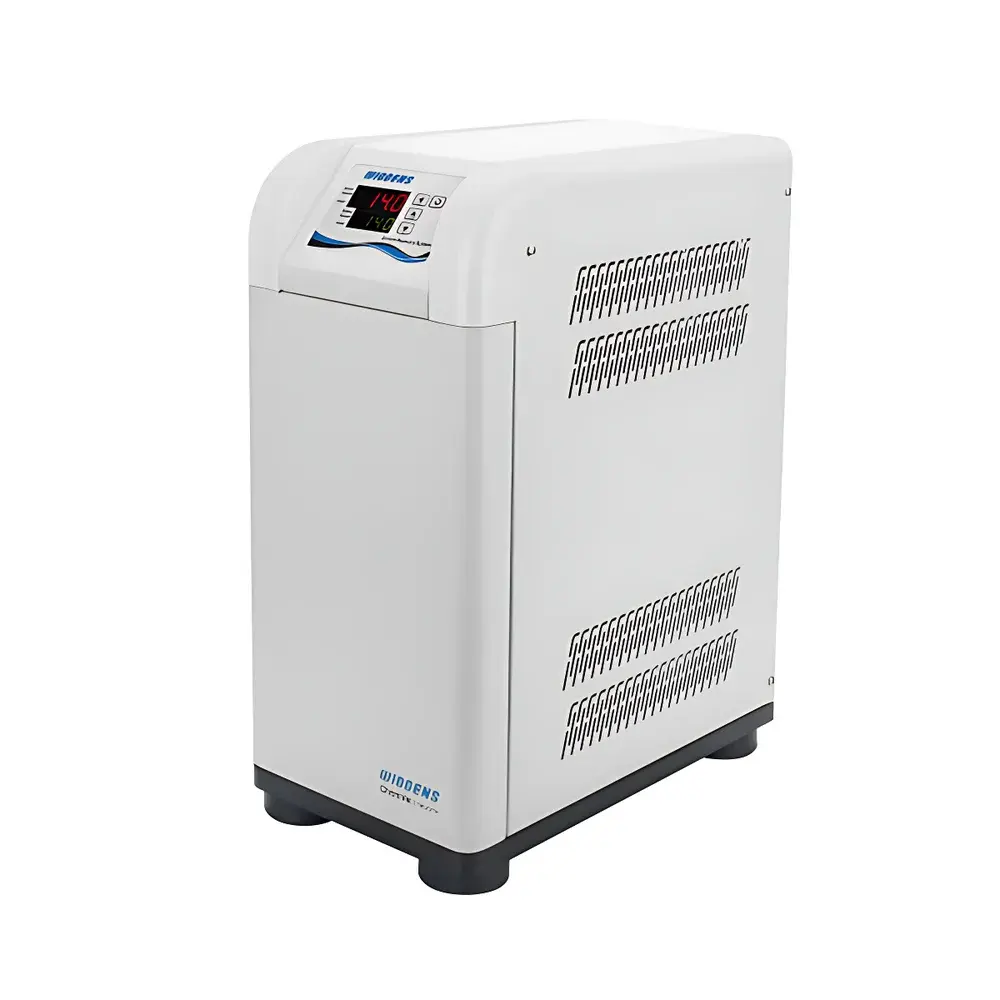
WIGGENS C900EEF Corrosion-Resistant Variable-Frequency Diaphragm Vacuum Pump System
| Brand | WIGGENS |
|---|---|
| Origin | Germany |
| Model | C900EEF |
| Instrument Type | Diaphragm Pump |
| Product Type | Oil-Free Vacuum Pump |
| Pumping Speed | 95 L/min |
| Ultimate Vacuum | ≤30 mbar |
| External Dimensions (W×D×H) | 220 × 400 × 495 mm |
| Weight | 25 kg |
| Motor Power | 400 W |
Overview
The WIGGENS C900EEF Corrosion-Resistant Variable-Frequency Diaphragm Vacuum Pump System is an engineered solution for laboratories and industrial process environments requiring precise, stable, and chemically inert vacuum generation. Based on dry, oil-free diaphragm pump technology, the system operates without lubricating oil—eliminating risks of oil backstreaming, contamination, or hazardous waste disposal associated with rotary vane or diffusion pumps. Its core principle relies on reciprocating PTFE-coated diaphragms driven by a brushless AC motor, whose rotational speed is dynamically regulated via an integrated frequency converter and intelligent PID control unit. Unlike conventional fixed-parameter PID controllers, the C900EEF implements adaptive AI-driven self-tuning logic: during operation, the controller continuously analyzes pressure deviation, response time, and load dynamics to autonomously optimize proportional, integral, and derivative coefficients in real time. This ensures exceptional pressure stability (±0.1 mbar resolution) across variable process conditions—including fluctuating gas loads, condensable vapors, or intermittent flow demands—common in distillation, solvent recovery, and vacuum drying applications.
Key Features
- Full PTFE-wetted path construction—including inlet/outlet valves, diaphragms, chamber liners, and gas-handling surfaces—providing broad resistance to aggressive acids (e.g., HCl, HNO₃), bases (e.g., NaOH), halogenated solvents (e.g., chloroform, DCM), and reactive vapors.
- Hermetically sealed dual-chamber architecture isolates the pneumatic cavity from the drive mechanism, preventing corrosive ingress into bearings, motor windings, or electronics—extending service life beyond 15,000 hours under typical lab usage.
- Integrated variable-frequency drive (VFD) with real-time PID auto-tuning enables programmable vacuum setpoints from 0.1 to 1000 mbar, with dynamic adjustment of motor RPM (1380–1680 rpm) to maintain target pressure within ±0.3 mbar accuracy.
- Thermal protection circuitry monitors internal housing temperature; automatic shutdown occurs above 75 °C, followed by autonomous restart once thermal equilibrium is restored—ensuring uninterrupted operation in unattended overnight protocols.
- Compact footprint (220 × 400 × 495 mm) and low acoustic emission (≤50 dB(A)) permit benchtop integration in fume hoods, cleanrooms, or shared analytical suites without structural reinforcement or dedicated ventilation.
- IP54-rated enclosure provides dust resistance and protection against incidental water splashes, supporting deployment in QC labs, pilot plants, and GMP-compliant manufacturing environments.
Sample Compatibility & Compliance
The C900EEF is validated for continuous duty with chemically aggressive, condensable, and particulate-laden gas streams typical in pharmaceutical synthesis (e.g., API crystallization under reduced pressure), fine chemical purification (rotary evaporation of pyridine or acetic anhydride), and environmental sample preparation (solid-phase extraction of pesticide residues). All wetted materials comply with USP Class VI and FDA 21 CFR 177.1550 for PTFE. The system meets IEC 61000-6-3 (EMC emissions) and IEC 61000-6-2 (immunity), and its pressure control architecture supports audit-ready data integrity when interfaced with LIMS or SCADA systems under ISO/IEC 17025 or ASTM E2500-15 guidelines.
Software & Data Management
While the C900EEF operates as a standalone instrument with front-panel digital display and tactile keypad, it includes RS-485 Modbus RTU and analog 0–10 VDC output interfaces for integration into centralized vacuum management networks. Optional WIGGENS VacuumLink™ software (Windows-based) enables remote monitoring, multi-point pressure logging at user-defined intervals (1 s to 60 min), export to CSV/PDF, and configurable alarm thresholds (e.g., vacuum loss >5 mbar for >30 s triggers email notification via SMTP). Audit trails include timestamped operator actions, parameter changes, and thermal event logs—fully compliant with FDA 21 CFR Part 11 requirements when deployed with electronic signature validation.
Applications
- Large-scale vacuum distillation of heat-sensitive compounds (e.g., vitamins, terpenes) where precise pressure ramping prevents thermal degradation.
- High-capacity filtration of corrosive slurries in catalyst recovery or metal hydride processing.
- Controlled vacuum drying of lithium battery electrode coatings under inert atmosphere gloveboxes.
- Continuous solvent recovery in parallel synthesis platforms using integrated cold traps and condensers.
- Vacuum-assisted degassing of epoxy resins prior to semiconductor encapsulation.
- Automated solid-phase extraction (SPE) workstations handling hydrofluoric acid-treated silica cartridges.
FAQ
Is the C900EEF suitable for pumping explosive or flammable vapors?
Yes—when operated within its specified pressure range and coupled with appropriate explosion-proof accessories (e.g., ATEX-certified solenoid valves, grounded stainless steel tubing), the oil-free design eliminates ignition sources inherent to oil-lubricated systems.
Can the pump handle saturated solvent vapors without performance loss?
The PTFE diaphragm and valve assembly tolerate transient condensation; however, for sustained high-vapor-load applications (e.g., ethanol distillation), we recommend upstream installation of a chilled trap or coalescing filter to prevent liquid carryover.
What maintenance intervals are recommended?
Under standard laboratory use, diaphragm replacement is required every 12–18 months; no oil changes, valve grinding, or bearing lubrication are needed—only periodic inspection of inlet filters and cooling vents.
Does the system support GLP-compliant electronic record keeping?
Yes—when used with VacuumLink™ software and configured with user authentication, digital signatures, and immutable log files, it fulfills ALCOA+ principles for data reliability and traceability.
How does the self-tuning PID differ from standard laboratory vacuum controllers?
Conventional controllers use static gain values optimized for one nominal condition; the C900EEF’s adaptive algorithm recalculates all three PID terms every 200 ms based on real-time error dynamics—reducing overshoot by up to 70% during rapid setpoint transitions.
Related Products



